Introduction
You walk into a mobile shop in Karachi or Lahore. Two phones sit side by side — same price, similar specs. But one screen looks vibrant and crisp while the other appears washed out and dull. You ask the shopkeeper why. He shrugs and says, “Both are good phones, sir.”
This happens every day across Pakistan. Most buyers have no idea what makes a phone screen great — or terrible. They focus on processor, camera, and price while ignoring the display — the part of the phone you literally stare at for hours every day.
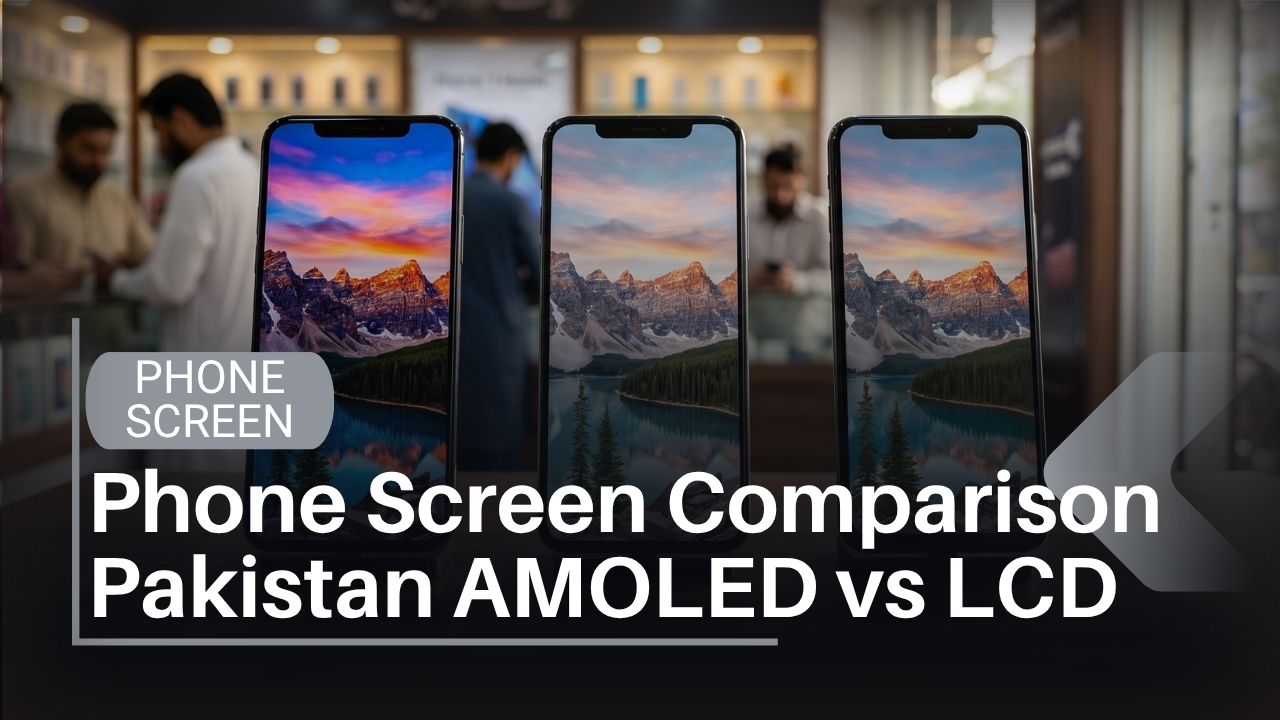
Phone screen comparison in Pakistan reveals dramatic differences between display technologies, even within the same price range. In 2026, the gap between premium AMOLED displays and budget LCD screens has widened significantly. Understanding these differences can save you from buying a phone that looks great in specs but disappoints in daily use.
In this comprehensive guide, we explain AMOLED, LCD, and IPS display technologies in simple terms, compare real-world performance across Pakistan’s climate conditions, rank the best displays by budget, and help you make the smartest screen choice for your needs and rupees.
Understanding Display Technologies: AMOLED vs LCD vs IPS Made Simple
Before diving into Pakistan-specific recommendations, let us break down the three main display types you will encounter in 2026’s mobile market.
AMOLED (Active-Matrix Organic Light-Emitting Diode)
AMOLED screens create light at the pixel level. Each individual pixel can turn completely off to create perfect blacks. This technology is found in premium phones and increasingly in mid-range devices.
How AMOLED Works:
When you view a dark image or use dark mode, AMOLED pixels literally turn off. This saves battery life and creates infinite contrast ratios. Colors appear more vibrant because there is no backlight bleeding through.
AMOLED Advantages:
- Perfect blacks and infinite contrast ratio
- Lower power consumption with dark content
- Thinner displays — no separate backlight needed
- Faster response times for gaming
- Better viewing angles
AMOLED Disadvantages:
- More expensive to manufacture
- Potential burn-in with static images over time
- Can be oversaturated for professional color work
LCD (Liquid Crystal Display) with LED Backlight
LCD screens use liquid crystals that twist to block or allow light from a backlight to pass through. Most budget and some mid-range phones use LCD technology.
How LCD Works:
A constant LED backlight shines through liquid crystal layers. The crystals twist to create different colors, but they cannot block light completely — hence LCD blacks look grey rather than true black.
LCD Advantages:
- Significantly cheaper to produce
- No burn-in issues — more durable over years
- Often more color-accurate for professional work
- Better performance in direct sunlight
LCD Disadvantages:
- Cannot achieve true black colors
- Higher battery consumption
- Thicker displays due to backlight layer
- Limited viewing angles on cheaper models
IPS (In-Plane Switching) LCD
IPS is actually a subtype of LCD technology. It arranges liquid crystals in a different pattern to improve viewing angles and color accuracy compared to standard LCD.
IPS Advantages:
- Excellent color accuracy
- Wide viewing angles
- No color shift when viewed from sides
- Good outdoor visibility
IPS Disadvantages:
- Still cannot achieve true blacks (backlight limitation)
- Slightly slower response times than AMOLED
- Higher battery consumption than AMOLED
Understanding these basics helps you avoid common phone buying mistakes Pakistani users make when choosing based on display quality.
Phone Screen Comparison Pakistan: Brand Analysis by Display Technology
Different brands have clear preferences and strengths when it comes to display technology. Here is how the major players compare in Pakistan’s 2026 market.
Samsung — AMOLED Leaders
Samsung manufactures AMOLED displays not just for their own phones but for Apple, OnePlus, and many other brands. In Samsung’s Galaxy S24 vs S23 comparison for Pakistan, both generations feature excellent AMOLED displays with adaptive refresh rates.
Even Samsung’s mid-range phones like the Galaxy A-series in Pakistan now feature AMOLED displays. This gives Samsung phones consistent, premium-looking screens across most price tiers.
Samsung Display Strengths:
- Industry-leading AMOLED technology
- Excellent outdoor brightness (1000+ nits)
- Adaptive refresh rate (1Hz to 120Hz) saves battery
- Consistent color calibration across device range
Chinese Brands — Mixed Approaches
Chinese vs Korean phones in Pakistan show interesting display differences. Xiaomi, OPPO, and Realme mix AMOLED and LCD across their lineups strategically.
Xiaomi/Redmi/POCO: Use AMOLED in flagship and upper mid-range phones. Budget Redmi phones often use IPS LCD to hit aggressive price targets. The Redmi Note 14 Pro+ features a 120Hz AMOLED display at a very competitive price.
OPPO/Realme: Focus heavily on AMOLED across their range. The OPPO Reno 11 series and OPPO Find X7 premium models use high-quality AMOLED panels with excellent color accuracy.
Apple — Premium LCD and OLED
Apple uses Super Retina XDR OLED displays (which are essentially premium AMOLED) in most iPhone models. The iPhone pricing in Pakistan reflects the premium display quality — iPhone screens consistently rank among the best for color accuracy and brightness.
Budget Brands — LCD Focus
Budget brands like itel, QMobile, and GFive almost exclusively use basic LCD displays to achieve their ultra-affordable pricing. The itel Vision 3 Plus and QMobile 2026 models serve their target market well with functional LCD screens.
For elderly users specifically, GFive phones use large, clear LCD displays that prioritize readability over advanced features.
Gaming and Multimedia: Which Screen Technology Wins for Pakistani Users?
For Pakistani users who game, watch videos, or consume multimedia content heavily, display technology makes a massive difference in experience quality.
Gaming Performance — Phone Screen Comparison Pakistan for Gamers
Gaming phones in Pakistan for 2026 overwhelmingly prefer AMOLED displays for several key reasons:
AMOLED Gaming Advantages:
- Faster pixel response times reduce motion blur in fast games like PUBG and COD
- Perfect blacks enhance visibility in dark game environments
- Higher contrast ratios make enemy detection easier
- Lower battery drain during dark game scenes
Top Gaming Displays in Pakistan 2026:
- ASUS ROG Phone 9 Pro: 185Hz AMOLED with 1ms response time
- Samsung Galaxy S25+: 120Hz Dynamic AMOLED 2X
- Xiaomi gaming phones: 144Hz AMOLED displays
- Realme GT series: High refresh AMOLED panels
Video Streaming and YouTube
Pakistan’s mobile data usage has exploded, with YouTube, Netflix, and local streaming consuming significant bandwidth. For video consumption:
AMOLED Benefits:
- True blacks enhance movie watching experience
- Higher contrast ratios show more detail in dark scenes
- Vibrant colors make content more engaging
- Lower power consumption during dark content
LCD Benefits:
- More accurate color reproduction for professional content
- No risk of burn-in from static interface elements
- Often brighter in direct sunlight
For selfie phone users in Pakistan who also consume lots of video content, AMOLED displays provide a better overall multimedia experience.
Battery Life and Display Technology: What Pakistani Users Need to Know
In Pakistan’s load shedding environment, every bit of battery life matters. Display technology significantly impacts how long your phone lasts on a single charge.
AMOLED Power Efficiency
AMOLED displays consume power differently than LCD displays. With dark content, AMOLED pixels turn off completely — using nearly zero power for black areas.
Real-World Battery Impact:
- Using dark mode on AMOLED phones saves 15-30% battery life
- Watching dark movies or shows saves more power than bright content
- Gaming with dark themes (like PUBG night maps) consumes less power
This makes AMOLED particularly valuable for battery phone users in Pakistan who need maximum longevity.
LCD Power Consumption
LCD displays maintain constant power draw regardless of content brightness. The backlight always runs at full power, then liquid crystals block light to create darker areas.
LCD Battery Characteristics:
- Consistent power draw regardless of content
- Slightly higher overall consumption than AMOLED
- Dark mode provides minimal battery savings
- Better thermal management in Pakistan’s hot climate
Practical Battery Tips for Pakistani Climate
Pakistan’s summer temperatures can exceed 45°C in cities like Multan and Jacobabad. High temperatures affect both display performance and battery life:
Summer Display Management:
- AMOLED displays can become dimmer in extreme heat to protect pixels
- LCD displays maintain brightness better but consume more power for cooling
- Outdoor brightness significantly drains battery on both technologies
- Using auto-brightness saves battery and protects display longevity
For users prioritizing fast charging phones in Pakistan, display power consumption becomes less critical since rapid charging compensates for higher usage.
Display Quality Across Price Tiers: Pakistan Market Analysis 2026
Let us break down what display quality you can expect at different price levels in Pakistan’s 2026 market.
Ultra-Budget Segment (Rs. 10,000 – Rs. 25,000)
Typical Display: Basic LCD, 720p or 1080p resolution, 60Hz refresh rate
What You Get:
- Functional displays suitable for basic tasks
- Adequate for calls, messaging, and light app usage
- Poor viewing angles and color reproduction
- Dim outdoor visibility
Representative Phones:
- itel Vision 3 Plus: Basic LCD display
- Entry-level QMobile phones: Simple LCD panels
- Budget Realme C-series: IPS LCD with decent viewing angles
Mid-Range Segment (Rs. 25,000 – Rs. 80,000)
Typical Display: IPS LCD or AMOLED, 1080p resolution, 90Hz-120Hz refresh rate
What You Get:
- Significant improvement in color accuracy and brightness
- AMOLED becomes available at the upper end of this segment
- 90Hz or 120Hz refresh rates for smoother scrolling
- Good outdoor visibility
Representative Phones:
- Redmi Note 14 Pro+: 120Hz AMOLED display
- Samsung Galaxy A55: Super AMOLED with vibrant colors
- POCO vs Redmi comparison models: Mix of LCD and AMOLED options
Premium Segment (Rs. 80,000+)
Typical Display: High-quality AMOLED, 1080p or 1440p resolution, 120Hz+ adaptive refresh rate
What You Get:
- Premium AMOLED panels with excellent color accuracy
- Adaptive refresh rates (1Hz to 120Hz) for battery optimization
- HDR10+ support for enhanced video content
- High peak brightness (1000+ nits) for outdoor use
Representative Phones:
- Samsung Galaxy S24/S25 series: Dynamic AMOLED 2X displays
- iPhone price range in Pakistan: Super Retina XDR displays
- OPPO Find X7 series: Curved AMOLED with premium quality
Outdoor Visibility and Pakistan’s Climate Challenges
Pakistan’s intense sunlight creates unique challenges for phone display visibility. Summer temperatures and bright sunshine test display technology limits.
Peak Brightness Comparison
Budget LCD (300-400 nits):
- Barely visible in direct sunlight
- Requires finding shade for outdoor use
- Adequate for indoor environments
Mid-Range AMOLED (600-800 nits):
- Usable in bright outdoor conditions
- May require maximum brightness setting
- Good balance of visibility and battery life
Premium AMOLED (1000+ nits):
- Excellent outdoor visibility even in direct sunlight
- Adaptive brightness adjusts automatically
- Maintains color accuracy in bright conditions
Real-World Pakistan Usage Scenarios
Rickshaw/Bus Commute: Bright outdoor conditions require high-brightness displays. Premium AMOLED phones remain clearly visible while budget LCD phones become nearly unusable.
Office/Indoor Work: Mid-range IPS LCD or AMOLED displays perform equally well in controlled indoor lighting.
Outdoor Photography: Bright displays help with camera phone composition when taking photos in Pakistan’s bright conditions.
Durability and Longevity: Which Displays Last in Pakistani Conditions?
Budget phone durability testing for Pakistan reveals important differences in how display technologies handle local conditions.
AMOLED Durability Concerns
Burn-In Risk:
AMOLED displays can develop permanent image retention (burn-in) if static images remain on screen for extended periods. Navigation bars, status bars, and app interfaces can leave permanent marks.
Heat Sensitivity:
Pakistan’s extreme summer heat can cause AMOLED displays to dim automatically to prevent pixel damage. This is protective but can reduce usability during peak summer months.
Lifespan:
AMOLED organic compounds gradually degrade over time. Blue pixels typically degrade faster, causing color shift after 2-3 years of heavy usage.
LCD Durability Advantages
No Burn-In:
LCD displays do not suffer from permanent image retention, making them more suitable for users who keep phones for many years.
Heat Resistance:
LCD displays maintain consistent brightness and color accuracy even in Pakistan’s extreme temperatures.
Longer Lifespan:
LCD technology typically lasts 5+ years without significant degradation, making it better for budget-conscious users who keep phones longer.
Practical Durability Tips for Pakistani Users
- Use dark mode on AMOLED phones to reduce pixel stress
- Avoid maximum brightness for extended periods in summer heat
- Enable auto-brightness to prevent manual over-brightness
- Consider LCD phones if you typically keep phones for 3+ years
- Budget for screen replacement costs when buying AMOLED phones
For users considering used phones in Pakistan, LCD displays age more gracefully than AMOLED displays.
8 Expert Tips for Choosing the Right Display Technology in Pakistan 2026
Here are the most practical tips for Pakistani buyers making display-focused phone decisions:
- Test outdoor visibility before buying — Take the phone outside the shop in bright sunlight. Many displays that look great indoors become unusable outdoors. This is particularly important in Pakistan’s bright climate.
- Consider your usage patterns — Heavy gamers and video watchers benefit significantly from AMOLED. Basic users save money with quality IPS LCD displays without sacrificing usability.
- Factor in long-term costs — AMOLED screens cost 2-3x more to replace than LCD screens. If you are rough on phones or keep them for many years, LCD durability advantages matter.
- Check refresh rate specifications — 120Hz AMOLED feels dramatically smoother than 60Hz LCD for scrolling and gaming. Don’t compromise on refresh rate for display technology alone.
- Enable dark mode immediately on AMOLED phones — This single setting saves 15-30% battery life and reduces burn-in risk. Most Pakistani users benefit significantly from this simple change.
- Compare brands within the same price tier — A Samsung AMOLED phone often has better display quality than a similar-priced Chinese brand. However, Chinese brands may offer AMOLED at lower price points. Check our Chinese vs Korean phone comparison for detailed brand analysis.
- Time your purchase around sales seasons — Premium display phones see significant discounts during Eid and year-end sales. Track phone discount opportunities in Pakistan to get better displays for less money.
- Check upcoming launches — Display technology advances rapidly. Consult the new phone launch calendar for Pakistan 2026 — a phone with significantly better display technology may be just weeks away from launch.
Common FAQs: Phone Screen Comparison Pakistan 2026
Q1: Which is better for Pakistani users — AMOLED or LCD displays?
AMOLED is better for multimedia consumption, gaming, and battery life with dark content. LCD is better for outdoor visibility, longevity, and budget-conscious buyers. Choose based on your primary usage and budget.
Q2: Do AMOLED displays really save battery compared to LCD?
Yes, but only with dark content. AMOLED displays save 15-30% battery when using dark mode, watching dark videos, or playing games with dark themes. With bright content, AMOLED and LCD consume similar power.
Q3: Is screen burn-in a serious problem on AMOLED phones in Pakistan?
Moderate concern. AMOLED burn-in typically occurs after 2-3 years of heavy usage with static content. Modern AMOLED displays have better burn-in resistance, but LCD displays have no burn-in risk at all.
Q4: Which phones have the best displays available in Pakistan under Rs. 50,000?
The Redmi Note 14 Pro+ with 120Hz AMOLED and Samsung Galaxy A55 with Super AMOLED offer excellent display quality under Rs. 50,000. Both provide vibrant colors, good brightness, and smooth refresh rates.
Q5: Are budget phones like itel or QMobile displays good enough for daily use?
For basic tasks — yes. itel and QMobile displays handle calls, messaging, and light app usage adequately. For multimedia, gaming, or outdoor use, investing in better display technology makes a significant difference.
Q6: Should display quality influence my phone buying decision in Pakistan?
Absolutely. You interact with the display for hours daily. A poor display affects your entire phone experience regardless of other specifications. Prioritize display quality alongside processor, camera, and battery based on your usage patterns.
Conclusion
Phone screen comparison in Pakistan reveals that display technology significantly impacts daily user experience, battery life, outdoor usability, and long-term satisfaction. AMOLED displays offer superior contrast, vibrant colors, and battery efficiency with dark content, while LCD displays provide better durability, outdoor visibility, and value for budget-conscious buyers.
The key is matching display technology to your specific needs and usage patterns. Gamers and multimedia consumers benefit from AMOLED’s superior contrast and response times. Basic users and those keeping phones long-term may prefer LCD’s durability and lower replacement costs.
Explore the complete Xiaomi and Redmi display options or OPPO and Realme screen technologies to find your perfect display match.
What matters most to you in a phone display — vibrant colors, outdoor visibility, battery savings, or long-term durability? Share your display priorities in the comments and help fellow Pakistani buyers choose wisely!