Introduction
We’re at an inflection point in artificial intelligence. The AI tools you’ve been hearing about—ChatGPT, Claude, image generators—do what you ask them to do. They respond to prompts. They’re reactive.
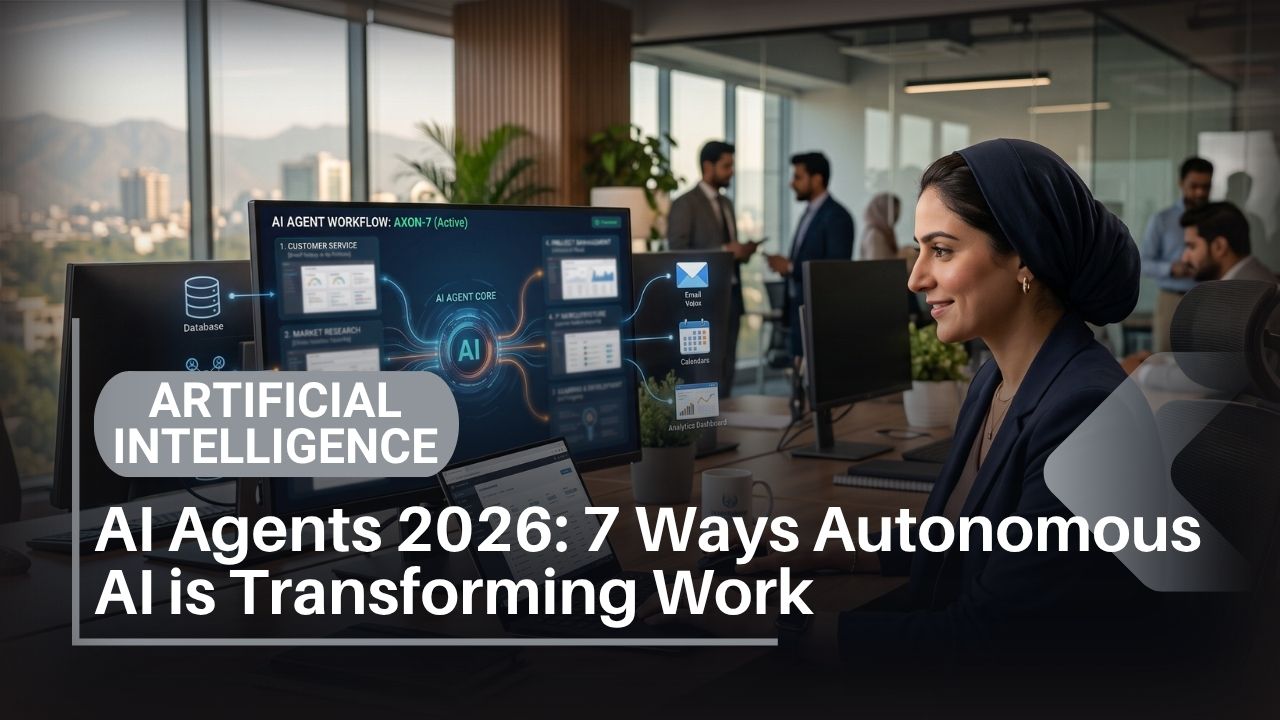
AI agents are fundamentally different. They’re autonomous systems that set goals, break them into steps, use tools independently, and work toward objectives with minimal human intervention. They don’t wait for instructions. They take action.
This distinction matters enormously. The difference between asking ChatGPT to write an email and an AI agent autonomously managing your entire email workflow, categorizing messages, drafting responses, and flagging urgent items for your attention is the difference between a helpful tool and a fundamental change in how work happens.
By 2026, AI agents are moving from theoretical research projects to practical business applications. Pakistani professionals, entrepreneurs, and organizations that understand AI agents and adapt to them will have significant competitive advantages over those still relying solely on reactive AI tools.
This guide explores what AI agents actually are, seven concrete ways they’re transforming work, real-world applications, and practical implications for Pakistani professionals. “Explore AI image and video generation technology“
Let’s move beyond the hype and understand what’s genuinely happening.
Quick Answer
What are AI agents?
AI agents are autonomous software systems that can perceive environments, make decisions, use tools independently, and take actions toward goals without requiring human intervention for each step. Unlike ChatGPT (which responds to prompts), AI agents work continuously toward objectives.
How are they different from regular AI tools?
Regular AI tools are reactive—you ask them something, they respond. AI agents are proactive—they identify problems, plan solutions, execute tasks, and adapt based on results. Agents can use multiple tools, learn from outcomes, and improve over time.
Will AI agents replace my job?
Probably not your entire job. But they’ll change what your job looks like. Routine tasks will be automated. Your role will shift toward oversight, strategic thinking, and handling exceptions agents can’t solve.
Key Takeaways
- AI agents are autonomous, not reactive – They work continuously toward goals, not just responding to prompts
- They can use multiple tools independently – Access databases, software, APIs, and other systems without human intervention
- Real-world applications already exist – Not theoretical; businesses use agents in 2026
- They learn and adapt – Performance improves as agents encounter new situations
- Job transformation is real but not job elimination – Work changes, not disappears
- Pakistani businesses benefit from early adoption – Competitive advantage available now
- Limitations remain significant – Agents still need human oversight for critical decisions
- Integration with existing systems is crucial – Best results combine agents with human judgment
- Cost-benefit calculations are favorable – Time savings often exceed implementation costs
- Ethical frameworks are still developing – Responsibility and accountability questions persist
Table of Contents
WHAT EXACTLY ARE AI AGENTS?
Before discussing how AI agents change work, we need clear understanding of what they actually are.
Definition:
An AI agent is an autonomous software system capable of perceiving its environment, making decisions based on that perception, taking actions toward specific goals, and learning from outcomes. Unlike passive tools that wait for user input, agents actively pursue objectives with minimal human intervention.
Key characteristics:
Autonomy – Acts without requiring constant human direction. Makes decisions independently within defined parameters.
Perception – Understands its environment through data, sensors, or system access. Knows what’s happening around it.
Action – Can execute tasks directly. Access systems, modify data, trigger processes, interact with other software.
Goal-orientation – Works toward specific objectives. Measures progress and adjusts strategy if needed.
Learning – Improves performance over time. Learns what works and what doesn’t.
Adaptability – Handles new situations beyond initial programming. Responds flexibly to changing circumstances.
Real-world analogy:
Think of it this way: A ChatGPT user asks “Write me a marketing email.” ChatGPT writes it. Done. User reviews and sends manually.
An AI agent’s workflow: “Generate leads, research their company, customize email based on research, send through email system, track opens, send follow-up if not opened after three days, escalate to human if high-value prospect.” The agent does all this automatically.
Current state (2026):
AI agents aren’t science fiction anymore. They’re real systems working in businesses right now. They’re not perfect—they still make mistakes and need human oversight—but they’re genuinely useful and getting better rapidly.
THE 7 POWERFUL WAYS AI AGENTS ARE CHANGING WORK IN 2026
1. Automating Routine Decision-Making
What’s happening:
Businesses historically employ people specifically to make routine decisions. “Should we approve this expense?” “Is this invoice legitimate?” “Does this customer qualify for this discount?” “Should we schedule a meeting?” These decisions follow clear rules.
AI agents now make these decisions automatically. “learn about AI writing tools and capabilities“
Real example:
A Pakistani e-commerce company implements an AI agent that:
- Reviews customer refund requests
- Checks return policy
- Verifies purchase history
- Approves legitimate refunds automatically
- Flags suspicious requests for human review
Result: What previously took a customer service team 2 hours daily now happens in minutes. The team shifts to handling complex customer issues agents can’t resolve.
Impact on work:
Decision-making shifts from routine execution to exception handling. Employees focus on the 5% of decisions requiring judgment rather than the 95% following predictable patterns.
2. 24/7 Customer Service Without Human Agents
What’s happening:
Customer service teams traditionally operate during business hours. Customers outside those hours wait for responses. AI agents now provide immediate responses around the clock.
Real example:
An AI agent for a Pakistani SaaS company:
- Answers common questions from knowledge base
- Troubleshoots technical issues following decision trees
- Escalates complex problems to human agents
- Provides solutions before problems become critical
The team receives fewer incoming tickets because agents resolve most issues immediately. Humans focus on complex, high-value interactions.
Impact on work:
Customer service jobs don’t disappear. They transform. Less time responding to “How do I reset my password?” More time building relationships, solving complex problems, gathering feedback.
3. Research and Synthesis at Scale
What’s happening:
Research tasks require hours of work: finding sources, reading content, organizing findings, synthesizing insights. AI agents automate this entirely.
Real example:
A Pakistani consulting firm implements an AI agent that:
- Researches competitor activities daily
- Monitors industry publications automatically
- Summarizes findings
- Identifies trends
- Alerts analysts to significant developments
What required a researcher working full-time now happens overnight. Analysts review curated findings instead of conducting raw research.
Impact on work:
Research roles shift from “find information” to “analyze and act on information.” The value adds higher up the chain—strategy, insights, recommendations—rather than lower down—information gathering.
4. Autonomous Project Coordination
What’s happening:
Project management involves constant coordination: tracking progress, identifying delays, reassigning work, communicating status. AI agents handle this autonomously.
Real example:
An AI agent manages a software development project:
- Tracks task completion
- Identifies bottlenecks
- Reassigns work from overloaded developers
- Schedules meetings when blockers arise
- Updates stakeholders on progress
- Predicts delivery delays before they happen
The project manager receives alerts about problems and opportunities, not routine status updates.
Impact on work:
Project management shifts from administrative tracking to strategic oversight. Managers focus on high-level decisions and problem-solving rather than status updates and task tracking.
5. Intelligent Content Creation and Distribution
What’s happening:
Content teams manually create content, optimize for different platforms, schedule distribution. AI agents automate all of this.
Real example:
A Pakistani marketing agency uses an AI agent that:
- Researches trending topics in target market
- Drafts blog posts, social posts, email content
- Optimizes for different platforms and audiences
- Schedules distribution at optimal times
- Tracks performance
- Adjusts strategy based on results
The team focuses on strategy and messaging, not execution and optimization.
Impact on work:
Content creation shifts from doing to strategizing. Teams spend more time understanding audience and messaging, less time formatting and scheduling.
6. Proactive Maintenance and Problem Prevention
What’s happening:
Traditionally, systems fail and companies react. AI agents monitor continuously and fix problems before they impact users.
Real example:
An AI agent manages a Pakistani company’s IT infrastructure:
- Monitors system health continuously
- Predicts failures before they happen
- Schedules preventive maintenance
- Applies security patches automatically
- Alerts IT team only when human intervention needed
- Tracks costs and capacity
IT teams shift from reactive firefighting to proactive infrastructure optimization.
Impact on work:
IT roles shift from “fix broken systems” to “design resilient systems.” Less crisis management. More strategic infrastructure planning.
7. Personalized Learning and Development
What’s happening:
Employee training historically means one-size-fits-all programs. AI agents now provide personalized learning paths for each employee.
Real example:
An AI agent managing employee development:
- Assesses skill gaps for each employee
- Recommends learning resources tailored to their role
- Tracks progress
- Adjusts difficulty and content based on learning pace
- Suggests career development paths
- Schedules learning time without disrupting work
HR teams spend less time on generic training administration, more time on career strategy and high-impact development.
Impact on work:
HR roles shift from training administration to talent strategy. Less “everyone takes this course.” More “let’s develop this person for this career path.”
REAL-WORLD EXAMPLES IN 2026
Pakistani Business Context:
Financial Services:
A Karachi-based fintech company deploys an AI agent that reviews loan applications. The agent verifies documentation, checks credit history, assesses risk, and approves qualified applications automatically. Loan officers review flagged applications and handle appeals. Approval time drops from 5 days to 2 hours for 85% of applications.
E-commerce:
A Lahore-based online retailer uses an AI agent that manages inventory automatically. The agent monitors stock levels, predicts demand based on trends, reorders when necessary, adjusts pricing based on competition and stock levels, and communicates with suppliers. The role shifts from manual inventory management to strategic supply chain optimization.
Manufacturing:
A Pakistani factory implements an AI agent monitoring production equipment. The agent predicts maintenance needs, schedules downtime strategically, tracks quality metrics, and alerts technicians only when intervention is needed. Downtime decreases 40%; maintenance becomes predictive instead of reactive.
Professional Services:
A consulting firm uses an AI agent that manages billable hours, tracks project profitability, identifies which clients are most profitable, flags projects running over budget, and recommends pricing adjustments. Finance teams focus on strategic pricing strategy rather than administrative time tracking. “discover AI tools specifically for students“
HOW AI AGENTS WORK TECHNICALLY
Understanding the technical foundation helps explain why AI agents are different.
The agent architecture:
Perception module – Gathers information from environment (systems, databases, APIs, sensors)
Decision-making module – Analyzes information and decides what action to take
Planning module – Breaks goals into steps and sequences actions
Action module – Executes decisions (modifies data, triggers processes, communicates)
Learning module – Analyzes outcomes and improves future decisions
Memory module – Stores information about past interactions and outcomes
The workflow:
- Agent perceives situation (gathers data from systems)
- Compares current state to goals
- Identifies gap between where things are and where they should be
- Plans action sequence to close gap
- Executes actions
- Observes outcomes
- Learns from results
- Repeats
Tool usage:
Critical to AI agents is their ability to use tools independently. An agent might:
- Query a database for customer information
- Call an API to check inventory
- Send an email through your email system
- Update a spreadsheet
- Create calendar events
- All without human intervention between steps
Constraints and guardrails:
Because agents act autonomously, they need safety constraints:
- Cannot exceed spending limits
- Cannot approve transactions above thresholds
- Cannot modify certain protected data
- Cannot make decisions conflicting with company policy
- Flag uncertain decisions for human review
AI AGENTS VS REGULAR AI TOOLS
The fundamental difference:
| Aspect | Regular AI Tools | AI Agents |
| Initiation | User asks question | Agent works autonomously |
| Scope | Single task | Multi-step workflow |
| Tool usage | Provides information | Actually uses tools |
| Continuity | Stops after response | Continues toward goal |
| Learning | Session-based | Persistent improvement |
| Decision making | Provides options | Makes decisions independently |
| Error handling | Stops on uncertainty | Escalates or retries |
When to use which:
Regular AI tools (ChatGPT, Claude, etc.):
- Single questions or tasks
- Need human judgment in decision-making
- Exploring ideas and options
- One-time content generation
AI agents:
- Repetitive workflows
- Continuous monitoring
- Autonomous decision-making within parameters
- Multi-system coordination
- Round-the-clock operations
INDUSTRIES MOST AFFECTED
Finance & Banking:
AI agents handle routine loan approvals, fraud detection, investment recommendations, compliance monitoring. Significant job transformation but not elimination—analysts focus on complex cases and strategy.
E-commerce & Retail:
Inventory management, pricing optimization, customer service, personalized recommendations. Sales increase because inventory is optimized and customer experience improves.
Manufacturing:
Equipment maintenance prediction, quality control, supply chain optimization, production scheduling. Downtime decreases; efficiency improves.
Healthcare:
Appointment scheduling, patient follow-ups, preliminary diagnostics, medication reminders, referral coordination. Doctors focus on diagnosis and treatment; administrative burden decreases.
Professional Services:
Time tracking, billing, project management, client relationship management, document preparation. Professionals focus on billable client work rather than administrative tasks.
Technology & Software:
System monitoring, security management, bug detection, code review, deployment automation. Development teams focus on building features rather than maintaining systems. “compare ChatGPT alternatives and AI platforms“
PROS & CONS FOR BUSINESSES
Pros of AI Agents
Massive efficiency gains – Automation of routine work frees time for strategic work
24/7 operation – Agents work continuously without fatigue or breaks
Consistent decision-making – Follow rules consistently without emotional variability
Scalability without proportional cost increase – Handle 10x volume without 10x staff
Faster problem identification – Catch issues before they impact customers
Data-driven insights – Agents generate patterns humans might miss
Reduced human error – Routine tasks executed consistently
Competitive advantage – Early adopters gain significant edge
Employee satisfaction improves – Less tedious work; more meaningful work
Cons of AI Agents
Significant implementation costs – Integration, training, infrastructure
Job displacement anxiety – Real concern requiring thoughtful management
Errors can scale – Mistakes multiply across all automated instances
Requires clear rule definition – Works well for rule-based decisions, poorly for ambiguous situations
Accountability questions – Who’s responsible when agent makes wrong decision?
Security risks – Autonomous systems accessing multiple systems increases attack surface
Requires organizational change – Can’t just deploy agent; organization must adapt
Dependency risk – Over-reliance on agents without human oversight
PREPARING FOR AI AGENTS
For Pakistani Organizations: “explore all 15 best AI tools available today“
1. Audit your workflows – Identify which processes are highly routine and rule-based. These are agent candidates.
2. Build technical infrastructure – Agents need access to your systems. Audit which systems agents can safely access.
3. Develop governance frameworks – Clear policies about what agents can decide autonomously vs. what requires human review.
4. Upskill your workforce – Not learning to code, but learning to work alongside agents. Different skillset needed.
5. Start small – Implement agents in low-risk areas first. Learn what works before scaling.
6. Maintain human oversight – Agents should augment humans, not replace decision-making entirely.
7. Plan for job transformation – Proactively discuss how roles will change. Retrain people rather than terminate them.
8. Monitor and adapt – Agents need continuous monitoring. Performance degrades if rules become outdated.
FREQUENTLY ASKED QUESTIONS
Q: Are AI agents going to eliminate jobs?
A: Some specific jobs will disappear, but the total job count likely won’t decrease dramatically. Jobs will transform. People currently doing routine data entry or basic decision-making will shift to oversight and exception handling. New jobs will emerge around agent management and oversight.
Q: Do AI agents work in Pakistan?
A: Yes. They don’t care about geography. Pakistani companies use the same agents as companies anywhere. Language is an issue for agents processing Pakistani languages (Urdu, Sindhi, etc.), but this is improving rapidly.
Q: How much do AI agents cost?
A: Implementation costs are high (potentially 1-5 million PKR+ for complex systems). Per-transaction costs are very low once implemented. ROI usually positive within 6-12 months for high-volume processes.
Q: Can small Pakistani businesses use AI agents?
A: Yes, though implementation is challenging. Cloud-based agent platforms make it more accessible. A small e-commerce business might implement a simple customer service agent for 50,000-100,000 PKR and recover costs in months.
Q: What happens if an AI agent makes a mistake?
A: Depends on the mistake. Agents are designed with guardrails—approval thresholds, human escalation for uncertain decisions, etc. For truly critical decisions, humans should make the final call. Agents handle repetitive decisions within established parameters.
Q: Do I need to be technical to use AI agents?
A: Not necessarily. Many agent platforms are now user-friendly enough for non-technical people. You don’t need to code. You do need to understand your workflows and decision rules clearly.
Q: How different are AI agents from AI tools I already use?
A: Significantly different in how they operate. ChatGPT responds to questions. An agent working continuously in your system making decisions autonomously is fundamentally different. Different technology, different implementation, different organizational impact.
Q: Are there ethical concerns with AI agents?
A: Yes. Accountability questions arise when agents make significant decisions. Bias in training data can propagate at scale. Privacy concerns when agents access multiple systems. These are important but manageable with proper governance.
Q: What’s the timeline for AI agents in Pakistan?
A: Already here for early adopters. By 2027-2028, expect broader adoption. By 2030, agents handling routine workflows will be standard in most organizations.
Q: Will agents work with my existing systems?
A: Most can integrate via APIs or database access. Legacy systems might require custom integration. This is usually the biggest implementation challenge—connecting agents to existing business systems.
Q: What if I’m worried about job loss?
A: Legitimate concern. Companies should: (1) Upskill and retrain people whose jobs are affected, (2) Create new roles around agent management and oversight, (3) Reduce hours for affected workers rather than eliminating jobs, (4) Use productivity gains for business growth rather than just cost reduction.
PROS & CONS: DETAILED BREAKDOWN
Business Benefits
Efficiency Perspective:
- Routine tasks eliminated = 20-40% productivity increase typical
- 24/7 operation = no downtime
- Consistent rule application = no variance in decision quality
- Scalability = handle growth without hiring proportionally
Strategic Benefits:
- Freed human time = focus on higher-value work
- Better data insights = faster decision-making
- Competitive advantage = first-mover advantage in your industry
- Customer experience = faster responses, better personalization
Business Challenges
Implementation:
- High upfront costs for development and integration
- Requires clear process documentation
- Training and organizational change management needed
- Significant IT infrastructure required
Operational:
- Agents need continuous monitoring
- Performance can degrade if rules become outdated
- Error scaling (mistakes can multiply)
- Accountability questions when things go wrong
EXTERNAL REFERENCES & AUTHORITATIVE SOURCES
AI Agent Research & Standards:
- OpenAI Agent Architecture Research
- IEEE AI Governance Standards
- NIST AI Risk Management Framework
- Google AI Responsible Innovation
Industry-Specific Applications:
Pakistani Technology Context:
- Pakistan Software Houses Association
- Higher Education Commission Pakistan
- State Bank of Pakistan FinTech Guidelines
CONCLUSION: THE AI AGENT TRANSITION
Here’s what’s genuinely happening: AI agents aren’t some distant future scenario. They’re real systems working in real businesses in 2026. Pakistani organizations that understand this transition and adapt will gain significant competitive advantages.
The question isn’t whether AI agents will change work. They already are. The question is whether your organization will lead this transition or scramble to catch up.
For individuals: Your job won’t disappear because of AI agents. It will change. Routine, administrative work will be automated. Your value will shift toward judgment, creativity, strategy, and human connection—things agents can’t do well.
For organizations: Implementing AI agents isn’t optional anymore. It’s competitive necessity. Organizations that don’t adopt them will struggle to compete against those that do.
For Pakistan specifically: We have opportunity to leapfrog traditional AI adoption patterns. Rather than laboriously implementing simple tools, we can adopt more sophisticated agent-based systems. This requires investment and organizational change, but the payoff is significant. “Understand artificial intelligence fundamentals and how AI works“,
The transition is underway. The question is whether you’ll shape it or be shaped by it.