Humanoid robots have moved from science-fiction imagery to one of the most closely watched areas of artificial intelligence and robotics. By 2026, companies are developing machines that can walk, manipulate objects, interpret camera data and increasingly respond to natural-language instructions.
The attraction of the human form is practical. Factories, warehouses, tools, doors, stairs and workplaces were designed around people. A sufficiently capable humanoid machine could potentially work in these environments without every building and production line being redesigned around a specialized robot.
Tesla is developing Optimus. Figure AI is working on general-purpose humanoid systems and has publicized industrial deployments and partnerships. Boston Dynamics is developing its electric Atlas platform. Agility Robotics has focused Digit on logistics work, while NVIDIA provides computing and AI technologies intended to support robotics development. Chinese manufacturers are also making the sector increasingly competitive.
Yet humanoid robots remain far from universally capable mechanical workers. Impressive demonstration videos can hide the difficult questions: How often does the robot complete a task successfully? How much human supervision is required? How long can it work? Is it safe around people? And can it produce an economic return after hardware, software, integration and maintenance costs?
This guide examines 15 important facts and future trends using developments visible through 2026, while separating commercial reality from long-term predictions.
What Are Humanoid Robots?
Humanoid robots are robots designed with a body structure or physical characteristics resembling humans, typically including a torso, arms and sometimes two legs, hands and a head-like sensor unit.
Modern humanoid robots combine mechanical engineering, electric actuators, cameras and other sensors, computing hardware, control software and increasingly artificial intelligence.
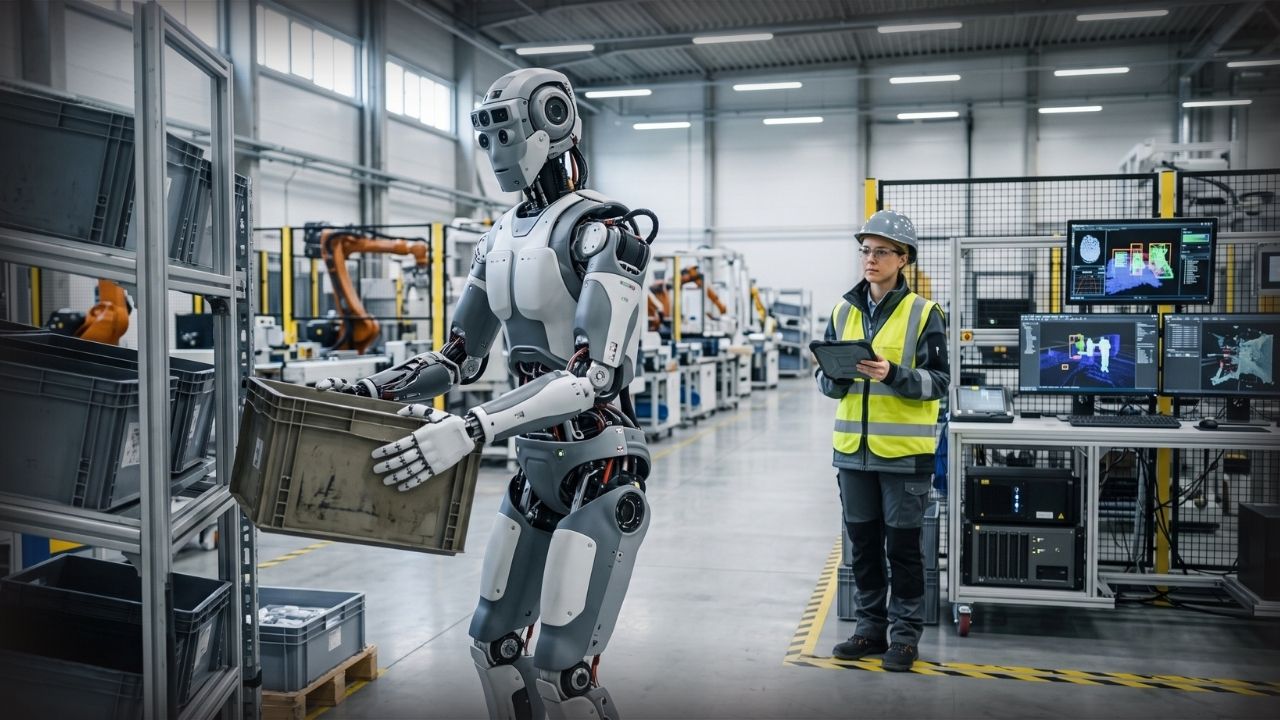
Their most realistic near-term uses are factories, logistics, warehouses and other structured environments. Home robots are a more difficult problem because homes are unpredictable and require high levels of dexterity, safety and reliability.
Humanoid robotics is expected to remain an important part of broader technology trends for 2027, but widespread adoption timelines remain uncertain.
Key Takeaways
- Humanoid robots are real machines, but their capabilities vary considerably.
- AI can help robots understand vision, language and complex tasks.
- Factories and warehouses are more practical early markets than homes.
- Tesla Optimus, Figure, Boston Dynamics Atlas and Agility Robotics Digit represent different approaches to humanoid development.
- Walking is only one challenge; reliable manipulation is often harder.
- Battery life, actuator efficiency and computing requirements limit operating time.
- Many impressive demos do not reveal intervention rates or long-term reliability.
- Humanoid robots are unlikely to replace all workers.
- Robots may instead automate particular tasks within jobs.
- Cloud AI, edge computing and faster AI chips are important supporting technologies.
- Security becomes critical when network-connected robots can physically interact with their environment.
- Pakistan could eventually benefit in manufacturing and logistics, but economics will determine adoption.
- Consumers should be cautious about expensive household-robot pre-orders and unsupported availability claims.
Table of Contents
Humanoid Robots Compared
| Robot/Company | Main focus | Form | Position through 2026 |
| Tesla Optimus | General-purpose work | Biped humanoid | Development/industrial deployment efforts |
| Figure | General-purpose/industrial | Biped humanoid | Commercial development and industrial work |
| Boston Dynamics Atlas | Research/development and industrial capabilities | Biped humanoid | Electric platform in development |
| Agility Robotics Digit | Logistics/material handling | Biped humanoid | Commercial logistics focus |
| Apptronik Apollo | Industrial/general-purpose | Biped humanoid | Commercial pilots/development |
| Unitree humanoids | Research/development and broader robotics | Biped humanoid | Commercial hardware/development |
Capabilities, autonomy and availability change quickly. Manufacturer demonstrations should not be treated as directly comparable benchmarks.
1. Humanoid Robots Are Human-Shaped for a Reason
Building a robot with two legs is far harder than putting wheels under it, so why bother?
The answer is our environment.
Stairs are designed for legs. Shelves are positioned for human arms. Tools use human-sized handles. Workstations, doors and vehicles assume human proportions.
A versatile robot with human-like reach and mobility could theoretically operate inside existing workplaces without extensive reconstruction.
That does not mean humanoid design is always best. Wheeled robots are often cheaper, more stable and more energy-efficient. Specialized industrial robotic arms can outperform humanoids at fixed repetitive jobs.
The humanoid form makes the strongest case when flexibility across human-designed tasks offsets its additional complexity.
For background terminology, Wikipedia’s overview of humanoid robots provides useful historical and technical context.
2. AI Is Making Humanoid Robots More Flexible
Traditional industrial robots perform preprogrammed actions exceptionally well. Their limitation is flexibility.
Modern AI can potentially make robots better at understanding less structured environments.
Computer vision helps identify objects and obstacles. Language models can interpret natural-language instructions. Machine-learning systems can help select actions, while robotic control systems translate plans into physical movement.
A worker could eventually give a request such as “move the blue container to the empty shelf” without every movement being manually programmed.
This connection between robotics and future AI development is one reason progress has accelerated.
AI does not solve every robotics problem, however. Software intelligence cannot remove mechanical wear, weak grip, battery limitations or unsafe movements.
3. Tesla Optimus Has Made Humanoid Robotics Mainstream
Tesla’s Optimus, also known as Tesla Bot, has generated substantial public attention around humanoid robotics.
Tesla’s ambition is to develop a general-purpose bipedal robot capable of performing useful physical work, initially with potential applications in manufacturing.
The company’s experience with batteries, electric motors, manufacturing and machine-learning systems gives the project relevant engineering capabilities.
Still, potential and proven deployment are different things.
Buyers and businesses should focus on independently verifiable performance, production numbers, operating hours, human intervention rates and economics rather than future production targets alone.
Optimus matters because it has helped move humanoid robots into mainstream technology discussion, but the competitive field extends far beyond Tesla.
4. Figure AI Is Pushing Toward General-Purpose Robots
Figure AI is another prominent company developing AI-powered humanoid machines.
Its approach emphasizes the combination of human-scale robotic hardware and models that can connect vision, language and actions.
The important objective is generalization.
A conventional industrial system might need substantial reprogramming whenever a task changes. General-purpose humanoid robots aim to learn or adapt to new work more efficiently.
That remains an extremely difficult goal.
When evaluating Figure or any competitor, ask whether a demonstrated task is autonomous, how frequently intervention is required, whether the system is operating at useful speed, and whether performance can be maintained over an entire work shift.
Those measurements matter more than a single polished demonstration.
5. Boston Dynamics Rebuilt Atlas Around Electric Actuation
Boston Dynamics has spent years demonstrating exceptionally dynamic robots. Atlas became famous for complex movement and research demonstrations.
In 2024, the company retired its hydraulic Atlas research platform and revealed an all-electric successor.
The change is significant because electric actuation is highly relevant to potential industrial humanoid systems.
The new Atlas also illustrates an interesting principle: a humanoid machine does not have to move exactly like a person. A robot can use joint configurations and movements that exploit its mechanical structure rather than mimic human biomechanics perfectly.
Boston Dynamics remains an important company to watch because control, balance and whole-body movement are foundational challenges in humanoid robotics.
6. Agility Robotics Digit Shows Why Logistics Comes First
Agility Robotics’ Digit demonstrates a more focused path.
Instead of beginning with the assumption that robots must perform every imaginable human task, logistics provides narrower, measurable problems such as moving containers or materials.
Warehouses are attractive environments because routes and workflows can be standardized.
Businesses can also calculate whether automation produces an economic return.
This may determine the first real winners in humanoid robotics. A machine does not need to be an artificial person to become commercially valuable. It needs to reliably solve a problem at an acceptable cost.
That distinction is essential when assessing the future of robotics.
7. China Is Becoming a Major Humanoid Robotics Competitor
The humanoid robotics race is not limited to American companies.
Chinese firms, including Unitree and other robotics manufacturers, have demonstrated increasingly sophisticated humanoid platforms.
China also has deep manufacturing capabilities in batteries, electric motors, electronics and supply chains—all relevant to scaling robots.
This competition could help reduce hardware prices over time.
Smartphones provide an interesting analogy. Technology that initially appears only in expensive flagship products eventually moves down the market as manufacturing improves and component costs fall.
Pakistan has seen this dynamic with Android devices from Xiaomi, Realme, Oppo, Vivo, Infinix and Tecno. Robotics could eventually follow a similar pattern, although humanoid machines are far more mechanically complex than phones.
8. Robot Hands May Be Harder Than Robot Walking
A humanoid walking across a room looks impressive, but useful hands can be an even harder engineering problem.
Human hands combine extraordinary dexterity, sensitivity and adaptability. We can handle a fragile glass and then lift a heavy object using the same biological hardware.
Robotic hands need to estimate force, identify object geometry and respond when something slips or moves unexpectedly.
Real-world objects are also inconsistent. Bags deform. Fabric folds. Cables bend. Containers have different textures.
This is why manipulation deserves close attention when watching robot demonstrations.
The key question is not simply “Can this robot walk?”
Ask: “What objects can it reliably manipulate without human assistance?”
9. Battery Life Is a Fundamental Constraint
A mobile humanoid requires substantial energy.
Motors move its arms and legs. Computers process sensor information. Cameras and other sensors operate continuously. Wireless systems communicate with local or cloud infrastructure.
Every gram of battery also adds weight, and moving that weight consumes more energy.
Battery technology therefore matters directly to robotics.
Improvements in conventional lithium-ion cells, silicon-rich anodes and eventual advances in solid-state batteries could increase operating time or reduce robot weight.
Solid-state technology remains an area of intense development rather than a guaranteed near-term solution for every robot. For broader context, Wikipedia explains the principles behind solid-state batteries.
Battery progress is among the future technology trends worth watching precisely because mobile robots, electric vehicles and consumer devices all depend on energy density.
10. Robots Can Learn Through Simulation and Human Demonstration
Programming every movement manually would make general-purpose robotics painfully slow to scale.
Developers therefore use methods including simulation, reinforcement learning, teleoperation and learning from human demonstrations.
Simulation is particularly useful because virtual robots can practice without breaking expensive physical machines.
The difficult part is transferring learned behaviour into reality. Physics simulations cannot perfectly reproduce every surface, object, sensor imperfection and unexpected event.
This is known broadly as the simulation-to-reality, or sim-to-real, challenge.
Human demonstrations are another useful source of training data. A person can perform a task while the system records the actions, allowing a model to learn patterns from examples.
This does not mean the robot immediately understands the task as a person would. Generalizing safely beyond training situations remains difficult.
11. Factories and Warehouses Are the Most Logical First Market
Factories provide what humanoid robots need most: structure.
Routes can be marked. Lighting can be controlled. Workstations can be standardized. Unsafe areas can be separated, and technical staff can supervise machines.
The economics are also measurable.
If a robot performs useful material-handling work for sufficient hours, a company can compare its cost with existing automation and labour arrangements.
Pakistan could eventually see this technology in automotive assembly, textiles, warehouses, logistics and large manufacturing facilities if the economics make sense.
Cloud infrastructure may also support fleet management and analytics. Businesses preparing for more automated operations should understand the fundamentals in our cloud computing for businesses guide.
12. Household Humanoid Robots Are Much Harder
A factory can control its environment. A home cannot.
Children leave objects on floors. Pets move unpredictably. Furniture changes position. Kitchens contain heat and sharp objects. Stairs and bathrooms introduce additional hazards.
A household humanoid also needs extremely good manipulation.
Consumers will expect it to handle dishes without breaking them, identify belongings correctly and operate safely around family members.
Reliability expectations will be high because a powerful moving machine can cause physical harm.
This is why predictions of inexpensive general-purpose household humanoid robots should be treated cautiously. Industrial success does not automatically imply that safe home deployment is close.
13. Humanoid Robots Are More Likely to Automate Tasks Than Entire Economies
Will robots take human jobs? The more useful question is which tasks can be automated economically.
Jobs are collections of tasks.
A warehouse worker may move goods, solve unexpected problems, coordinate with colleagues, inspect damage and make judgment calls. A robot might initially automate only the repetitive transport portion.
That can still affect employment.
Some roles may require fewer people, while demand could grow for robot technicians, fleet supervisors, safety engineers, software developers and automation specialists.
Students in Pakistan should therefore focus on adaptable skills instead of trying to predict one “safe” occupation.
Programming, electronics, mechatronics, AI, mechanical engineering, cybersecurity and data analysis are all relevant to an increasingly automated economy.
Students beginning with AI can explore these AI tools for students in Pakistan.
14. Robot Cybersecurity Is a Physical Safety Issue
Cybersecurity takes on a different meaning when a connected computer has arms, legs and substantial physical strength.
A compromised email account can expose information. A compromised robot could potentially interact dangerously with its environment.
Robotic platforms therefore need secure authentication, encrypted communications, carefully controlled software updates, network segmentation and strong access permissions.
Cloud-connected fleets need additional protection because an attacker who compromises centralized management infrastructure could potentially affect many machines.
Businesses deploying connected automation should make cloud security part of robotics planning from the start.
Individual users should also understand basic online cybersecurity practices, as robots will increasingly become another category of networked computer.
15. Humanoid Robots Could Eventually Matter to Pakistan
Pakistan is unlikely to become a mass consumer market for expensive humanoid robots before wealthier early-adopter economies, but industrial opportunities are more realistic.
Manufacturing, logistics, warehousing and hazardous industrial inspection could benefit if robot costs fall enough.
The central question will be return on investment.
Labour economics differ substantially between Pakistan and markets with very high wages. A robot that makes financial sense in one country may not offer the same return in Pakistan.
Import duties, maintenance expertise, replacement parts, electricity reliability and technical support also matter.
Local universities and engineering programmes may have another opportunity: research, software, robotic control, computer vision and low-cost automation do not necessarily require Pakistan to manufacture every advanced component domestically.
For official technology policy developments, readers should consult Pakistan’s Ministry of Information Technology and Telecommunication and the Government of Pakistan.
How AI, 5G, 6G and Cloud Computing Connect to Robots
Humanoid robots do not operate in isolation.
AI helps with perception, planning and language. Edge computing handles time-sensitive processing close to the robot. Cloud computing can provide fleet analytics, software management and computational resources.
Wireless connectivity can support telemetry and coordination. Existing Wi-Fi and cellular systems, including 5G, can already handle many applications.
6G is sometimes discussed alongside future robotics because researchers envision highly connected intelligent machines. However, robots do not need to wait for 6G.
Mainstream commercial 6G is not a 2026 reality. The International Telecommunication Union is a better source for next-generation mobile developments than speculative marketing.
In Pakistan, network and spectrum developments should be verified through the Pakistan Telecommunication Authority.
Step-by-Step Guide: How to Judge a Humanoid Robot Demonstration
When you see a remarkable robotics video, use five checks.
- Determine whether the footage is real-time, edited or accelerated.
- Check whether the robot is autonomous, teleoperated or receiving human assistance.
- Look for continuous operating time rather than one successful attempt.
- Find information about task success rate and intervention frequency.
- Check whether the system is commercially deployed or remains an experimental prototype.
A sixth question is equally useful: how much does the complete system cost to operate?
Hardware price alone ignores maintenance, charging, integration, supervision and software expenses.
Pros and Cons of Humanoid Robots
| Advantages | Limitations |
| Can potentially use human-designed spaces | Biped movement is mechanically complex |
| Could automate repetitive physical work | Hardware remains expensive |
| May perform dangerous tasks | Battery life can restrict operation |
| AI enables more flexible instructions | AI can make mistakes |
| Can potentially use existing tools | Dexterous manipulation is difficult |
| Could operate across multiple tasks | Reliability must improve |
| Useful for labour shortages in some markets | Employment disruption is possible |
| Can support hazardous operations | Cybersecurity becomes a safety concern |
Humanoid machines make sense only when their flexibility provides enough value to justify the complexity.
Buying Advice: Should You Buy a Humanoid Robot?
Most ordinary Pakistani consumers should not purchase an expensive general-purpose humanoid robot based on future promises.
This remains an early market.
Businesses considering deployment should request measurable evidence of reliability, safety certification where applicable, local technical support, spare-parts availability, software-update policies and the complete operating cost.
Do not rely on a demonstration video as proof that a robot can perform unsupervised commercial work.
For individual buyers, more mature automation products may provide better value. Specialized cleaning robots, security equipment and industrial systems solve narrower tasks but have clearer capabilities.
This is similar to buying any emerging technology: current usefulness should matter more than being first.
Expert Tips for Evaluating Humanoid Robot Companies
Company announcements can move faster than commercial reality. Evaluate projects using evidence instead of promises.
Look for long-duration customer deployments, actual production capacity, autonomy rates, safety data and repeatable performance. Check whether customers are purchasing machines or simply participating in trials.
Hardware also matters as much as AI. Excellent software cannot compensate indefinitely for unreliable actuators, weak hands or inadequate batteries.
Finally, compare a humanoid with simpler automation. If a wheeled robot or conventional robotic arm performs the same task more reliably for less money, the humanoid form may not be economically justified.
For wider context around robotics, AI, quantum computing, AR/VR and next-generation networks, see our coverage of technology trends in 2027.
Summary Box: 15 Humanoid Robot Facts
Humanoid robots are becoming increasingly capable, largely because robotics is converging with modern AI, better sensors, improved processors and advanced electric actuation.
The most important point is that intelligence alone does not solve robotics. Reliable machines also require strong mechanical engineering, energy-efficient hardware, safe control systems and excellent manipulation.
Industrial environments offer the clearest near-term business case. General-purpose household machines face much greater technical and economic barriers.
The future may be significant, but humanoid robotics should be measured by repeatable real-world work rather than impressive demonstrations.
FAQs
What is a humanoid robot?
A humanoid robot is a robotic system whose physical form resembles the human body. It typically has a torso and arms, while many advanced models use two legs and human-like manipulators.
Are humanoid robots real?
Yes. Multiple companies have functional humanoid robot platforms. However, capability, autonomy, commercial availability and reliability vary widely between systems.
Which companies make humanoid robots?
Prominent developers include Tesla, Figure AI, Boston Dynamics, Agility Robotics, Apptronik and Unitree, alongside a growing number of companies and research organizations worldwide.
What is Tesla Optimus?
Optimus is Tesla’s humanoid robot programme. Tesla is developing the platform with the long-term objective of performing useful physical tasks, including work in manufacturing environments.
Can humanoid robots use artificial intelligence?
Yes. Modern systems can use AI for computer vision, language interpretation, task planning and learned control. They also rely heavily on traditional robotics software and control engineering.
Can humanoid robots work without the internet?
Potentially, yes, depending on their architecture and task. Time-critical functions should generally execute locally, while some services may use cloud infrastructure for model access, analytics or fleet management.
Will humanoid robots replace workers?
They are more likely initially to automate specific physical tasks rather than replace every activity performed by a person. Employment effects will vary by industry, economics and robot capability.
Can I buy a humanoid robot in Pakistan?
Commercial availability is limited and highly product-specific. Import costs, support, maintenance, regulation and spare parts need to be considered. Consumers should verify availability directly with manufacturers or authorized channels.
Are humanoid robots safe?
They can be engineered with safety systems, but physical interaction creates real risks. Safe commercial deployment requires appropriate hardware controls, software safeguards, testing and operating procedures.
Why do humanoid robots have two legs?
Legs potentially allow a robot to navigate stairs and spaces built for humans. In environments without that requirement, wheels may be cheaper and more efficient.
What is the biggest technical challenge for humanoid robots?
There is no single challenge. Reliable manipulation, balance, safety, battery efficiency, generalization, hardware durability and cost all remain difficult engineering problems.
Will humanoid robots be common in homes by 2030?
It is possible that more domestic robots will be available by then, but widespread adoption of affordable general-purpose humanoid household robots cannot be predicted confidently. Reliability, safety and cost remain major uncertainties.
How much do humanoid robots cost?
Prices vary enormously, and many advanced platforms are not sold as ordinary retail products. Businesses should consider total operating cost rather than hardware price alone.
How are humanoid robots connected to future AI?
Multimodal AI can help robots interpret images, language and sensor data, while AI planning and learned control can make them more adaptable. Robotics effectively gives AI systems a way to interact physically with the world.
Do humanoid robots need 6G?
No. Humanoid robots can operate using local computing, Wi-Fi, Ethernet, private networks and existing cellular technologies. Future 6G networks could enable new applications, but robots do not depend on 6G to function.
Conclusion
Humanoid robots are one of the most important intersections of AI, mechanical engineering and computing in 2026.
Tesla Optimus, Figure, Boston Dynamics Atlas, Agility Robotics Digit and competing platforms illustrate how quickly the field is developing. Better AI is helping machines interpret language and visual information, while advances in processors, actuators, batteries and simulation are improving their physical capabilities.
The biggest challenges are now easier to see as well. Walking is not enough. A useful robot must manipulate objects reliably, operate safely for meaningful periods, recover from unexpected situations and produce enough economic value to justify its cost.
Factories, warehouses and other controlled environments consequently offer the strongest near-term opportunity. Household humanoid robots require a much higher level of general reliability and safety.
For Pakistan, widespread adoption will depend on economics, support infrastructure and useful local applications rather than global hype. Manufacturing, logistics, research and engineering education are the areas worth watching first.
Humanoid robots may eventually become an important part of everyday technology. The best evidence of that future will not be a viral demonstration—it will be robots quietly completing useful work, day after day, without requiring someone behind the scenes to rescue them.