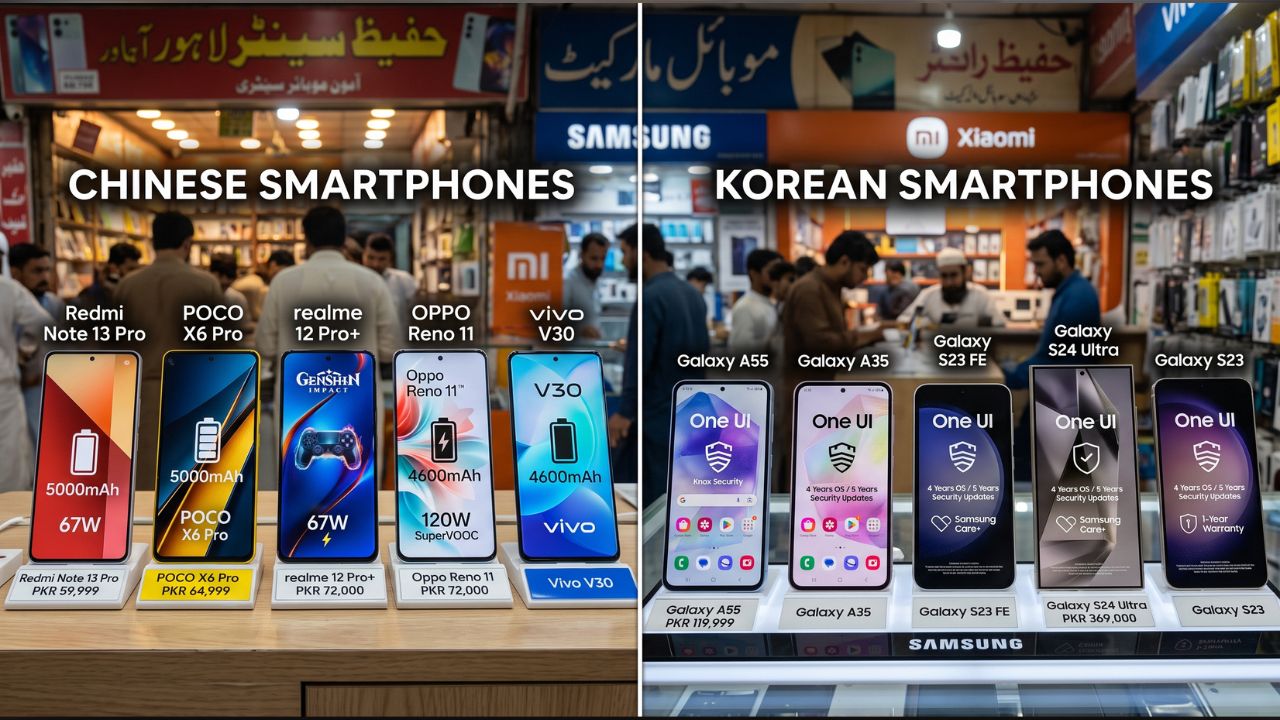
Introduction
You’re standing in a mobile shop in Lahore or Karachi, looking at two phones side by side. One is a Xiaomi Redmi priced at Rs. 28,000. The other is a Samsung Galaxy A at Rs. 38,000. Both have similar specs on paper but one is made in China, the other in South Korea.
The shopkeeper says, “Chinese phones are better value, but Samsung lasts longer.” You’re confused. Who’s right?
This debate Chinese vs Korean phones Pakistan is one of the most common questions we hear from Pakistani mobile buyers. And honestly, the answer isn’t simple because it depends entirely on what “better value” means to you.
In this 2026 guide, we’ll break down Chinese vs Korean phones Pakistan across every dimension that matters: pricing, build quality, camera performance, software longevity, after-sales service, and total cost of ownership. We’ll compare specific models like Xiaomi vs Samsung, Oppo vs LG, and Realme vs everything else.
By the end, you’ll know exactly which choice makes sense for your needs and budget.
The Chinese Phone Ecosystem in Pakistan What You’re Really Getting
When we talk about Chinese vs Korean phones Pakistan, we need to clarify what “Chinese phones” actually means in 2026.
Who Makes Chinese Phones?
Chinese phones sold in Pakistan come from major companies like:
- Xiaomi (including Redmi, POCO brands)
- Oppo and OnePlus
- Realme (now independent from Oppo)
- Vivo (less common but available)
- Tecno and Itel (budget segment)
- Transsion Holdings brands (Itel, Gfive, Tecno)
These aren’t small knockoff brands — they’re billion-dollar companies with research facilities across the world. Xiaomi, for instance, is the world’s fourth-largest smartphone manufacturer.
The Chinese Phone Value Proposition
Chinese phones in Pakistan compete primarily on value. Their business model is simple: offer maximum features and performance at the lowest possible price. They make profit through volume — selling millions of units globally.
This means:
- Better specs at lower price points than competitors
- Frequent model refreshes (sometimes 3–4 new models per quarter)
- Aggressive pricing during new phone launch Pakistan 2026 events
- Heavy investment in marketing and partnerships in Pakistan
The Xiaomi Redmi and POCO phones price guide shows this perfectly — you get genuinely excellent hardware for the money.
The Trade-Off: Software Longevity
Here’s where Chinese vs Korean phones Pakistan starts getting interesting. Chinese phones typically receive 2–3 years of major OS updates and security patches. After that, your phone still works, but it stops receiving new Android versions.
Korean phones, particularly Samsung, now promise 4–7 years of updates on newer models — a massive advantage for long-term users.
The Korean Phone Ecosystem in Pakistan Premium Positioning
Korean smartphones in Pakistan are dominated by one brand: Samsung. (LG exited the smartphone market globally in 2021, so they’re not a real factor anymore.)
What Samsung’s Value Proposition Actually Is
Samsung doesn’t compete on price. They compete on ecosystem, longevity, and prestige. Their strategy is:
- Premium build quality and design
- Extended software support (4–7 years on newer models)
- Strong after-sales service network in Pakistan
- Brand trust among older and more affluent demographics
The Samsung Galaxy A series price guide and Galaxy S24 vs S23 comparison show Samsung’s entry and mid-range positioning.
The Samsung Service Advantage in Pakistan
This is often overlooked in Chinese vs Korean phones Pakistan discussions, but it’s real. Samsung has official service centres in every major Pakistani city. Getting a screen replaced, battery swapped, or warranty claim processed is straightforward — you walk into an authorized centre, and it’s handled professionally.
Chinese phone brands have varying service quality in Pakistan. Xiaomi’s service network is growing but still inconsistent. Oppo and Realme have better support than they did two years ago, but it’s not yet Samsung-level across the country.
Price Comparison: Chinese Phones Win (Decisively)
Let’s get concrete. Here’s a real-world price comparison of phones at similar capability levels:
Budget Segment (Rs. 15,000–25,000)
| Phone Model | Brand | Price | Key Specs |
| Itel Vision 3 Plus | Chinese | Rs. 13,000–14,000 | 4GB RAM, 64GB, 5000mAh |
| Redmi 13C | Chinese | Rs. 20,000–22,000 | 4GB RAM, 128GB, 5000mAh |
| Samsung Galaxy A15 | Korean | Rs. 32,000–35,000 | 4GB RAM, 128GB, 5000mAh |
Verdict: Chinese phones offer 30–40% better pricing at similar specs. See our budget brands guide for Itel, QMobile, Gfive for more budget options.
Mid-Range Segment (Rs. 40,000–70,000)
| Phone Model | Brand | Price | Key Specs |
| Redmi Note 13 | Chinese | Rs. 32,000–35,000 | 108MP, AMOLED, Gorilla Glass |
| Realme GT 6T | Chinese | Rs. 74,000–80,000 | Flagship chipset, 120W charging |
| Samsung Galaxy A35 | Korean | Rs. 55,000–60,000 | 50MP, AMOLED, Gorilla Glass |
Verdict: Chinese phones offer better specs at lower prices in mid-range. The Redmi Note 13 price guide shows exceptional mid-range value. Compare with our Realme vs Oppo comparison.
Premium Segment (Rs. 100,000+)
| Phone Model | Brand | Price | Key Specs |
| Xiaomi 14 Ultra | Chinese | Rs. 150,000–170,000 | Flagship specs, 512GB option |
| Samsung Galaxy S24 | Korean | Rs. 185,000–210,000 | Similar flagship specs |
| iPhone 15 Pro | American (not in comparison) | Rs. 200,000–240,000 | Premium iOS ecosystem |
Verdict: Chinese phones offer flagship specs at 20–30% lower prices. However, Samsung’s extended update promise adds long-term value.
Clear winner on raw price: Chinese phones win across all segments.
Build Quality and Durability The Real Story
This is where Chinese vs Korean phones Pakistan gets nuanced. Raw pricing doesn’t tell the whole story.
Physical Durability Testing
We’ve covered this extensively in our budget phone durability test 2026, but here’s the summary:
Chinese phones: Modern Chinese phones use quality materials — polycarbonate or plastic-aluminum hybrids that are genuinely durable. They don’t feel as premium as Samsung, but they survive Pakistani conditions well. The Redmi Note 13 has Gorilla Glass and good drop protection.
Korean phones (Samsung): Premium build quality is Samsung’s calling card. They use better glass, tighter tolerances, and more robust frames. A Galaxy A series phone feels more expensive than a Redmi at the same price point.
Advantage: Korean phones — but Chinese phones at the same price now offer 85–90% of Samsung’s build quality.
Heat and Environmental Resistance
Pakistani summers are brutal — temperatures exceed 50°C in some regions. How phones handle heat is critical.
Chinese phones in 2026 often throttle performance more aggressively under heat to protect battery longevity. This is actually good design — the phone stays cool, but performance dips temporarily.
Samsung phones handle sustained heat slightly better — their thermal management is marginally superior. But the difference is measurable only in extreme edge cases.
Advantage: Slight edge to Korean phones, but not a dealbreaker for either.
Water Resistance
Neither Chinese vs Korean phones Pakistan in the budget-to-mid-range segment offer official water resistance ratings (IP ratings). Both get damaged by heavy rain or submersion. For actual water protection, you need either:
- A protective case (Rs. 300–800)
- A phone in the premium segment (Rs. 100,000+)
Camera Performance: Chinese Innovation Leads
This is where Chinese vs Korean phones Pakistan gets genuinely interesting in 2026.
Camera Hardware
Chinese phones now lead the pack in megapixel counts:
- Redmi Note 13: 108MP main sensor
- Oppo Find X7: 50MP with periscope zoom (up to 90x)
- Realme 12 Pro: Dual 50MP setup
Samsung’s Galaxy A series typically tops out at 50MP. In the premium segment, both match up, but Chinese phones often include more creative camera setups (periscope zooms, macro sensors, etc.).
Advantage: Chinese phones — more aggressive innovation in camera hardware.
Real-World Photo Quality
Here’s where things flip slightly. Despite having fewer megapixels, Samsung’s image processing is often more reliable and consistent. A Samsung phone’s 50MP camera sometimes produces better-looking photos than a Redmi’s 108MP in certain lighting conditions.
This matters for casual users who just want good shots without fiddling with settings. Chinese phones give you more powerful hardware that requires understanding how to use it properly.
Advantage: Tied — depends on user skill level.
Video and Selfie Performance
For video, Chinese phones increasingly match or beat Samsung. The best phone camera Pakistan 2026 guide shows that mid-range Chinese phones now handle video stabilization and low-light performance excellently.
For best selfie phone Pakistan 2026, Chinese brands like Oppo and Realme have made selfie cameras their specialty — sometimes offering 32MP or 40MP front cameras vs Samsung’s 20MP typical.
Advantage: Chinese phones — particularly for video and selfie performance.
Software and Long-Term Support: Korean Phones Finally Win
This is the category where Chinese vs Korean phones Pakistan genuinely matters for long-term ownership.
Update Support Duration
Samsung’s new promise (2024 onwards):
- Galaxy S series: 7 years of major OS updates
- Galaxy A series: 4 years of major OS updates
- Security patches: 5 years minimum
Chinese brands (Xiaomi, Realme, Oppo):
- Major OS updates: 2–3 years typically
- Security patches: 2–3 years
This is a massive gap. A Samsung Galaxy A phone bought in 2024 will receive Android updates through 2028. A Redmi phone will get updates through 2026–2027.
Clear advantage: Korean phones (Samsung).
What This Means Practically
After 2–3 years, Chinese phones often start showing their age:
- Apps stop updating because they require newer Android versions
- New features roll out to Android but your phone is stuck on an old version
- Security vulnerabilities accumulate
A Samsung Galaxy A at Rs. 35,000 that lasts 4 years with full support is actually better value than a Rs. 22,000 Redmi that’s outdated after 2.5 years.
Software Bloatware and Customization
Interestingly, Chinese phones often have cleaner software experiences. Xiaomi’s MIUI is feature-rich but less cluttered than Samsung’s OneUI. This is a subjective preference, but many Pakistani users appreciate Chinese phones’ cleaner approach.
Gaming Performance: Chinese Phones for Serious Gamers
If you’re hunting for the best gaming phone in Pakistan 2026, Chinese vs Korean phones Pakistan reveals a clear winner.
Gaming Chipsets
Chinese phones consistently get the latest Snapdragon 8 Gen 3 Leading Version or equivalent flagships first — often weeks before Samsung does.
The Realme GT series gaming review shows Chinese phones dominating gaming benchmarks. A Realme GT 6T (Chinese, Rs. 80,000) outperforms Samsung Galaxy S24 (Korean, Rs. 200,000) in gaming — not because the chipset is different, but because Chinese phones prioritize gaming optimization in thermal management and cooling.
Real-World Gaming Tests
For games like PUBG Mobile on high settings, Call of Duty Mobile at maximum graphics, and Genshin Impact:
- Chinese phones: Consistent 60+ FPS on high settings
- Samsung phones: Mixed results depending on the model
Clear advantage: Chinese phones — especially in the mid-range gaming segment.
Battery Drain During Gaming
Chinese phones often have larger batteries (5000–5500mAh) compared to similar Samsung phones. Combined with aggressive battery management, they outlast Samsung devices during extended gaming sessions.
Battery and Fast Charging — Chinese Dominance
Battery Capacity
Chinese phones lead decisively here:
- Budget Chinese phones: 4000–5000mAh standard
- Mid-range Chinese phones: 5000–6000mAh
- Premium Chinese phones: 5500–6000mAh
Samsung’s Galaxy A series typically uses 3500–4500mAh — noticeably smaller. Even Samsung flagships don’t guarantee the battery sizes you’d find in Chinese phones at the same price.
For the best battery phone in Pakistan 2026, Chinese brands take the crown in practically every category. See our dedicated battery phone comparison for detailed analysis.
Fast Charging: Chinese Innovation Wins
Chinese phones: 33W, 67W, 80W, even 120W fast charging is standard across price ranges.
- Redmi Note 13: 33W charging
- Oppo Find X7: 80W charging
- Realme GT 6T: 120W charging
Samsung phones: 25W fast charging is typical for Galaxy A series. Flagships reach 45W maximum.
Massive advantage: Chinese phones — you can charge a Chinese phone from 0–100% in 30–45 minutes. Samsung takes 60–90 minutes.
For users who work mobile jobs, travel frequently, or just live busy lives in Pakistani cities, faster fast charging phone Pakistan options in Chinese devices genuinely matter.
After-Sales Service: Samsung Wins (But Chinese Improving)
This is where geography matters in Pakistan.
Service Network
Samsung: Official service centres in Karachi, Lahore, Islamabad, Rawalpindi, Multan, Faisalabad, and Peshawar. Consistent service quality, genuine spare parts, professional technicians.
Chinese brands:
- Xiaomi: Growing network, but inconsistent quality across regions
- Oppo/Realme: Good in major cities, spotty in smaller towns
- Itel/Gfive: Minimal service infrastructure in Pakistan
If you live in a major Pakistani city, Chinese phone service is acceptable. If you’re in a smaller city or semi-rural area, Samsung’s advantage becomes significant.
Advantage: Korean phones (Samsung) — particularly if you’re outside major metros.
9 Expert Tips for Choosing Between Chinese vs Korean Phones in Pakistan
Here’s practical guidance for your decision:
- Choose Chinese if you upgrade every 2–3 years. Better value, more features, excellent performance. The software longevity gap doesn’t matter if you’re constantly upgrading anyway.
- Choose Korean (Samsung) if you want to keep your phone 4+ years. Extended update support means your phone stays secure and usable longer — offsetting the higher initial cost.
- For gaming, always choose Chinese. Gaming optimization is simply better in Chinese phones at every price point.
- For photography, test both before buying. Don’t assume megapixels = better photos. Visit a shop and compare camera samples on actual phones.
- Check your city’s service infrastructure. If you’re in Karachi, Lahore, or Islamabad, both work fine. If you’re in a smaller city, Samsung’s service advantage becomes real.
- Calculate total cost of ownership over 3 years. A cheaper Chinese phone that you replace after 3 years might cost less total than a pricier Samsung that lasts 4–5 years. Do the math.
- Prioritize battery capacity if you’re on the go constantly. Chinese phones’ larger batteries and faster charging are genuinely valuable for busy Pakistani lifestyles.
- Compare the specific model, not just “Chinese vs Korean.” A Redmi Note 13 is more comparable to a Samsung Galaxy A25 than to a Galaxy S24. Compare models at similar price points, not by country of origin.
- Read Pakistani-specific reviews before buying. Global reviews don’t account for Pakistan’s climate, network infrastructure, and service realities. Check our site for Realme vs Oppo comparisons, Oppo Reno 11 reviews, and Samsung Galaxy A series guides that factor in Pakistani conditions.
Common Mistakes and FAQs About Chinese vs Korean Phones in Pakistan
Mistake 1: Assuming Higher Price = Better Quality
Many Pakistani buyers think Samsung’s higher price means better quality across the board. Not true. A Rs. 35,000 Samsung Galaxy A35 is not that much better than a Rs. 28,000 Redmi Note 13 — it’s actually the Samsung’s longevity that justifies the premium, not immediate quality.
Mistake 2: Ignoring Software Support When Budgeting
This is a serious phone buying mistake in Pakistan. Buyers focus on initial specs but ignore that Chinese phones will become outdated in 2.5 years while Samsung phones stay current for 4+. Over your ownership period, Samsung can actually be better value despite higher upfront cost.
Mistake 3: Thinking All Chinese Phones Are the Same
Xiaomi, Oppo, Realme, and Itel are all Chinese, but they’re vastly different in quality, support, and longevity. Itel Vision 3 Plus is not comparable to a Redmi Note 13 — even though both are Chinese. Always compare specific models at similar price points.
FAQ 1: Are Chinese phones less durable than Samsung in Pakistan’s climate?
No. Modern Chinese phones are built to handle heat, dust, and humidity just as well as Samsung. The difference in budget phone durability in Pakistan between Chinese and Korean phones is marginal — both will survive typical Pakistani usage patterns. Both lack official water resistance under Rs. 40,000 anyway.
FAQ 2: Will my Chinese phone get outdated faster than Samsung?
Yes. For software updates and security patches, Chinese phones typically stop receiving updates after 2–3 years. Samsung phones get 4–7 years depending on the series. After year 3, a Chinese phone may feel slow as apps update beyond what your phone’s Android version supports.
FAQ 3: Which Chinese brand has the best service in Pakistan?
Xiaomi and Oppo have the most established service networks in major Pakistani cities. Realme is catching up. For rural areas or smaller cities, none match Samsung’s coverage. Check whether your specific city has a service centre for the brand before buying.
FAQ 4: Should I buy Chinese for gaming and Samsung for everything else?
Essentially yes. If gaming is your priority, Chinese phones win decisively with better cooling, bigger batteries, and faster charging. If you want a balanced device that lasts longer, Samsung’s software support becomes the differentiator.
FAQ 5: What about resale value Chinese or Korean phones?
Samsung phones generally hold resale value better in Pakistan. Because of stronger brand loyalty and better software longevity, used Samsung phones sell faster and at higher prices. Check our used iPhone Pakistan buying guide — the same principles apply to Android resale.
The Real Verdict: Context Matters
Chinese vs Korean phones Pakistan isn’t a simple competition with a universal winner.
Choose Chinese if:
- You upgrade every 2–3 years
- Gaming and camera hardware matter most
- You want maximum features at the lowest price
- You live in a major city with good service access
- You prioritize battery life and fast charging
Choose Korean (Samsung) if:
- You want to keep your phone 4+ years
- Long-term software support matters to you
- You value consistent, reliable service
- You’re in a smaller city or rural area
- You want a phone that stays secure and current longer
The best value isn’t always the cheapest phone — it’s the phone that serves your needs longest without disappointing you.
Conclusion
The Chinese vs Korean phones Pakistan debate in 2026 comes down to this: Chinese phones offer better hardware value and performance right now. Korean phones (Samsung) offer better long-term value through extended software support.
For most Pakistani buyers, a Chinese phone at Rs. 28,000–35,000 provides genuine flagship-level features at prices that would cost Rs. 50,000+ from Samsung. But if you plan to keep your phone for 4+ years, Samsung’s extended update support justifies the premium.
Smart shopping means understanding these trade-offs, comparing specific models rather than entire countries of origin, and choosing based on your priorities — not general rules.
Explore detailed reviews of specific Chinese phones on our Xiaomi Redmi POCO guide, Realme gaming phones, and Oppo reviews. Compare with Samsung Galaxy guides to make your final call.
Which matters more to you — saving money upfront or keeping your phone longer? And have your past experiences with Chinese or Korean phones shaped your preference? Tell us in the comments!