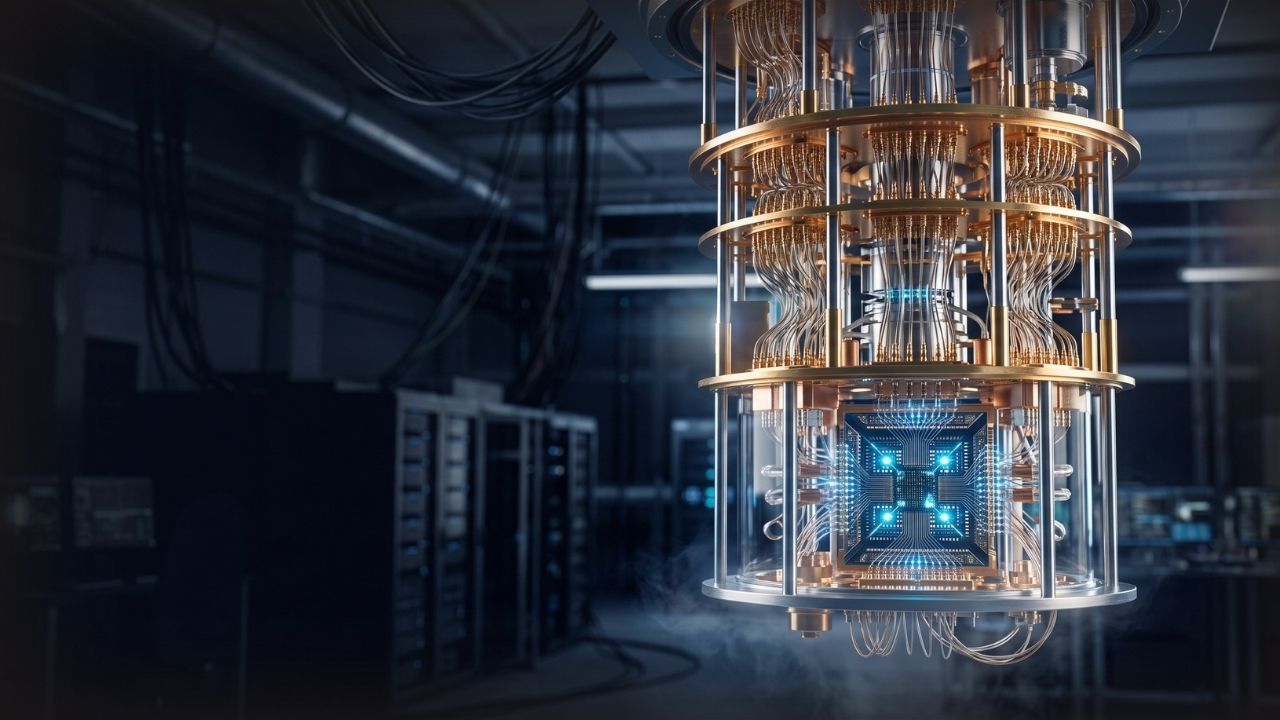
Quantum computing is one of technology’s most promising—and most misunderstood—fields. It is frequently presented as a future replacement for ordinary computers, but that is not how the technology works.
A quantum computer uses quantum-mechanical phenomena to process information in ways fundamentally different from conventional digital computers. For certain carefully selected problems, sufficiently capable quantum machines may eventually deliver advantages that are impractical to achieve with classical systems.
That does not mean your next laptop, Android phone or iPhone will contain a general-purpose quantum processor.
In 2026, quantum computing remains a specialized field combining physics, mathematics, computer science and advanced engineering. Google, IBM, Microsoft, Quantinuum, IonQ and other organizations are developing competing technologies. Researchers have demonstrated important advances in quantum error correction and hardware, but building large, useful, fault-tolerant machines remains an enormous challenge.
Quantum technology is nevertheless worth understanding now. Its possible applications include chemistry, materials science and selected optimization problems, while its implications for cryptography are already driving a transition toward post-quantum security.
For readers in Pakistan, the immediate opportunity is primarily education, research, software and cloud access rather than buying quantum hardware.
Here are 15 facts and future applications that explain what quantum computing can really do, where the field stands through 2026 and what developments deserve attention next.
What Is Quantum Computing?
Quantum computing is a computing approach that manipulates information using quantum bits, or qubits. Unlike an ordinary bit measured as either 0 or 1, a qubit can exist in a quantum state described by a combination of possibilities before measurement.
Quantum algorithms use properties including superposition, entanglement and interference to perform particular computations.
This does not make a quantum computer faster at every task. Quantum advantage depends on the problem, algorithm, hardware quality and ability to control errors.
In 2026, useful large-scale fault-tolerant quantum computers are not general consumer products. Most quantum hardware is accessed by researchers and developers through laboratories or cloud platforms.
Key Takeaways
- Quantum computers use qubits instead of conventional bits.
- Superposition does not mean a quantum computer simply “tries every answer at once.”
- Entanglement enables correlations important to many quantum algorithms.
- Quantum interference helps algorithms amplify useful outcomes.
- Qubits are highly sensitive to noise.
- Quantum error correction is central to building reliable large-scale systems.
- Physical qubit count alone is a poor measure of practical usefulness.
- Different companies use different qubit technologies.
- Chemistry and materials simulation are important potential applications.
- Some optimization problems could eventually benefit, but broad advantages are not guaranteed.
- Quantum computing will complement rather than replace conventional CPUs and GPUs.
- Powerful future quantum machines create risks for widely used public-key cryptography.
- Post-quantum cryptography is already being standardized and deployed.
- Cloud access allows Pakistani students to explore quantum computing without owning hardware.
- Timelines for broadly useful fault-tolerant quantum computers remain uncertain.
Table of Contents
Classical vs Quantum Computing
| Feature | Classical computing | Quantum computing |
| Information unit | Bit | Qubit |
| Basic measured state | 0 or 1 | 0 or 1 after measurement |
| Hardware examples | CPU, GPU, NPU | Superconducting, trapped-ion and other qubits |
| Error rates | Very low in mature systems | Much more challenging |
| Consumer availability | Universal | Specialized |
| Best suited to | General computing | Selected quantum algorithms |
| Smartphones | Standard | Not general-purpose quantum devices |
| Operating temperature | Varies | Some approaches require extreme cooling |
| Cloud access | Common | Available from several providers |
| Cryptographic impact | Runs current encryption | Future machines could threaten some public-key systems |
The technologies are complementary. Quantum machines are better viewed as specialized accelerators than replacements for conventional computing.
1. Quantum Computing Is Not Simply a Faster PC
This is the most important misconception to remove.
A sufficiently powerful quantum computer will not automatically make Google Play load instantly, improve an AMOLED display, render every game faster or make Android more responsive.
Classical computers are extraordinarily efficient for ordinary applications.
Apple processors, Qualcomm Snapdragon chips and MediaTek platforms contain CPUs, GPUs and dedicated AI hardware optimized for consumer workloads. Quantum hardware is designed around completely different computational principles.
A future data centre might use CPUs for general control, GPUs for AI and a quantum processor for a specialized calculation.
That hybrid model is more realistic than replacing every conventional chip.
For broader context about where this technology fits, see our guide to future technology trends for 2027.
2. A Qubit Is Not Just a Smaller Bit
A classical bit stores one of two binary values: 0 or 1.
A qubit is a quantum system whose state can involve a combination of basis states before measurement.
When measured in the computational basis, however, the result is still classical: 0 or 1, according to probabilities determined by the quantum state.
The challenge is controlling that state accurately enough to perform useful calculations.
Depending on the hardware design, a qubit may be implemented using superconducting circuits, trapped ions, neutral atoms, photons or other physical systems.
This diversity is one reason there is no universally settled hardware architecture for large fault-tolerant quantum computing.
For an introductory scientific reference, Wikipedia’s overview of quantum computing provides useful terminology and references.
3. Superposition Does Not Mean “Every Answer at Once”
Popular explanations often say qubits can simultaneously be 0 and 1.
That is a convenient introduction but an incomplete description.
A qubit can exist in a superposition of basis states. Quantum algorithms manipulate amplitudes associated with these states.
The important problem is measurement: you cannot simply inspect every component of the quantum state and receive every possible answer.
A useful algorithm must exploit interference so that desirable results become more likely when the system is measured.
This subtle distinction explains why adding qubits does not magically solve arbitrary problems.
The algorithm is as important as the hardware.
4. Entanglement Creates Powerful Quantum Correlations
Entanglement occurs when quantum systems share a joint state that cannot be completely described by treating each component independently.
It is a crucial resource for many quantum-information tasks.
Entanglement does not allow information to travel faster than light—a common misconception.
Instead, it enables correlations that classical systems cannot reproduce in the same way.
Researchers must create and preserve these delicate states while performing precise operations, which becomes increasingly challenging as quantum processors grow.
5. Quantum Interference Is What Makes Algorithms Work
Interference is one of the less famous but essential concepts behind quantum computation.
Quantum algorithms manipulate probability amplitudes so that paths associated with useful outcomes can reinforce each other while others cancel.
This is why describing quantum computing merely as “parallel computing” is misleading.
Famous algorithms exploit quantum mechanics in carefully structured ways.
Shor’s algorithm, for instance, showed that a sufficiently capable fault-tolerant quantum computer could factor large integers far more efficiently than the best known classical approaches, with major implications for cryptography.
Grover’s algorithm provides a quadratic speedup for certain unstructured search problems.
Those advantages apply to specific mathematical structures—not computing in general.
6. Noise Is One of the Biggest Quantum Computing Problems
Qubits are extremely sensitive.
Interactions with their surrounding environment, imperfect control operations and measurement errors can damage the quantum information required for a calculation.
This loss of useful quantum behaviour is associated with decoherence and other sources of error.
Classical hardware also experiences physical errors, but decades of engineering have made ordinary digital systems extraordinarily reliable.
Quantum machines operate in a much more fragile regime.
That is why comparing systems based solely on the number of physical qubits can be misleading. Quality, connectivity, gate fidelity, error rates and the ability to perform useful circuits matter too.
7. Quantum Error Correction Could Unlock Useful Scale
Quantum error correction is one of the central engineering problems in the industry.
A logical qubit is an error-corrected quantum unit encoded using multiple physical qubits. The exact overhead varies dramatically depending on hardware quality and the error-correction code.
The objective is not to eliminate physical errors completely. It is to detect and correct enough of them for a long computation to remain reliable.
A key concept is operating below an error-correction threshold: as the code grows, the logical error rate should decrease instead of becoming worse.
Progress here matters more to long-term capability than simply announcing a bigger raw physical-qubit number.
This is why error correction has become such an important benchmark for judging quantum research.
8. There Are Multiple Competing Types of Quantum Computers
The industry has not settled on a single equivalent to today’s silicon transistor architecture.
Several physical approaches are being investigated.
Superconducting qubits are used by companies including Google and IBM. Trapped-ion systems manipulate charged atoms using electromagnetic fields. Neutral-atom approaches use individually controlled atoms, while photonic systems encode quantum information using light.
Microsoft has invested heavily in topological approaches.
Each technology involves trade-offs in gate speed, fidelity, connectivity, manufacturability, cooling and control complexity.
A slower qubit is not necessarily worse if its operations are more accurate. A platform with many qubits is not necessarily better if those qubits cannot perform sufficiently reliable algorithms.
This makes simplistic specification comparisons risky.
9. Google’s Work Highlights the Importance of Error Correction
Google Quantum AI has been one of the most prominent research groups in quantum computing.
Google’s superconducting processors have supported research into both quantum computation and error correction. The company’s Willow announcement in late 2024 drew particular attention to improvements in quantum error correction as code size increased, alongside a benchmark computation.
The significance is not that a quantum computer suddenly became better than every conventional computer at useful everyday work.
The more meaningful point is progress toward controlling errors as quantum systems scale.
Readers following the research should consult Google Quantum AI directly, because technical results matter more than simplified headlines.
Google’s work also shows why quantum computing should be evaluated using peer-reviewed or technically detailed evidence rather than one benchmark number.
10. IBM Is Building Hardware and a Cloud Quantum Ecosystem
IBM is another major quantum-computing developer.
Its strategy combines quantum processors, software tools and cloud access. IBM Quantum has helped make real quantum hardware accessible to researchers and developers who cannot maintain specialized machines themselves.
This cloud model is particularly relevant for Pakistan.
A university or student does not need to purchase a cryogenic quantum computer to learn algorithms. They can study quantum programming on classical simulators and, subject to service availability and access conditions, run experiments on remote hardware.
This mirrors conventional cloud computing, where expensive infrastructure is shared remotely.
Our cloud computing guide for Pakistan explains the underlying service model.
11. Microsoft Is Pursuing Topological Quantum Computing
Microsoft is pursuing a different long-term architecture built around topological quantum computing.
The attraction of topological qubits is the possibility of making quantum information more intrinsically resistant to certain local errors.
The difficulty is building and verifying the required physical systems.
Microsoft announced Majorana 1 in 2025 as part of its topological quantum programme. The announcement generated substantial attention and scientific scrutiny, illustrating a wider lesson: extraordinary quantum claims should be evaluated through detailed evidence, independent research and subsequent replication.
Competition between architectures is useful because nobody can yet confidently declare which physical platform will dominate large-scale fault-tolerant computing.
12. Chemistry and Materials Science Are Promising Applications
Nature is quantum mechanical, so simulating quantum systems is one of the most natural applications for quantum computing.
Classical simulation becomes extremely difficult as the complexity of some quantum systems grows.
Sufficiently capable quantum machines may eventually help researchers study molecular electronic structure and materials more accurately.
Potential applications include:
- Catalyst development
- Materials discovery
- Battery chemistry
- Chemical reactions
- Pharmaceutical research
- Energy-related materials
This links quantum research with other technology trends expected to shape 2027, including solid-state batteries and biotechnology.
“Potential” is important. Quantum computing has not already transformed drug development or battery manufacturing at commercial scale.
13. Optimization and AI Are Promising but Need Realistic Expectations
Quantum optimization receives considerable attention because businesses face difficult scheduling, routing and resource-allocation problems.
Finance, logistics, telecommunications and manufacturing are frequently discussed application areas.
Whether quantum algorithms deliver practical advantages depends on the exact problem, hardware and classical alternatives.
Classical optimization is already extremely sophisticated.
The same caution applies to quantum machine learning. Researchers are studying ways quantum systems might contribute to certain AI tasks, but today’s future AI development remains overwhelmingly powered by conventional CPUs, GPUs and specialized AI accelerators.
Quantum computing should not be presented as the engine behind current generative AI.
14. Quantum Computing Is Already Changing Cybersecurity Planning
This is the area where future quantum computers affect technology before those machines fully arrive.
Widely used public-key cryptographic systems rely on mathematical problems that are difficult for classical computers. A sufficiently capable fault-tolerant quantum computer running Shor’s algorithm could threaten important current schemes such as RSA and elliptic-curve cryptography.
That creates a long-term security problem.
Organizations cannot wait until a cryptographically relevant quantum computer exists and then replace every system overnight.
There is also a “harvest now, decrypt later” risk: attackers could store encrypted information today with the aim of decrypting it if future technology becomes capable enough.
In 2024, the U.S. National Institute of Standards and Technology finalized its first principal post-quantum cryptography standards. Readers can follow the NIST post-quantum cryptography project for authoritative information.
Consumers do not need to implement these algorithms themselves. Maintaining supported software remains the practical approach.
Our cybersecurity guide for Pakistan covers threats requiring attention today.
15. Pakistan Can Participate Without Owning a Quantum Computer
Pakistan does not need domestic ownership of a giant quantum processor for students and software developers to start learning the field.
Quantum programming can be studied through simulators and cloud platforms.
Useful foundations include:
- Linear algebra
- Probability
- Complex numbers
- Python
- Algorithms
- Basic quantum mechanics
- Computer science
Physics and electrical-engineering students can explore deeper hardware and control-system topics.
Computer-science students can focus initially on quantum algorithms, software and hybrid classical-quantum workflows.
This is comparable to AI. Pakistani developers do not have to manufacture NVIDIA GPUs or Snapdragon chips to develop valuable software on top of them.
Students looking at the broader technology landscape can also explore AI tools for students in Pakistan while developing the mathematical foundations required for quantum computing.
Quantum Computing vs AI: What Is the Difference?
AI and quantum computing are frequently grouped together because both are considered advanced technologies. They solve different problems.
Artificial intelligence attempts to build systems capable of tasks such as language processing, prediction, perception and generation. Current AI runs almost entirely on classical computers.
Quantum computing is a computational architecture intended to exploit quantum mechanics for selected algorithms.
A future system might combine them.
An AI application could run primarily on conventional data-centre infrastructure while using a quantum processor as a specialized accelerator for a particular subproblem.
That resembles how a modern computer already combines a CPU, GPU and NPU.
It is more accurate than claiming quantum computers will “run AI instantly.”
Quantum Computing vs 6G
Quantum computing and 6G are unrelated technologies despite often appearing together in technology predictions.
6G is the proposed next generation of mobile communications. Quantum computing is a fundamentally different computing model.
You do not need 6G to access a quantum computer.
A researcher can access quantum services over ordinary fixed broadband, Wi-Fi, 4G or 5G if latency and service requirements permit.
Likewise, future 6G networks do not require quantum processors to function.
Our guide to 6G facts and future technology explains where the mobile standard actually stands.
Will Quantum Computing Come to Smartphones?
Not in the conventional sense.
A future Samsung Galaxy, Apple iPhone, Google Pixel, Xiaomi, Oppo, Vivo, Realme, Infinix or Tecno handset will continue to depend on conventional semiconductor technology.
Qualcomm Snapdragon and MediaTek chips combine CPUs, GPUs, modems and AI accelerators suited to mobile applications. These are fundamentally different from quantum processors.
Your smartphone may eventually access a quantum computing service through the cloud, just as it can access enormous AI systems today.
But that does not make the phone itself a quantum computer.
For current buyers, battery endurance, storage, software updates, 5G connectivity, Google Play support, cameras and AMOLED display quality are much more relevant. Our smartphone buying guide for Pakistan covers what actually matters today.
Step-by-Step Guide: How to Start Learning Quantum Computing
Students do not need access to exotic laboratory equipment.
Step 1: Build the Mathematics
Start with vectors, matrices, complex numbers, probability and basic linear algebra.
Without these concepts, quantum algorithms quickly become difficult to understand.
Step 2: Learn Python and Classical Computing
Understand basic programming, algorithms and computational complexity before moving deeply into quantum code.
Step 3: Learn Qubits and Quantum Gates
Study superposition, measurement, entanglement and common gates.
Avoid relying only on popular analogies. Eventually, work with the mathematics.
Step 4: Use a Simulator
Quantum circuit simulators let you experiment on an ordinary laptop.
Our laptop buying guide for Pakistan can help students choosing conventional hardware for programming and study.
Step 5: Try Cloud Quantum Services
Platforms from established providers allow developers to experiment with real or simulated quantum systems remotely, depending on availability.
Step 6: Read Primary Research
Once you understand the basics, rely increasingly on official technical documentation, academic papers and peer-reviewed research rather than viral technology claims.
Pros and Cons of Quantum Computing
| Potential advantages | Challenges |
| Major speedups for specific algorithms | Not faster for every problem |
| Quantum-system simulation | Qubits are fragile |
| Potential materials research benefits | Error correction requires major resources |
| New scientific tools | Hardware is expensive |
| Specialized optimization research | Classical algorithms remain highly competitive |
| New cryptographic research | Threatens some existing cryptography |
| Cloud accessibility | Hardware access remains limited |
The technology’s strength is specialization, not universal superiority.
Buying Advice: Should Consumers Buy “Quantum” Products?
Ordinary consumers should be skeptical when “quantum” appears as a vague marketing term.
A smartphone, laptop, accessory or application is not automatically based on quantum computing because its name contains the word.
Ask what specific quantum technology is being used.
Is there a genuine quantum processor? Is the service remotely accessing quantum hardware? Is the claim supported by an established research institution or manufacturer?
For mainstream technology purchases in Pakistan, conventional specifications remain much more useful.
And if a retailer claims a smartphone contains a quantum computer capable of replacing cloud quantum hardware, that claim deserves exceptionally strong evidence.
Expert Tips for Evaluating Quantum Computing News
The field moves quickly, but headlines often remove essential context.
First, distinguish physical qubits from logical qubits. Second, inspect error rates and useful algorithmic performance instead of qubit count alone. Third, determine whether a claimed advantage applies to a practical problem or a specially designed benchmark.
Also ask whether the comparison uses the best available classical algorithm and comparable hardware assumptions.
Finally, pay attention to peer review and independent replication. Company announcements can contain important research, but science becomes stronger when results can be scrutinized and reproduced.
Readers wanting broader context can follow our future technology trends analysis.
FAQs
What is quantum computing in simple words?
Quantum computing is a form of computation that uses quantum-mechanical systems called qubits. It can provide different computational capabilities from ordinary computers for certain specialized algorithms.
What is a qubit?
A qubit is the basic unit of quantum information. Before measurement, its state can be a superposition of basis states. Measurement produces a classical outcome according to probabilities determined by that state.
Is quantum computing real?
Yes. Functional quantum processors exist and can be accessed through research institutions and cloud platforms. However, today’s machines are still limited by errors, scale and other engineering challenges.
Is quantum computing available in Pakistan?
Pakistanis can study quantum computing and access some international quantum platforms remotely where service access permits. Owning local quantum hardware is not necessary for learning quantum programming.
Will quantum computers replace normal computers?
No. Conventional computers are expected to remain dominant for everyday tasks. Quantum processors are more likely to operate as specialized accelerators for selected problems.
Is a quantum computer faster than a supercomputer?
Not universally. Quantum computers may eventually outperform classical supercomputers on certain algorithms, while classical systems remain better suited to many other workloads.
What is quantum supremacy or quantum advantage?
These terms generally describe situations where a quantum system performs a computational task beyond practical classical approaches. The exact terminology and usefulness of a demonstrated task need to be evaluated carefully.
What are the main applications of quantum computing?
Important research areas include chemistry, materials science, specialized optimization, cryptography and fundamental physics simulations.
Can quantum computers break encryption?
A sufficiently powerful fault-tolerant quantum computer running Shor’s algorithm could threaten widely used public-key cryptosystems such as RSA and elliptic-curve cryptography. Today’s systems are not generally at that scale.
What is post-quantum cryptography?
Post-quantum cryptography refers to classical cryptographic algorithms designed to resist known attacks from both classical and quantum computers. It runs on conventional computers.
Are quantum computing and AI the same?
No. AI involves systems performing tasks such as prediction, perception and language processing. Quantum computing is a computing architecture based on quantum mechanics.
Does ChatGPT run on a quantum computer?
Mainstream generative AI systems run on conventional computing infrastructure such as GPUs and other AI accelerators, not general-purpose quantum computers.
Will smartphones have quantum processors?
Ordinary smartphones are expected to continue using classical semiconductor processors. They may access remote quantum services, but that is different from having a full quantum computer inside the phone.
Which companies are working on quantum computers?
Google, IBM, Microsoft, Quantinuum, IonQ and several other companies and research organizations are developing quantum hardware, software or related services.
When will useful quantum computers arrive?
Quantum computers already perform research tasks, but there is no reliable date for broadly useful, large-scale fault-tolerant machines. Exact predictions should be treated cautiously because progress depends on difficult unresolved engineering problems.
Conclusion
Quantum computing is important precisely because it is different from conventional computing—not because it is destined to replace every computer we already use.
Its building blocks, qubits, can exploit superposition, entanglement and interference to implement algorithms with capabilities unavailable to ordinary classical architectures. Turning those principles into reliable machines, however, requires overcoming noise, scaling challenges and enormous quantum error-correction demands.
Progress through 2026 gives researchers good reasons to keep pushing forward, while also giving readers good reasons to be skeptical of extravagant timelines. Google, IBM, Microsoft and competing quantum developers have made significant advances, but useful fault-tolerant scale remains the defining challenge.
For Pakistan, the opportunity does not require waiting for a domestic quantum computer. Students and professionals can build skills in mathematics, physics, programming, quantum algorithms, cybersecurity and cloud computing now.
And for ordinary smartphone or laptop buyers, there is nothing to wait for. Quantum computing is unlikely to replace your Snapdragon-powered Android phone, Apple device or conventional PC. Its most likely role is elsewhere: as a highly specialized computational tool that classical computers can call upon when a genuinely quantum problem demands it.