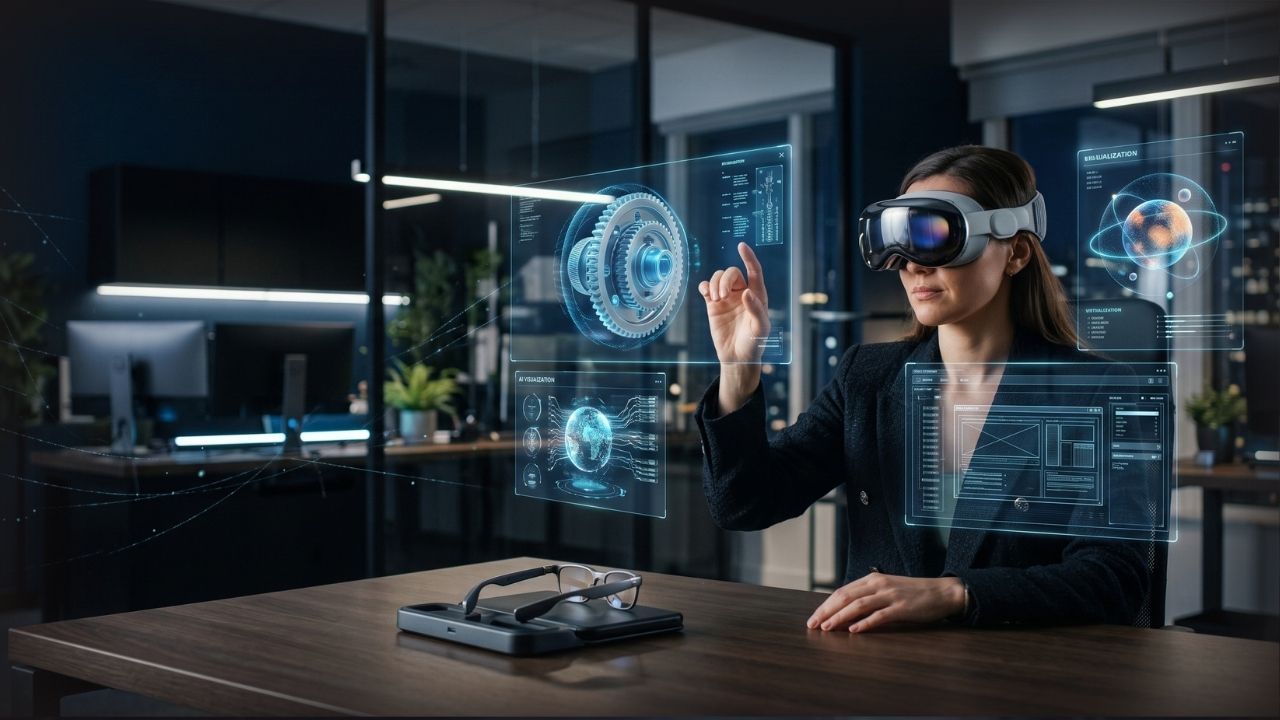
AR/VR is moving beyond its early reputation as technology mainly for gaming. In 2026, augmented reality and virtual reality are increasingly connected with spatial computing, artificial intelligence, smart glasses, education, engineering, workplace training and entertainment.
The hardware is also becoming more sophisticated. Meta continues developing its Quest ecosystem. Apple has pushed high-end spatial computing with Vision Pro. Google and Samsung are working around Android XR, Google’s platform for headsets and glasses. Qualcomm’s Snapdragon XR platforms provide computing hardware for many extended-reality devices.
The next challenge is less about proving AR/VR can work and more about making it comfortable, affordable and useful enough for people to wear regularly.
That distinction matters in Pakistan. Premium headsets can be expensive after exchange rates, taxes and importer margins are considered. Official availability and after-sales support can also differ from larger international markets. A headset that looks impressive in an overseas demonstration may therefore be a poor local purchase.
This guide examines 15 important AR/VR trends, real-world applications and future developments based on the state of technology through 2026.
What Is AR/VR?
AR/VR is a broad term covering augmented reality (AR) and virtual reality (VR).
Augmented reality overlays digital content onto a view of the real world. Virtual reality places the user inside a predominantly computer-generated environment. Mixed reality (MR) combines virtual content with spatial understanding of the physical environment.
Extended reality, or XR, is commonly used as an umbrella term covering these related immersive technologies.
AR/VR is used for gaming, education, simulation, industrial training, design, healthcare visualization, entertainment and remote collaboration. Future systems are likely to become increasingly connected with AI and smart glasses.
Key Takeaways
- AR adds digital information to a user’s view of the physical world.
- VR replaces most of that view with an immersive virtual environment.
- Mixed reality combines digital objects with spatially understood surroundings.
- Meta Quest represents the mainstream standalone VR/MR approach.
- Apple Vision Pro emphasizes premium spatial computing.
- Google and Samsung are developing around the Android XR ecosystem.
- Qualcomm Snapdragon XR chips are important hardware platforms for headsets and glasses.
- Future AI could make AR/VR interfaces more conversational and context-aware.
- Smart glasses could eventually become more practical for everyday AR than large headsets.
- Gaming remains important, but professional uses are growing.
- Education, engineering and industrial training are compelling non-gaming applications.
- Motion sickness, comfort, battery life and price remain significant barriers.
- AR/VR devices collect sensitive environmental and behavioural data, making privacy important.
- 5G can support some mobile immersive applications; AR/VR does not need to wait for 6G.
- Pakistan buyers should check application compatibility, warranty and local availability before importing expensive hardware.
Table of Contents
AR vs VR vs MR Comparison
| Technology | What it does | Typical hardware | Strong applications |
| AR | Adds digital information to the real world | Phones, tablets, glasses | Navigation, retail, assistance |
| VR | Creates an immersive virtual environment | Headsets | Gaming, simulation, training |
| MR | Places interactive digital objects within mapped physical space | Advanced headsets | Design, work, training |
| XR | Umbrella term for immersive technologies | Various devices | Broad category |
| Spatial computing | Computing interfaces positioned and manipulated in physical/3D space | Headsets and glasses | Productivity, design, entertainment |
These categories increasingly overlap, so manufacturers do not always use the terminology identically.
1. AR and VR Solve Different Problems
The easiest way to understand AR/VR is to separate the two technologies.
Augmented reality preserves your view of the physical world and places information over it. A navigation arrow, virtual piece of furniture or maintenance instruction can appear in context.
Virtual reality instead creates an immersive digital environment.
VR can therefore be ideal when the objective is immersion: simulations, games, virtual travel or training environments where real-world distractions should be reduced.
Modern mixed-reality headsets blur this distinction by using cameras to show the environment while placing digital objects inside it.
For additional technical background, Wikipedia provides accessible references for both augmented reality and virtual reality.
2. Spatial Computing Is Expanding the Idea of AR/VR
Spatial computing treats the space around the user as part of the computer interface.
Instead of arranging every application on a laptop display, users can position digital windows or three-dimensional objects within an environment.
Apple strongly popularized this language around Vision Pro. Meta’s Quest devices also offer mixed-reality capabilities, while other companies are developing related products.
The long-term significance is the possibility of moving beyond flat displays.
That does not mean laptops, phones and monitors are about to disappear. Physical keyboards, lightweight screens and conventional interfaces remain extremely efficient.
AR/VR needs to provide a better experience for a task—not merely a more futuristic one.
This is why spatial computing features among the broader technology trends to watch for 2027.
3. Future AI Will Make AR/VR More Context-Aware
AI could become one of the most important technologies behind the next generation of AR.
Cameras and microphones give a wearable system information about the user’s surroundings. Multimodal AI can potentially interpret those signals and respond through audio or visual overlays.
Imagine looking at unfamiliar equipment and asking, “How do I replace this filter?”
An AI assistant could identify the device, understand the spoken request and display relevant instructions in the user’s view.
Other possibilities include translation, object recognition, navigation and accessibility.
The development fits naturally with the shift toward future AI systems capable of understanding text, images, audio and video.
The trade-off is privacy. An AI system that can see and hear what surrounds you may handle extraordinarily sensitive information.
4. Smart Glasses Could Make AR More Practical
Large headsets are powerful but difficult to wear throughout an ordinary day.
Smart glasses offer a different route.
Some current products focus primarily on cameras, microphones, speakers and AI instead of sophisticated transparent AR displays. This reduces power consumption and weight.
True everyday AR glasses are considerably harder to engineer.
Manufacturers need to fit displays, optics, processing, wireless connectivity and batteries inside lightweight frames while controlling heat.
Display brightness is another challenge. Digital graphics must remain visible in varying environmental conditions without draining the battery too quickly.
The likely path is gradual: increasingly useful smart glasses first, followed by more capable visual AR as hardware improves.
5. Gaming Will Remain One of VR’s Strongest Markets
Gaming remains a natural use case because immersion has obvious entertainment value.
VR can provide motion-controlled interaction, spatial audio and a sense of physical presence that a conventional monitor cannot reproduce.
Standalone headsets have also reduced one major barrier: they do not always require an expensive gaming PC.
PC VR remains valuable for high-end graphics, simulations and enthusiasts, however.
Pakistani users interested in more traditional gaming hardware can compare gaming phones and laptops in Pakistan before deciding whether a VR system provides enough extra value.
Buyers should check the headset’s game library first. Powerful hardware is not useful if the applications you want are unavailable.
6. AR/VR Could Make Education More Visual
Immersive learning is one of the most appealing non-gaming applications.
A biology student could examine a three-dimensional model of an organ. Engineering students could inspect machinery virtually. History classes could explore reconstructed environments.
This can make spatial concepts easier to understand than static textbook images.
AR can be useful when students still need to see their real environment, while VR works well for complete simulations.
The limitations matter.
Schools need hardware, maintenance, suitable educational content and teachers trained to use the technology effectively. A headset cannot compensate for inaccurate learning material or poor teaching.
In Pakistan, mobile AR may be more accessible initially because students already use Android smartphones.
Students exploring complementary technologies can also review AI tools designed for students.
7. Workplace Training Is an Especially Strong VR Application
Some jobs are difficult, expensive or dangerous to practise in the real world.
VR lets organizations recreate scenarios without exposing trainees to the same physical risk.
Applications can include industrial safety, equipment operation, emergency procedures and technical training.
Training simulations also allow organizations to repeat identical scenarios and collect performance data.
AR serves a different role.
A field technician could see an instruction beside a component while still looking at the actual machine. Remote specialists could potentially guide someone through a repair.
These uses are valuable because the technology solves a specific business problem rather than simply creating novelty.
8. Healthcare Has Useful AR/VR Applications—but Needs Evidence
Immersive technologies have been researched and used in areas including professional medical training, rehabilitation and some therapeutic applications.
Three-dimensional visualization can also help medical professionals examine anatomical or imaging data.
But healthcare technology requires careful language.
A consumer headset is not automatically a medical device, and an AR/VR app should not be assumed to diagnose or treat a condition simply because it claims a health benefit.
Medical use needs appropriate clinical evidence and regulatory oversight.
In Pakistan, health-related device claims should be checked with qualified healthcare professionals and relevant authorities. The Drug Regulatory Authority of Pakistan is an appropriate official source for regulatory information concerning medical products within its remit.
9. Engineering and Product Design Could Become More Immersive
Designing a physical product usually involves converting three-dimensional ideas onto a two-dimensional display.
AR/VR can reduce that disconnect.
Engineers and designers can examine models at realistic scale, inspect components and collaborate around the same virtual object.
Automotive, architecture, manufacturing and construction applications are particularly intuitive.
A designer might walk around a virtual prototype before an expensive physical model is produced.
AR could then place a proposed product or structure inside a real environment for context.
The strongest professional applications will be those where avoiding one design mistake or reducing prototyping time offsets the hardware and software costs.
10. Remote Collaboration Could Move Beyond Video Calls
Video conferencing reduced the need to share a physical room, but participants remain represented in rectangular windows.
Immersive collaboration attempts to create a stronger sense of shared space.
Teams may interact around 3D designs, digital whiteboards or virtual work environments.
This has potential for engineering and design teams working across countries.
There are obstacles. Wearing a headset throughout an entire working day can be uncomfortable, and virtual collaboration requires more setup than opening a conventional video call.
Cloud infrastructure is important because shared immersive applications need synchronization and data processing.
Businesses can understand the foundations through our cloud computing guide for Pakistan.
11. 5G and Edge Computing Can Support Immersive Applications
AR/VR is often mentioned alongside 5G and future 6G networks.
The relationship is useful but frequently exaggerated.
A standalone VR headset can run applications locally and does not require cellular connectivity. Home systems can use Wi-Fi. PC VR can process content on a connected computer.
Network improvements become particularly interesting when computational work is offloaded to edge or cloud infrastructure.
A lightweight device might handle tracking locally while remote computing processes more demanding graphics or AI.
Lower latency and higher capacity can improve this model.
Future 6G may eventually enable more sophisticated experiences, but AR/VR does not need to wait for it. Our 6G technology explainer explains why mainstream 6G remains a longer-term development.
12. Better Displays, Optics and Chips Will Make Headsets More Comfortable
A headset is effectively a collection of difficult engineering compromises attached to your face.
Higher-resolution displays can improve visual clarity but require greater processing power. Faster processors generate heat. Larger batteries increase weight.
Optics determine how displays can be positioned and focused while influencing headset size.
Semiconductor improvements therefore matter enormously.
Qualcomm’s Snapdragon XR platforms are designed for extended-reality devices, combining processing with technologies relevant to tracking, graphics and connectivity.
Google’s Android XR platform extends the Android ecosystem toward headsets and glasses. That could eventually give developers a more familiar path to building immersive applications.
Samsung is an important hardware partner in that ecosystem.
Unlike smartphones from Samsung, Xiaomi, Oppo, Vivo, Realme, Infinix and Tecno, however, XR remains a much smaller consumer category in Pakistan.
13. Haptics Could Make Virtual Environments Feel More Physical
Modern VR provides convincing vision and sound, but touch remains comparatively limited.
Controllers can vibrate, while specialized accessories can create more sophisticated feedback.
Future haptic technology could help users feel resistance, texture or contact more convincingly.
That could be particularly useful for training.
A medical or technical simulator becomes more realistic if users receive physical feedback instead of interacting with weightless virtual objects.
Full-body haptic suits receive attention, but they add cost, complexity and setup.
As with humanoid robots, physical interaction is harder than purely digital simulation. Mechanical systems have to reproduce sensations safely and consistently.
The intersection between virtual environments and physical robotics is one reason humanoid robot development is relevant to XR research, training and teleoperation.
14. AR/VR Privacy Is More Complicated Than Smartphone Privacy
A headset can collect unusually sensitive information.
Depending on the device and enabled features, sensors can map rooms, track head and hand movements, analyze surrounding objects and capture audio or video.
Eye tracking can potentially produce additional behavioural information.
That makes permissions important.
Users should check what information stays on-device, what reaches the cloud, how long it is retained and whether third-party applications can access it.
Organizations using headsets at work need appropriate account management and data policies.
General security principles still apply: install updates, use strong authentication and download applications from trusted sources.
Our online cybersecurity guide covers useful protections for connected devices.
15. AR/VR in Pakistan Will Depend on Price and Practical Value
Pakistan presents different market conditions from the United States and other early-adopter countries.
Exchange rates make premium imported technology expensive. Official distribution may be limited, and replacement components can be difficult to find.
This gives mobile AR an important advantage.
Millions of users already own smartphones equipped with cameras, sensors and GPUs capable of basic augmented-reality experiences.
Android dominates many price-sensitive segments through manufacturers such as Samsung, Xiaomi, Realme, Oppo, Vivo, Infinix and Tecno. Qualcomm Snapdragon and MediaTek processors increasingly provide capable graphics and AI acceleration at lower price levels.
More advanced headsets are likely to appeal initially to gaming enthusiasts, universities, design professionals and businesses with specific training or visualization requirements.
General consumers should buy according to current applications rather than promises about a future “metaverse.”
AR/VR and Smartphones: What Pakistani Buyers Need to Know
You do not necessarily need a flagship smartphone for basic AR, but performance matters for demanding applications.
The processor affects graphics and computer vision. Cameras and sensors influence tracking. A quality AMOLED or other low-latency, high-refresh display can improve visual experiences on devices that use the phone screen directly.
Modern Android phones based on capable Snapdragon and MediaTek platforms can support various AR features, depending on software compatibility.
Google Play availability also matters because many applications are distributed through Google’s ecosystem.
Do not assume every Android handset supports every AR technology simply because it has a strong processor. Software certification and sensors matter too.
Our smartphone buying guide for Pakistan explains how to compare current devices, while the AMOLED vs LCD vs IPS guide explains display differences.
Step-by-Step Guide: How to Choose an AR/VR Headset
Buying on specifications alone is a mistake. Use this sequence instead.
- Decide what you want to do: gaming, productivity, development, simulation, fitness or professional design.
- Check the software library before comparing processor specifications.
- Decide whether you need standalone VR, PC connectivity, mixed reality or smart-glasses functionality.
- Check comfort factors including headset weight, fit, glasses support and adjustment range.
- Consider total cost, including controllers, straps, prescription inserts, PC hardware and software.
- Verify official regional support, warranty and replacement-part availability in Pakistan.
- Review privacy settings and account requirements before connecting sensitive workplace information.
If gaming is the priority and a PC is required, our gaming laptop guide for Pakistan can help with the conventional hardware side.
Pros and Cons of AR/VR
| Advantages | Limitations |
| Highly immersive experiences | Headsets can be uncomfortable |
| Powerful simulation and training | Premium hardware can be expensive |
| Better 3D visualization | Battery life is limited |
| New gaming experiences | Motion sickness affects some users |
| Useful remote assistance | Application libraries vary |
| Spatial design tools | Privacy concerns |
| Accessibility possibilities | Cameras and sensors collect sensitive data |
| Hands-on education | Institutions need suitable content |
| AI can provide contextual assistance | AI output can be incorrect |
The value of immersive technology depends heavily on the use case. A headset that transforms an engineering workflow may be worthwhile at a high price; the same product may provide little value to a casual consumer.
Buying Advice for Pakistan
Before importing an expensive AR/VR product, calculate the complete cost.
Include the headset, shipping, duties where applicable, controllers or accessories, prescription lenses if needed, and the cost of a compatible PC for tethered systems.
Check whether the manufacturer officially supports Pakistan. International warranty service can be difficult if a product needs to be shipped abroad.
For gaming, inspect actual titles rather than advertised graphics performance. For professional use, confirm that your specific application works on the headset and operating system.
For smart glasses, determine exactly what “AR” means. Some glasses primarily provide camera, audio and AI functions without projecting rich digital graphics across the wearer’s view.
Above all, buy for capabilities shipping now. Future software roadmaps can change.
Expert Tips for Better AR/VR Experiences
Start with short sessions when using VR for the first time, particularly if you are susceptible to motion sickness. Stop if you experience persistent nausea, dizziness or discomfort.
Maintain a safe physical play area and use boundary systems correctly. VR blocks or alters your view of physical obstacles.
Keep headset lenses away from direct sunlight when the manufacturer warns against it, as focused sunlight can damage some displays.
Clean facial interfaces according to manufacturer instructions, particularly when headsets are shared.
For businesses, test one real workflow before buying a large fleet. A small pilot reveals far more than an impressive promotional demonstration.
For a wider view of how immersive computing fits alongside AI, quantum computing, advanced batteries and robotics, read our analysis of future technology trends for 2027.
Summary Box: The Future of AR/VR
AR/VR is evolving into a broader spatial-computing ecosystem.
VR will remain particularly strong for immersive gaming, simulations and training. AR has greater potential for everyday use because it can add information without completely separating users from their surroundings.
AI could accelerate both categories by allowing devices to understand scenes, objects and natural-language requests.
Smart glasses may eventually become the most convenient form of consumer AR, but major technical challenges remain around displays, batteries, optics, heat and privacy.
For Pakistan, smartphone-based AR and professional applications are likely to be more accessible in the near term than expensive premium spatial-computing headsets.
FAQs
What does AR/VR mean?
AR/VR refers to augmented reality and virtual reality. AR adds digital information to a user’s view of the real world, while VR immerses the user in a mostly computer-generated environment.
What is the difference between AR and VR?
AR preserves the user’s view of the physical environment and adds digital elements. VR replaces most of the physical view with an immersive virtual world.
What is mixed reality?
Mixed reality blends digital objects with a spatial understanding of the physical environment, enabling virtual content to appear anchored to and interact with real-world spaces.
What is spatial computing?
Spatial computing describes digital interfaces and applications that operate within three-dimensional space instead of being limited to a conventional flat screen.
What can AR/VR be used for?
Major applications include gaming, education, engineering, simulation, industrial training, product design, healthcare visualization, fitness and collaborative work.
Does AR/VR require 5G?
No. Most current headsets can use Wi-Fi, local processing or a connected computer. 5G can be useful for some mobile and cloud-based immersive applications.
Does AR/VR need 6G?
No. Existing technologies already support AR and VR. Future 6G networks may enable more sophisticated connected experiences, but they are not required for current headsets.
Is AR/VR available in Pakistan?
Yes, although individual headset availability, official distribution and warranty support vary. Smartphone AR is particularly accessible because it can operate on compatible Android and iOS devices.
Which companies are developing AR/VR?
Important companies include Meta, Apple, Google, Samsung, Qualcomm and numerous software, optics and gaming companies.
What is Android XR?
Android XR is Google’s Android-based platform for extended-reality devices such as headsets and glasses. It is intended to support an ecosystem of XR applications and hardware.
Are AR/VR headsets safe?
They can be used safely when manufacturer guidance is followed, but users should consider motion sickness, physical obstacles, fit, eye comfort and session duration. Health concerns should be discussed with an appropriate healthcare professional.
Can AR/VR replace smartphones?
Not in the near term. Smart glasses may eventually handle more communication, navigation and AI tasks, but smartphones remain more convenient for many applications.
Is AR/VR useful for students?
Yes, where well-designed educational software adds meaningful visualization or simulation. The technology should supplement sound teaching rather than replace it.
Is an AR/VR headset worth buying in Pakistan?
It depends on your intended use, budget, software requirements and access to support. Enthusiast gaming and professional applications can justify the cost more easily than casual experimentation.
What is the future of AR/VR?
The likely direction is lighter hardware, improved displays, more natural hand and eye interaction, stronger AI integration, better mixed reality and increasingly capable smart glasses.
Conclusion
AR/VR is becoming more useful as the technology moves beyond the idea of simply placing a screen close to your eyes.
Virtual reality already provides compelling gaming, simulation and training experiences. Augmented and mixed reality have broader ambitions: placing useful digital information directly into the physical environment.
The next phase will depend on several technologies advancing together. Better Snapdragon XR-class processors can improve performance. More efficient displays and optics can reduce headset size. Future AI can understand what users see and hear. Edge and cloud computing can handle demanding workloads, while improved connectivity can make remote experiences more responsive.
The barriers are equally important. Headsets remain heavier and less socially convenient than phones. Battery life is finite, privacy risks are substantial, and premium hardware can be particularly expensive for Pakistani consumers.
For buyers in Pakistan, the best approach is practical: decide exactly what you want AR/VR to accomplish, check the software first, verify local support and calculate the complete ownership cost.
The future of AR/VR will not be determined by how futuristic a headset looks. It will be determined by whether wearing one solves a real problem better than the phone, laptop or display people already have.