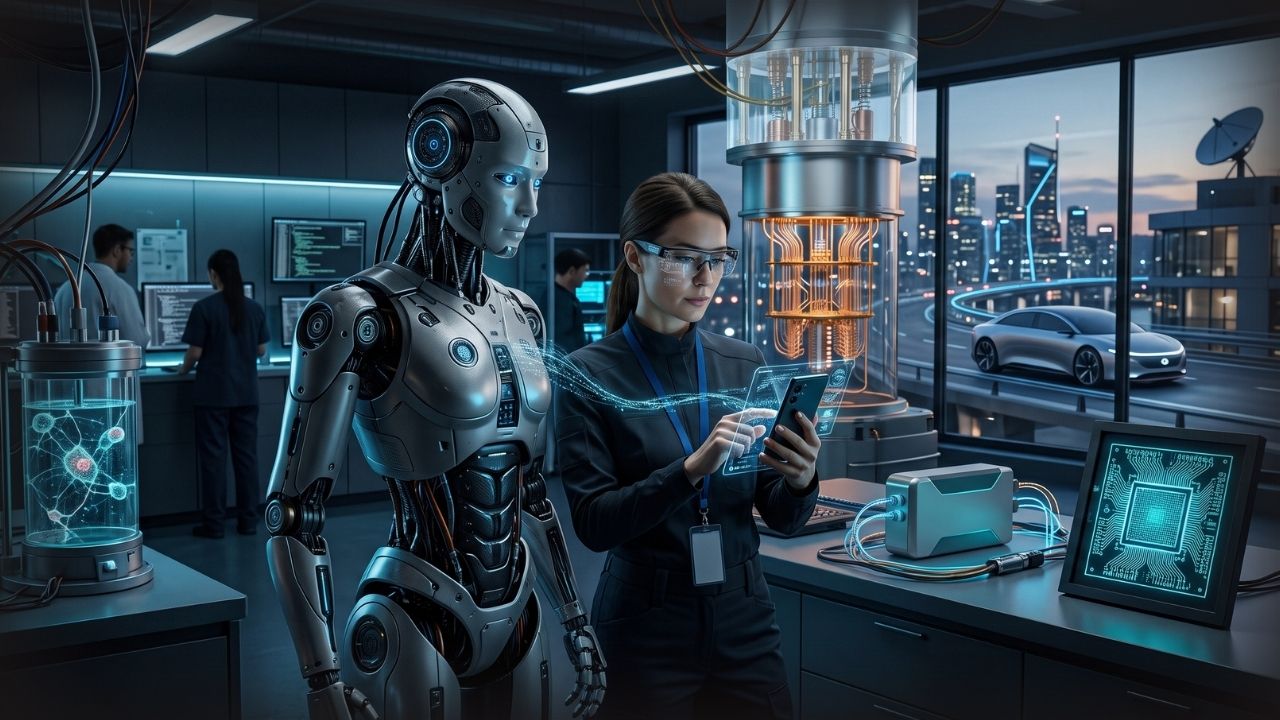
Technology in 2026 is moving beyond faster processors and better smartphones. Artificial intelligence is becoming part of operating systems and everyday software, robots are learning to work in human environments, satellite connectivity is expanding, and companies are investing heavily in technologies such as quantum computing, spatial computing and next-generation batteries.
For people in Pakistan, some changes will arrive much sooner than others. More capable AI smartphones, smarter software, cloud AI, improved cybersecurity tools and efficient chips can have an immediate impact. Technologies such as commercial 6G networks and large-scale fault-tolerant quantum computers remain longer-term developments.
That distinction matters. Technology forecasts often mix products that consumers can buy today with laboratory prototypes, industry trials and research roadmaps.
This guide examines 15 future technology trends worth watching as we move from 2026 into 2027. It explains what each technology does, how mature it is, what could happen next, and why it matters to consumers, students, professionals and businesses in Pakistan.
What Are the Biggest Future Technology Trends?
The most important future technology trends heading into 2027 include increasingly autonomous AI agents, on-device and multimodal AI, humanoid robots, AI-native computing devices, spatial computing, satellite-to-phone connectivity, early 6G research, quantum computing, post-quantum security, solid-state and alternative battery technologies, autonomous systems, smart glasses, edge AI, advanced semiconductor architectures and AI-powered biotechnology.
AI is likely to create the most visible short-term changes because it is already being integrated into smartphones, PCs, cloud services and business software.
Humanoid robotics, quantum computing, 6G and solid-state batteries have enormous potential, but adoption timelines remain less certain.
Key Takeaways
- AI agents are evolving from chat interfaces toward systems capable of completing multi-step tasks using software and external tools.
- On-device AI will become increasingly important in smartphones and computers because it can reduce cloud dependence, latency and some privacy risks.
- Humanoid robots are progressing rapidly, although widespread household adoption is not yet guaranteed.
- 6G is primarily a research and standardization story in 2026, not a reason to delay buying a good 4G or 5G smartphone.
- Quantum computers are advancing, but conventional computers will remain dominant for everyday computing.
- Post-quantum cryptography matters now because security migrations can take years.
- Solid-state batteries could improve safety and energy density, but large-scale affordable manufacturing remains the central challenge.
- Smart glasses and spatial computing may eventually complement smartphones rather than abruptly replace them.
- Satellite-to-device technology can improve connectivity outside conventional cellular coverage.
- Pakistan’s most immediate opportunities are likely to come from AI, cloud computing, cybersecurity, digital services, efficient mobile hardware and improved connectivity.
- Buyers should purchase devices for capabilities available today rather than paying heavily for speculative future features.
Table of Contents
Future Technology Trends Compared
| Technology | Status in 2026 | Likely near-term impact | Main limitation |
| AI agents | Commercial and rapidly developing | Very high | Reliability and security |
| On-device AI | Already shipping | Very high | Hardware and memory requirements |
| Humanoid robots | Pilots and early deployment | Medium | Cost and reliability |
| AI PCs/phones | Commercial | Very high | Inconsistent usefulness |
| AR/VR | Commercial | Medium | Cost, comfort and content |
| Satellite-to-phone | Early commercial rollout | Medium-high | Capacity and device/network support |
| 6G | Research/standardization | Long term | Deployment is years away |
| Quantum computing | Research and specialized systems | Medium long term | Error correction and scaling |
| Post-quantum cryptography | Deployment beginning | High | Migration complexity |
| Solid-state batteries | Development/early commercialization | Medium long term | Manufacturing scale |
| Autonomous systems | Commercial in limited environments | High | Safety and regulation |
| Smart glasses | Commercial/early stage | Medium | Battery, privacy and interface |
| Edge AI | Commercial | High | Compute and thermal limits |
| Advanced semiconductors | Commercial and developing | Very high | Cost and manufacturing complexity |
| AI biotechnology | Rapidly developing | High in specialist fields | Validation, safety and regulation |
1. AI Agents Will Move Beyond Simple Chatbots
Artificial intelligence has already changed internet search, writing, coding, image generation and productivity software. The next important transition is from AI that primarily answers questions to AI systems capable of taking actions.
An AI agent can interpret a goal, determine a series of tasks, use software or digital tools and attempt to complete the workflow.
Instead of asking an assistant how to organize a trip, for example, future agentic systems may compare transport, evaluate hotels, build an itinerary and prepare reservations for approval.
This difference sounds small but changes the role of AI considerably.
What Is an AI Agent?
An AI agent is software designed to reason about an objective and perform one or more actions toward achieving it, often by interacting with tools, applications, databases or other services.
Major technology companies and AI developers are investing in this model. Google is integrating increasingly sophisticated AI capabilities across its ecosystem, while enterprise software providers are developing agents designed for coding, customer support, analysis and business automation.
You can see the broader direction in our guide to how AI agents are changing work.
What Changes in 2027?
Expect AI agents to become more capable inside browsers, office software, programming environments and enterprise applications.
Promising applications include:
- Researching and summarizing information
- Scheduling meetings
- Managing routine business processes
- Writing and testing software
- Processing documents
- Customer support
- Data analysis
- Shopping and product comparison
- Personal productivity
However, autonomous does not mean infallible.
AI models can misunderstand instructions, produce false information and make incorrect decisions. Giving an agent permission to send emails, purchase products or access company systems introduces security risks beyond those associated with a conventional chatbot.
High-impact actions should therefore remain subject to human confirmation.
For Pakistani students and professionals wanting to explore the current generation before paying for expensive subscriptions, these AI tools available to students provide a useful starting point.
2. On-Device and Multimodal AI Will Become Standard
Future AI will not live exclusively in enormous cloud data centres.
Increasingly powerful neural processing units, or NPUs, allow phones and laptops to run parts of AI workloads locally.
Qualcomm Snapdragon platforms, MediaTek Dimensity chips, Apple silicon and processors used in modern Android hardware increasingly dedicate silicon to machine-learning operations.
This enables a hybrid model.
Simple or privacy-sensitive operations can run on a device, while demanding requests can still be sent to more powerful cloud models.
Why On-Device AI Matters
Local processing can provide four important advantages.
First is latency. A device does not necessarily need to wait for an internet request.
Second is privacy. Some information can potentially remain on the hardware rather than being uploaded for processing.
Third is availability. Certain features may work without continuous connectivity.
Fourth is cost and efficiency. Not every AI operation needs expensive cloud inference.
These advantages are particularly interesting in Pakistan, where connection quality and mobile data availability vary by location.
Multimodal AI Is Equally Important
Multimodal models can process several types of information such as text, images, speech, video and sometimes sensor data.
This could make digital assistants much more useful.
A future assistant might inspect what your smartphone camera sees, listen to a question, read an instruction manual and provide contextual guidance through audio or a display.
Consumers should nevertheless inspect privacy controls carefully. “On-device AI” does not automatically mean every associated function is processed locally.
Check the manufacturer’s documentation to determine which information goes to the cloud.
3. Humanoid Robots Are Becoming a Serious Industry
For decades, humanoid robots were mostly demonstrations, research projects and science-fiction concepts.
That is changing.
Companies including Tesla, Figure AI, Boston Dynamics and several Chinese robotics manufacturers are developing machines designed to perform tasks in environments originally built for people.
The human-like form has a practical advantage: factories, warehouses, stairs, doors, shelves and tools were designed around human bodies.
Instead of rebuilding an environment around a specialized machine, a general-purpose robot may eventually operate within the existing one.
Where Will Humanoid Robots Be Used First?
Factories and warehouses are more plausible early markets than ordinary homes.
Industrial environments usually offer:
- Repetitive jobs
- Controlled conditions
- Predictable routes
- Measurable economic returns
- Professional maintenance
- Clearly defined tasks
Households are much harder.
A home contains children, pets, delicate objects, stairs, changing environments and unpredictable requests. A useful domestic humanoid must combine sophisticated perception, safe movement, reliable manipulation and common-sense reasoning at an acceptable price.
That remains a formidable engineering problem.
AI Is Accelerating Robotics
Modern AI helps robots interpret images, language and demonstrations.
Instead of explicitly programming every possible action, developers are exploring models capable of translating instructions such as “place the blue container on the middle shelf” into robotic actions.
Still, compelling demonstration videos should not be confused with reliable general autonomy.
Watch repeatability, real-world deployment numbers and safety performance rather than individual demonstrations.
4. Smartphones and PCs Will Become AI-Native
AI is increasingly becoming part of the operating system rather than another standalone application.
Google is integrating Gemini functionality across Android and its services. Apple continues developing intelligence capabilities throughout its devices and software, while Samsung has made Galaxy AI a prominent element of recent Galaxy products.
Qualcomm, MediaTek and PC chip companies are similarly developing hardware capable of accelerating local AI models.
This makes AI one of the defining future technology trends for consumer electronics.
What Does an AI-Native Phone Actually Do?
Useful AI functionality can include:
- Call and text translation
- Voice transcription
- Image editing
- Search using images or natural language
- Summarizing documents
- Spam detection
- Writing assistance
- Photo organization
- Accessibility features
- Contextual digital assistance
The next stage will involve deeper interaction between assistants and apps.
Android users should follow official Android documentation and Google’s official AI information for platform-level changes rather than relying exclusively on rumours.
Do You Need an “AI Phone”?
Not necessarily.
Core phone quality still matters more: battery endurance, modem performance, display quality, cameras, software support, storage and repairability.
A mid-range Samsung, Xiaomi, Oppo, Vivo, Realme, Infinix or Tecno phone that meets your everyday requirements can represent better value than an expensive flagship purchased only for AI features.
Our smartphone buying guide for Pakistan explains the practical factors worth considering.
Display technology also remains relevant. If terms such as AMOLED, IPS and LCD are confusing, see our AMOLED vs LCD vs IPS explanation.
5. Spatial Computing, AR and VR Will Keep Evolving
Virtual reality replaces most of the user’s visual environment with digital content. Augmented reality overlays digital information onto the physical world. Mixed reality combines virtual content with an understanding of physical surroundings.
“Spatial computing” is a broader description for interfaces in which digital applications and content operate in three-dimensional space.
Apple’s Vision Pro brought substantial mainstream attention to this category, while Meta has continued developing Quest hardware and software. Other technology companies are working on headsets and glasses that combine AI with AR.
Why Spatial Computing Matters
Traditional computing is based around rectangular screens.
Spatial computing asks whether digital interfaces can become part of our surroundings.
Potential applications extend beyond entertainment:
- Engineering
- Medical visualization
- Architecture
- Remote collaboration
- Education
- Training simulations
- Product design
- Virtual tourism
- Gaming
Imagine an engineering student examining a three-dimensional engine instead of a textbook drawing, or a technician receiving repair instructions overlaid on equipment.
What Is Holding AR and VR Back?
Headsets still have weaknesses.
Price is one. Comfort is another. Battery life, motion sickness, field of view, application availability and social acceptability all influence adoption.
For Pakistan, imported high-end headsets can also be difficult to justify because currency conversion and retail availability can substantially affect the final cost.
The technology is promising, but smartphones and laptops are not about to disappear simply because spatial computers exist.
6. Satellite-to-Phone Connectivity Could Reduce Dead Zones
A smartphone normally talks to a nearby terrestrial cell tower. Satellite-to-device systems extend this model by enabling compatible phones to communicate with satellites under supported conditions.
Apple has already offered satellite-based emergency features on supported devices and in supported markets. Meanwhile, mobile operators, satellite companies and semiconductor manufacturers are developing broader direct-to-device capabilities.
The potential is significant.
People travelling through remote areas could obtain at least limited communication where traditional cellular infrastructure is unavailable.
Why This Matters for Pakistan
Pakistan contains mountainous regions, deserts and sparsely populated territories where conventional network coverage can be challenging.
Satellite communication could eventually provide valuable redundancy for:
- Emergency communication
- Disaster response
- Remote travel
- Agriculture
- Logistics
- Rural connectivity
But consumers should distinguish emergency messaging from full mobile broadband.
Satellite capacity, spectrum, handset compatibility, regulatory approval and network partnerships all affect what is possible.
The GSMA is a useful source for developments involving mobile networks and non-terrestrial connectivity, while Pakistan-specific spectrum and telecommunications information should be checked through the Pakistan Telecommunication Authority.
Do not buy a handset on the assumption that an advertised satellite feature will automatically work in Pakistan. Regional availability matters.
7. 6G Is Coming, but It Is Not a Consumer Network Yet
6G generates attention because every cellular generation promises substantially new capabilities.
However, the most useful fact for smartphone buyers in 2026 is simple:
6G is not currently a mainstream commercial mobile network.
Industry groups, equipment companies, researchers and standards organizations are working toward technologies that could form the next generation of wireless communications. Commercial deployment is generally associated with the period around 2030 rather than an immediate 2026 or 2027 replacement for 5G.
What Could 6G Offer?
Research directions commonly associated with 6G include:
- Extremely high network capacity
- Lower latency
- AI-assisted network management
- Better integration of communications and sensing
- Advanced non-terrestrial networks
- Massive numbers of connected devices
- New industrial applications
Some research also examines higher-frequency spectrum, which could provide enormous bandwidth but creates propagation and coverage challenges.
Should Pakistanis Wait for 6G Before Buying a Phone?
No.
A smartphone is normally replaced far sooner than a new cellular generation is researched, standardized and widely deployed.
Buy for the networks and capabilities you can actually use.
For current purchase decisions, our guide to 5G phones in Pakistan is more useful than attempting to future-proof a handset for 6G.
The most reliable long-term technical information will come from bodies such as the International Telecommunication Union and 3GPP, which develops specifications underlying cellular standards.
8. Quantum Computing Will Advance, but It Will Not Replace Your Laptop
Quantum computing is one of the most misunderstood future technologies.
A traditional computer stores information using bits represented as 0 or 1. Quantum computers operate using quantum bits, or qubits, whose behaviour draws on quantum-mechanical effects.
This does not mean a quantum computer is simply an incredibly fast PC.
Quantum computers are designed to offer advantages for particular classes of problems.
Where Could Quantum Computers Help?
Potential fields include:
- Molecular simulation
- Materials research
- Optimization
- Scientific modelling
- Cryptography research
- Chemistry
- Drug discovery
Companies such as IBM, Google and Microsoft are pursuing different strategies, alongside universities, startups and government research programmes.
The Central Problem: Errors
Qubits are fragile.
Environmental noise can disrupt quantum states, making error detection and correction fundamental engineering challenges.
The important race is therefore not simply “who has the most qubits?” A practical system needs sufficiently high-quality operations and techniques for generating useful logical qubits from error-prone physical hardware.
Research progress is real, but timelines for broadly useful fault-tolerant quantum computing remain uncertain.
Your Snapdragon or MediaTek smartphone will not be replaced by a pocket quantum computer in 2027.
Quantum computing will more likely function as specialized infrastructure accessed through research facilities or cloud services.
For readers wanting background on that model, our cloud computing guide for Pakistan explains how remote computing infrastructure is already delivered today.
9. Post-Quantum Cybersecurity Is Becoming Urgent
Quantum computing may sound distant, but security teams cannot wait until a cryptographically relevant quantum computer exists before preparing.
Current public-key cryptography underpins secure websites, software, communications and identity systems. Sufficiently capable future quantum machines could threaten widely used mathematical schemes.
Post-quantum cryptography, or PQC, uses algorithms designed to remain secure against known attacks by both classical and quantum computers.
Why Migration Is Starting Early
Cryptographic infrastructure changes slowly.
A bank, government department or global cloud provider cannot swap every security system overnight.
Another consideration is sometimes described as “harvest now, decrypt later”: an attacker can potentially collect encrypted information today in the hope that future capabilities make it decryptable.
In 2024, the U.S. National Institute of Standards and Technology finalized its first principal post-quantum cryptography standards, marking an important transition from research toward deployment.
Readers interested in the technical standards can consult NIST’s official post-quantum cryptography project.
What Should Ordinary Users Do?
Consumers do not need to manually implement quantum-safe encryption.
Instead:
- Keep operating systems updated.
- Install security patches.
- Use supported devices.
- Enable strong authentication.
- Avoid unsupported software.
- Let reputable operating-system, browser and cloud providers handle cryptographic migrations.
For practical protection today, our cybersecurity tips for staying safe online address risks that are far more immediate than quantum attacks.
10. Solid-State and Next-Generation Batteries Could Transform Devices
Battery technology determines how far electric vehicles travel, how long phones last and how effectively renewable electricity can be stored.
Conventional lithium-ion batteries rely on liquid or gel electrolytes. Solid-state batteries replace this with solid electrolyte materials.
In principle, this can unlock improvements in energy density and potentially safety, but real products depend heavily on the specific chemistry and engineering implementation.
Why Solid-State Batteries Are Exciting
Potential benefits include:
- More energy stored for a given size or weight
- Improved safety characteristics
- Faster charging possibilities
- Better electric-vehicle range
- New device designs
Manufacturers and battery companies are investing substantially in development.
But there is a large difference between an impressive laboratory cell and millions of affordable battery packs leaving factories with good manufacturing yields.
Interfaces between materials, cycle life, manufacturing methods, cost and scaling remain important technical challenges.
Will Smartphones Suddenly Get Week-Long Batteries?
Do not count on it.
Manufacturers can use higher energy density in several ways. A company might increase runtime, but it could instead make a device thinner or power more demanding hardware.
Meanwhile, silicon-carbon anode technology and improved lithium-ion designs are already contributing to higher-capacity batteries in some phones.
If endurance matters more than experimental chemistry, choose a phone based on measured real-world runtime. Our best battery phones in Pakistan guide focuses on current products rather than future promises.
11. Autonomous Vehicles and Machines Will Expand Gradually
Self-driving technology has spent years at the centre of ambitious predictions.
Progress exists, but the industry has also demonstrated why autonomy is hard.
A system must understand road markings, pedestrians, cyclists, weather, emergency vehicles, unpredictable drivers, construction and unusual objects—all with extremely high reliability.
There is also an important distinction between driver assistance and genuine autonomous driving.
Automation Has Different Levels
Many consumer vehicles offer advanced driver-assistance systems rather than unrestricted self-driving capability.
Features may include adaptive cruise control, lane centring and automatic emergency braking, yet still require the driver to supervise.
Highly automated services can be easier to deploy in limited geographical areas that are carefully mapped and supported.
Beyond Cars
Some of autonomy’s strongest near-term applications may appear outside private cars:
- Warehouse robots
- Mining equipment
- Agricultural machines
- Delivery platforms
- Industrial inspection
- Drones
- Ports and logistics centres
A controlled warehouse is easier for autonomous equipment to understand than an unpredictable city street.
For Pakistan, automation may consequently arrive through industry and logistics before fully autonomous private vehicles become commonplace.
12. Smart Glasses May Become the Next Major Computing Interface
Smart glasses sit somewhere between ordinary eyewear, headphones, cameras and augmented-reality headsets.
Some current glasses focus on cameras, audio and AI instead of placing sophisticated holographic graphics across the user’s entire view.
That approach has an advantage: it can produce lighter products with better battery life.
AI Changes What Smart Glasses Can Do
The combination of cameras, microphones and multimodal AI could allow glasses to understand the user’s surroundings.
Possible functions include:
- Translation
- Navigation
- Object identification
- Photography
- Voice assistance
- Accessibility tools
- Notifications
- Contextual search
The ambitious long-term goal is convincing augmented reality in ordinary-looking glasses.
Achieving that demands small displays, efficient processors, precise optics, lightweight batteries and careful thermal management.
Privacy Could Determine Adoption
A wearable camera creates obvious social concerns.
People need to understand when recording is occurring, what information is uploaded and how it is stored. Manufacturers will need visible indicators and understandable privacy controls.
The smartest wearable will not necessarily win. The one people feel comfortable wearing around other people may have the better chance.
13. Edge AI Will Put Intelligence Closer to Users
Cloud computing made enormous computing resources accessible over the internet.
Edge computing pushes some computation in the opposite direction: closer to where information originates.
That can mean a smartphone, vehicle, factory computer, security camera or local network server.
Edge AI combines local computing with machine learning.
Why Process AI at the Edge?
Consider a factory safety system.
If every camera frame must travel to a distant data centre and back before a dangerous situation can be detected, network delay becomes a liability.
Local processing can react more quickly.
Other applications include:
- Smart manufacturing
- Traffic management
- Retail
- Agriculture
- Healthcare equipment
- Vehicles
- Mobile devices
- Security systems
Privacy can also improve when sensitive raw information does not need to leave its source, although the actual benefit depends on system design.
Cloud and Edge Are Complementary
Edge AI does not eliminate cloud computing.
Cloud systems remain valuable for training large models, storing information and running computationally intensive workloads. Edge devices are useful for fast, localized inference.
The future will often be hybrid.
Businesses exploring this transition should understand the fundamentals of cloud computing for businesses before deciding where workloads belong.
14. Advanced Semiconductor Technology Will Power Almost Every Other Trend
The glamorous AI model gets attention, but it ultimately runs on physical hardware.
Semiconductor innovation therefore sits beneath almost every trend in this guide.
Apple, Qualcomm, MediaTek, NVIDIA, AMD, Intel and other chip companies compete on performance and efficiency, while manufacturers such as TSMC and Samsung Electronics play major roles in advanced semiconductor fabrication.
Chip Progress Is About More Than Smaller Transistors
Modern semiconductor development increasingly combines several strategies:
- Advanced process nodes
- Chiplets
- 3D packaging
- Specialized accelerators
- Faster memory
- Improved interconnects
- Better power management
- Dedicated neural processors
Chiplets are particularly interesting.
Instead of fabricating every component as one enormous piece of silicon, engineers can combine smaller specialized dies in an advanced package.
This can offer design and manufacturing advantages.
AI Is Reshaping Consumer Chips
Smartphone SoCs already combine CPUs, GPUs, image signal processors, modems and AI accelerators.
That integration explains why the Snapdragon or MediaTek model inside a phone can affect much more than benchmark scores. It can influence camera processing, connectivity, gaming, power efficiency and AI capabilities.
Future buying decisions may increasingly consider NPU performance alongside CPU and GPU performance.
Consumers should still prioritize actual applications over large “TOPS” figures. AI performance measurements are not always directly comparable across different hardware architectures and workloads.
15. AI, Biotechnology and Digital Health Will Increasingly Converge
Some of the most consequential future technology may not appear in a gadget shop.
AI is being applied to biology, medicine and pharmaceutical research, including protein analysis, medical imaging, drug discovery and clinical data.
DeepMind’s AlphaFold work demonstrated how machine learning could make major contributions to predicting protein structures, illustrating the potential of computational techniques in biological research.
Potential Applications
AI could assist researchers and clinicians with:
- Drug candidate discovery
- Protein and molecular analysis
- Medical-image interpretation
- Clinical documentation
- Disease research
- Genomic analysis
- Patient monitoring
- Personalized treatment research
Wearables are also collecting increasing quantities of physiological information.
Apple, Samsung and other manufacturers already incorporate heart-rate, sleep, activity and other health-related features into consumer devices.
Medical AI Needs a Higher Standard of Evidence
Healthcare is an area where incorrect output can cause serious harm.
An AI model producing a wrong restaurant recommendation is inconvenient. A system producing an unreliable medical recommendation has very different consequences.
Medical technology needs clinical validation, appropriate regulation, qualified professional oversight and strong privacy protection.
Consumer wearables should not automatically be treated as diagnostic medical equipment. Users should read manufacturers’ health disclaimers and consult qualified healthcare professionals for diagnosis and treatment.
Future AI: What Changes Most Between 2026 and 2027?
The biggest change will probably not be a single “super AI” release.
It will be AI disappearing into ordinary software.
AI features are moving into operating systems, Google services, productivity applications, Samsung Galaxy devices, Apple products, Android smartphones and cloud platforms.
That will make AI less visible as a separate product and more significant as infrastructure.
People will increasingly expect software to understand natural-language instructions, search personal information with permission, summarize documents and automate routine workflows.
The same transition occurred with internet connectivity: “internet-enabled” eventually stopped being a special category because connectivity became expected.
AI could follow a similar path.
For an overview of tools already useful locally, see our best AI tools for Pakistan.
Future Technology Trends in Pakistan
Pakistan will not experience every global trend at the same speed.
Consumer affordability, electricity reliability, telecommunications infrastructure, regulation, import policies, local availability and exchange rates influence adoption.
This creates a different technology landscape from markets such as the United States, China or South Korea.
AI Could Have the Fastest Local Impact
AI requires comparatively little new consumer infrastructure because many services run through existing phones, browsers and cloud platforms.
Students can use AI for research assistance and programming. Freelancers can use it for productivity, provided they verify outputs. Small businesses can automate routine support and document work.
Pakistan’s technology workforce can also participate in the global AI economy without waiting for advanced physical infrastructure.
Connectivity Remains Fundamental
AI applications, cloud platforms and digital businesses depend on dependable connectivity.
5G development therefore has a more immediate practical relationship with Pakistan’s future digital economy than speculative 6G hardware.
For authoritative local updates about spectrum, licensing and telecommunications regulation, consumers should consult PTA announcements rather than social-media rumours.
Affordable Android Devices Will Remain Important
Pakistan is a price-sensitive smartphone market.
Brands including Samsung, Xiaomi, Oppo, Vivo, Realme, Infinix and Tecno compete across various Android price segments.
Consequently, one of the most important technology developments will be AI functionality moving from flagship Snapdragon and premium MediaTek-powered devices into affordable hardware.
A feature that exists only on a very expensive flagship has limited population-wide impact. Once comparable capabilities reach mass-market devices, adoption can become much larger.
Readers comparing currently available options can use our best smartphones in Pakistan as a practical companion to these longer-term predictions.
Which Technologies Will Arrive First?
Forecasts become more useful when technologies are separated by maturity.
Available Now and Expanding
AI assistants, generative AI, AI-powered smartphones, cloud computing, edge AI, VR headsets, smart glasses, advanced driver-assistance systems and specialized AI chips already exist commercially.
The question is no longer whether they exist but how capable, affordable and widespread they become.
Emerging but Not Yet Universal
Satellite-to-phone services, more autonomous AI agents, advanced humanoid robots and some next-generation battery technologies are moving from development into increasingly practical uses.
These areas could advance quickly, but adoption will differ considerably between countries.
Longer-Term Technologies
Mass-market 6G, large-scale fault-tolerant quantum computing and universally capable household humanoid robots should be treated as longer-term possibilities.
Their long-term potential does not make them fictional. It simply means their development should not be confused with immediate consumer availability.
Step-by-Step Guide: How to Evaluate a Future Technology Claim
Technology predictions can sound convincing even when the underlying evidence is weak. Use this five-step process before believing an announcement.
Step 1: Identify the Source
Start with the original source rather than a social-media screenshot.
Was the announcement made by Google, Apple, Samsung, Qualcomm, MediaTek, a university, government agency or standards body?
Primary sources do not guarantee a prediction will prove correct, but they reduce misquotation.
Step 2: Determine What Was Actually Demonstrated
Ask whether you are seeing:
- Research
- A prototype
- A controlled demonstration
- A developer product
- A limited pilot
- A commercially shipping product
These are very different stages.
Step 3: Check Availability
A product “launch” may still have limited access.
Find the release date, supported countries, device requirements and pricing.
This is particularly important in Pakistan, where international features can have delayed or restricted availability.
Step 4: Look for Independent Evidence
Manufacturer demonstrations show what a company wants the technology to do.
Independent testing helps reveal what it actually does in normal circumstances.
Look for repeatable measurements rather than viral clips.
Step 5: Separate Potential From Present Capability
A technology can have enormous future potential without being a good purchase today.
Ask one practical question:
“What useful task can this product reliably perform for me right now?”
That prevents future promises from dominating sensible buying decisions.
Pros and Cons of Rapid Future Technology Development
| Pros | Cons |
| Higher productivity through AI automation | Job roles may change or disappear |
| Improved accessibility technology | New privacy concerns |
| Faster scientific discovery | AI errors can scale quickly |
| Better connectivity | Infrastructure costs remain high |
| More efficient devices | Advanced hardware can be expensive |
| Medical research opportunities | Sensitive health data needs protection |
| Cleaner transportation possibilities | Battery supply chains have environmental impacts |
| More capable robots | Safety and accountability challenges |
| Powerful cybersecurity tools | Attackers also gain better tools |
| Personalized digital services | Greater potential for surveillance |
Progress should therefore be judged by outcomes rather than novelty alone.
Buying Advice: Should You Future-Proof Your Technology Purchases?
Consumers frequently overpay for “future-proof” products.
True future-proofing is almost impossible because software requirements, connectivity standards and device capabilities evolve unpredictably.
A better strategy is to purchase a product that comfortably meets your needs today while offering enough support for the expected ownership period.
When Buying a Smartphone
Prioritize:
- Long software and security support
- Reliable battery endurance
- Sufficient RAM and storage
- Good network compatibility
- A quality display
- Camera performance relevant to your needs
- Local warranty and repair options
- A modern, efficient chipset
AI features can be useful, but determine whether they are processed on-device or require cloud connectivity and whether specific features are available in Pakistan.
Google Play support also matters greatly for Android buyers. Imported or unusual devices may have compatibility issues that are far more important than headline specifications.
When Buying a Laptop
For students and professionals, prioritize CPU performance, battery life, RAM, storage, display quality and after-sales support before worrying about experimental AI capabilities.
An NPU can help with compatible local AI workloads, but the software ecosystem matters as much as the advertised hardware figure.
See our laptop buying guide for Pakistan for current purchasing considerations.
When Buying Wearables
Treat AI features as a bonus rather than the entire reason for buying.
Comfort, battery life, smartphone compatibility, sensor quality and long-term software support determine whether a wearable stays useful after the novelty disappears.
Expert Tips for Preparing for Future Technology
You do not need to predict exactly which company or technology will dominate. Preparing for broad changes is more useful.
- Learn how to use AI tools, but also learn how to verify their outputs. Critical thinking becomes more valuable as generated information becomes more common.
- Develop transferable skills. Programming, cybersecurity, data analysis, communication and domain expertise will survive individual product cycles better than knowledge of a single application.
- Update devices regularly. Many future security improvements, including changes in cryptography, will arrive through software.
- Protect your accounts with strong authentication and unique passwords. Future technology does not eliminate basic cybersecurity.
- Check Pakistan availability before paying for an internationally advertised feature.
- Treat demonstrations as evidence of possibility, not proof of reliable mass-market performance.
- Follow primary sources such as manufacturers, standards organizations, regulators and government agencies.
- Avoid buying products purely because of “AI,” “6G-ready,” “quantum” or similar marketing labels. Demand a clear explanation of the actual benefit.
What Technology Trends Should Students in Pakistan Learn About?
Students do not need expert-level knowledge of all 15 technologies.
AI literacy should be the first priority because it is already influencing research, software development, design, writing, marketing and data analysis.
Cloud computing is similarly useful because modern applications increasingly rely on AWS, Microsoft Azure and Google Cloud infrastructure.
Cybersecurity is another durable field. As more economic activity becomes digital, authentication, network security, application security and privacy become more important.
Semiconductor engineering, robotics and biotechnology require more specialized pathways but may offer major opportunities for students with suitable engineering and scientific backgrounds.
Understanding fundamentals is more valuable than chasing whatever tool happens to be popular this month.
The Technologies That Deserve More Skepticism
Being optimistic about innovation does not require accepting every forecast.
Three areas deserve particularly careful interpretation.
Consumer 6G Claims
Anything marketed to ordinary buyers as essential “6G technology” in 2026 should be examined carefully because commercial 6G networks are not yet the normal consumer reality.
General-Purpose Household Robots
Humanoid robotics is progressing, but performing selected warehouse tasks is significantly easier than safely and reliably completing arbitrary household chores.
Quantum Consumer Products
Quantum computing is serious scientific research, but consumers should be skeptical of ordinary products using “quantum” as a marketing term without explaining what quantum technology is actually involved.
Clear definitions are one of the best defenses against technology hype.
Summary Box: The 15 Future Technology Trends
The technology landscape heading toward 2027 can be summarized simply.
AI agents will make software more action-oriented. Multimodal and on-device AI will make smartphones and PCs more context-aware. Humanoid robots will continue moving into structured industrial pilots. Spatial computing and smart glasses will experiment with alternatives to conventional displays.
Satellite connectivity will supplement terrestrial networks, while 6G research will lay groundwork for the next decade rather than replace today’s networks immediately.
Quantum computing will continue its difficult transition toward useful error-corrected systems, and post-quantum security will become increasingly important long before powerful quantum computers are commonplace.
Battery innovation, autonomous machines, edge AI and advanced semiconductors will quietly improve the physical infrastructure supporting the digital world.
Meanwhile, AI and biotechnology could create some of the most significant scientific advances of all—even if they receive less consumer attention than the next smartphone.
FAQs
What are the most important future technology trends for 2027?
AI agents, on-device AI, humanoid robotics, edge computing, spatial computing, satellite connectivity, advanced chips, cybersecurity and improved battery technologies are among the most important near-term trends. Quantum computing and 6G are also important, but their broad consumer impact is expected over a longer horizon.
What is the biggest technology trend after 2026?
Artificial intelligence is likely to remain the largest immediate trend because AI is spreading from standalone chatbots into operating systems, smartphones, PCs, browsers, enterprise software, robots and scientific research.
Will AI replace human jobs in 2027?
AI is likely to automate parts of many jobs rather than uniformly replace entire occupations. Some roles will shrink, others will change and new ones will appear. Tasks involving routine digital work are especially exposed to automation, while judgment, accountability, physical work and specialist expertise remain significant.
Will humanoid robots become common in 2027?
Humanoid robots may become more visible in factories, warehouses and pilot programmes, but widespread household adoption by 2027 should not be assumed. Cost, safety, dexterity, reliability and battery life remain major challenges.
Is 6G available in 2026?
No mainstream commercial 6G network exists for ordinary mobile customers in 2026. 6G remains a research and standardization effort, with broader commercial deployment generally discussed around 2030.
Should I wait for 6G before buying a 5G phone?
No. Buy a phone based on networks available during the period you expect to own it. Waiting several years for 6G is not a practical smartphone purchasing strategy.
What is quantum computing in simple words?
Quantum computing is a form of computing that uses quantum-mechanical properties to process information. It may eventually outperform classical computers on particular problems, but it is not simply a faster replacement for your laptop or smartphone.
Why does post-quantum cryptography matter now?
Security infrastructure can take years to replace, while sensitive encrypted information may need protection for decades. Organizations are therefore beginning migration work before cryptographically powerful quantum computers become available.
Are solid-state batteries better than lithium-ion batteries?
Solid-state batteries have the potential to provide advantages in areas such as energy density and safety, depending on their chemistry and design. Manufacturing cost, durability and large-scale production remain important hurdles. Conventional and improved lithium-ion technologies therefore remain highly relevant.
Will smartphones disappear because of smart glasses?
That is unlikely in the immediate future. Smart glasses could eventually handle tasks such as photography, translation, navigation and AI assistance, but smartphones provide larger displays, better input options, greater battery capacity and established software ecosystems.
What future technologies matter most for Pakistan?
AI, affordable computing, cloud services, cybersecurity, reliable broadband, improved cellular connectivity, digital payments and energy technology are likely to have stronger near-term effects in Pakistan than technologies such as consumer quantum computing or 6G.
Which skills should Pakistani students learn for future technology jobs?
Useful foundations include AI literacy, programming, cybersecurity, cloud computing, data analysis, mathematics, communication and critical thinking. Specialized students can explore robotics, electronics, semiconductor engineering and biotechnology.
Will AI run completely on smartphones?
Some AI workloads already run locally, and on-device capabilities will continue improving. Very large models and computationally demanding requests can still require cloud infrastructure. Hybrid AI—combining local and cloud processing—is therefore likely to remain important.
Are AI smartphones worth buying?
They can be, but AI branding alone is not a reason to upgrade. Evaluate battery life, cameras, chipset, RAM, storage, software support, repairability and price first. Then assess whether the advertised AI features solve tasks you actually perform.
How can I tell whether a future technology prediction is credible?
Check the primary source, distinguish prototypes from commercial products, verify independent testing, examine regional availability and look for standards or regulatory information where relevant. Be particularly cautious when a prediction gives an exact date for solving a difficult unresolved engineering problem.
Conclusion
The future of technology is unlikely to be defined by one breakthrough. It will emerge from several technologies advancing together.
AI is becoming the intelligence layer for smartphones, computers, cloud services and robots. More capable chips make that AI practical. Edge computing moves it closer to users. New connectivity technologies link more devices, while cybersecurity evolves to protect them. Better batteries can give mobile machines greater freedom, and advances in biotechnology show that computational progress can extend far beyond consumer electronics.
For Pakistan, the practical priorities are clearer than the headlines sometimes suggest. AI tools, affordable Android devices, reliable connectivity, cloud computing, cybersecurity and digital skills can create value now. Humanoid robots, 6G and fault-tolerant quantum computers are important to follow, but they should be evaluated according to evidence rather than hype.
The best approach to future technology trends is therefore not to predict every winner. Follow credible primary sources, understand the underlying technology and distinguish research demonstrations from products that ordinary people can actually use.
Technology moves quickly. Good buying decisions and useful skills do not require chasing every trend they require knowing which changes are already real, which are becoming practical, and which still need time.