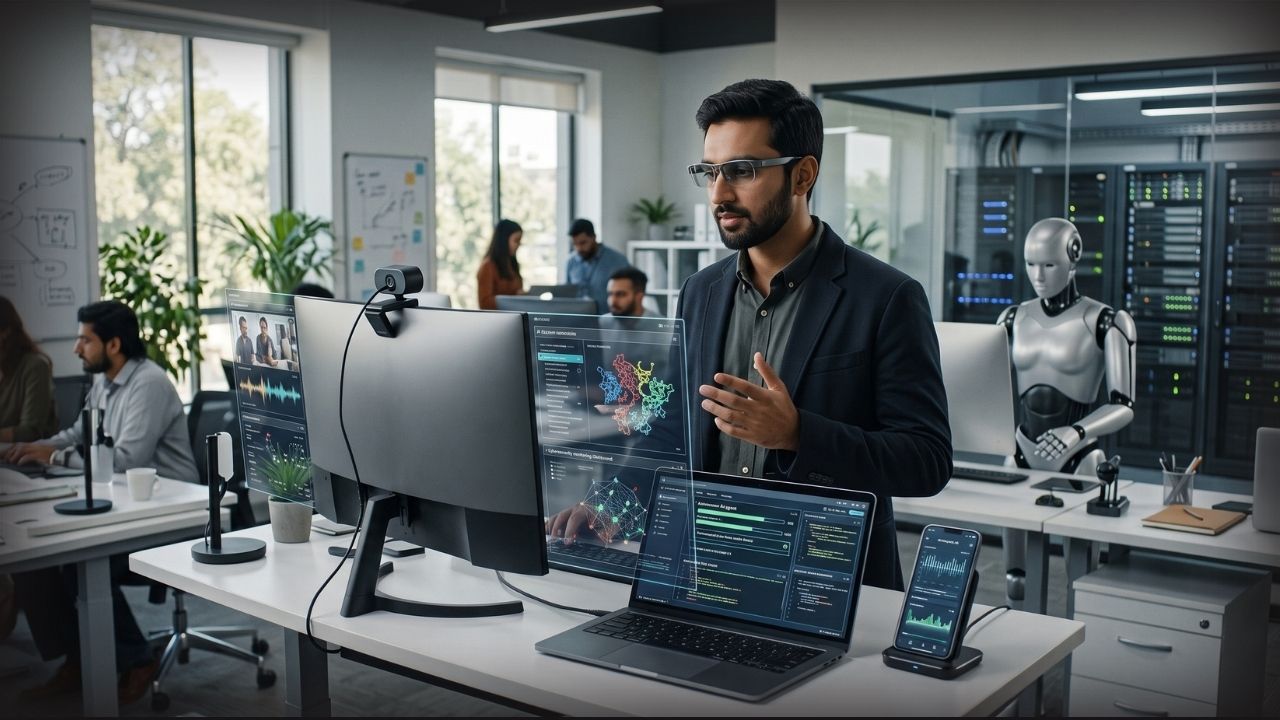
Future AI is moving beyond the familiar chatbot. The important shift visible in 2026 is AI becoming a layer inside operating systems, smartphones, business software, search, cybersecurity, scientific research and physical machines.
For consumers, that means more AI running directly on devices. For companies, it means software agents capable of handling multi-step workflows. For robotics, advances in vision, language models and machine learning are helping machines understand instructions and their surroundings more naturally.
Google, Apple, Samsung, Qualcomm and MediaTek are bringing AI deeper into consumer devices, while Android manufacturers such as Xiaomi, Oppo, Vivo and Realme increasingly compete around AI-powered cameras, translation and productivity. In Pakistan’s price-sensitive market, the eventual movement of useful AI into affordable Infinix, Tecno and other Android phones may matter as much as flagship breakthroughs.
Not everything associated with future AI will mature at the same speed. Humanoid robots are advancing but remain difficult to deploy reliably. 6G is still a research and standardization story rather than a mainstream consumer network. Quantum computing could eventually complement AI in specialized research, but it will not replace ordinary computers in 2027.
This guide uses developments observable through 2026 to identify 15 future AI trends worth watching next.
What Is the Future of AI?
Future AI will increasingly be multimodal, agentic, personalized and embedded directly into devices and software.
The 15 major trends to watch are:
- AI agents
- Multimodal AI
- On-device AI
- AI-powered operating systems
- AI smartphones and PCs
- AI search and answer engines
- AI coding assistants
- Humanoid robots
- AI smart glasses and AR/VR
- Edge AI
- AI cybersecurity
- AI-generated video and media
- AI in science and healthcare
- More efficient AI models and chips
- AI governance, provenance and safety
For most people in Pakistan, AI smartphones, productivity software, education tools, search, cybersecurity and cloud AI will have a more immediate effect than futuristic technologies such as 6G or quantum computing.
Key Takeaways
- AI is shifting from generating answers to performing actions with tools.
- Multimodal models can work across text, speech, images and video.
- On-device AI reduces reliance on cloud computing for supported tasks.
- Smartphones and computers are becoming increasingly AI-native.
- Humanoid robots are more likely to establish themselves in controlled industrial environments before ordinary homes.
- AI search is changing how users discover and consume information.
- Coding is becoming one of AI’s strongest practical applications.
- Edge AI can deliver faster processing close to where data is generated.
- AI creates new cybersecurity defenses as well as new attack methods.
- More efficient models will help bring capable AI to affordable devices.
- Human verification remains essential for medical, financial, legal and other high-impact decisions.
- AI literacy will be particularly valuable for Pakistani students and professionals.
Table of Contents
Future AI Trends at a Glance
| Future AI trend | Status in 2026 | Expected near-term impact | Main challenge |
| AI agents | Commercial/developing | Very high | Reliability |
| Multimodal AI | Commercial | Very high | Accuracy and privacy |
| On-device AI | Commercial | High | Hardware limitations |
| AI operating systems | Emerging | Very high | Permissions and privacy |
| AI smartphones/PCs | Commercial | High | Feature usefulness |
| AI search | Commercial | Very high | Source accuracy |
| AI coding | Commercial | Very high | Verification |
| Humanoid robots | Pilots/early deployment | Medium | Cost and safety |
| AI smart glasses | Early commercial | Medium | Privacy and battery |
| Edge AI | Commercial | High | Compute constraints |
| AI cybersecurity | Commercial | High | Adversarial use |
| AI video | Commercial | High | Authenticity |
| Scientific AI | Rapid development | High specialist impact | Validation |
| Efficient AI/chips | Rapid development | Very high | Cost and energy |
| AI governance | Developing | High | Global inconsistency |
1. AI Agents Will Start Doing More Work
The move toward AI agents is one of the clearest future AI trends.
An AI agent is software that can interpret a goal, plan steps, use digital tools and perform actions with varying levels of autonomy.
A conventional chatbot might explain how to organize a business trip. An agent could potentially research options, compare schedules, prepare an itinerary and present bookings for approval.
The same idea applies to customer support, research, spreadsheets, software development and administrative work.
This transition is already underway. For a practical explanation, see our analysis of how AI agents are changing work.
Reliability remains the limiting factor. AI can misunderstand instructions or generate incorrect information. High-impact actions such as spending money, deleting files or sending sensitive communications should include strong permission controls and human approval.
2. Multimodal AI Will Understand Text, Images, Audio and Video
AI interaction is no longer limited to typing a prompt.
Multimodal AI can process several kinds of information, including text, images, speech and video. This allows AI systems to understand a task in richer context.
A user could show an AI assistant a photograph of a device and ask why it is malfunctioning. A student could upload a diagram, ask a spoken question and request a simplified explanation.
Google and other major AI developers are investing heavily in multimodal systems.
This capability will also become useful for accessibility, translation, education and visual search.
There is an important privacy trade-off. An assistant with access to microphones, cameras, messages and personal documents potentially handles extremely sensitive information. Users should understand permissions and cloud-processing policies before enabling broad access.
For basic background on the field, Wikipedia’s overview of artificial intelligence provides definitions and references.
3. More AI Will Run Directly on Devices
Much of today’s most computationally demanding AI runs in data centres. Future AI will use a hybrid architecture combining cloud and local processing.
On-device AI means compatible machine-learning workloads execute directly on phones, laptops or other hardware.
Processors from Qualcomm, MediaTek, Apple and other companies increasingly include hardware specifically designed to accelerate AI calculations.
This can deliver several advantages: lower latency, functionality without a constant internet connection, reduced network usage and potentially stronger privacy when data genuinely remains local.
For Pakistan, offline and low-connectivity functionality can be particularly valuable.
However, users should not assume that every feature marketed as “on-device AI” stays entirely on the phone. Read the manufacturer’s privacy and technical documentation for individual features.
4. Operating Systems Will Become AI-Native
An assistant is much more useful when it can work across applications rather than living inside one chatbot window.
That is why operating systems are becoming strategically important to future AI.
Google can connect AI capabilities with Android and its broader ecosystem. Apple controls the integration between its hardware and operating systems. Samsung adds Galaxy-specific functionality on top of Android.
The next stage is likely to involve AI helping users search personal information, work with applications, understand notifications and automate routine actions—with permissions.
This also creates a major security challenge. An AI assistant allowed to access email, files and applications becomes a valuable target.
Developers can follow official Android developer guidance as platform APIs and security requirements evolve.
5. AI Smartphones and AI PCs Will Become Ordinary
Calling a device an “AI phone” will eventually become less meaningful because AI acceleration is becoming a normal feature of modern computing.
Snapdragon and MediaTek chips already include dedicated machine-learning capabilities. Apple and major PC processor companies are also emphasizing local AI.
Samsung, Google and Apple are pushing AI into premium consumer devices, while Xiaomi, Oppo, Vivo and Realme are expanding similar concepts across Android hardware. Infinix and Tecno can help make such features accessible at lower prices in markets such as Pakistan.
Useful applications include transcription, translation, photo editing, search, writing assistance and voice interaction.
But AI branding should not determine your purchase.
Our smartphone buying guide for Pakistan covers more important fundamentals such as battery life, software support, cameras, storage and network compatibility.
Display quality still matters too. Our AMOLED vs LCD vs IPS guide explains the practical differences.
6. AI Search Will Change How We Find Information
Traditional search retrieves web pages. Generative AI can synthesize information and answer questions conversationally.
Google and other search providers are combining these approaches, while AI answer engines are creating another route for information discovery.
Future AI search could make complex research faster by helping users compare concepts, interpret multiple sources and ask follow-up questions.
There is a trade-off: generated answers can be wrong.
Users should inspect original sources for consequential claims, particularly involving health, finance, law, government policy, specifications and product prices.
Search is moving toward answers, but reliable sources are becoming more important rather than less important.
7. AI Coding Assistants Will Become More Capable
Software development is already one of generative AI’s strongest practical uses.
Modern AI tools can generate code, explain unfamiliar functions, create tests, suggest fixes and help developers navigate large projects.
Agentic coding systems extend this idea by operating across multiple files and attempting multi-step development tasks.
This does not make software engineering knowledge unnecessary.
Generated code can contain bugs, insecure patterns and incorrect assumptions. Developers still need to understand architecture, testing, security and the business requirements behind software.
For Pakistani students, learning programming alongside AI tools is more useful than attempting to substitute prompting for technical fundamentals.
Those beginning with accessible tools can explore our AI tools for Pakistani students.
8. Humanoid Robots Will Combine AI With Physical Machines
Humanoid robotics is where future AI becomes physical.
Companies are attempting to combine computer vision, language understanding, motion planning and robotic manipulation into machines able to work in human environments.
Factories and warehouses offer an obvious starting point because tasks and layouts can be controlled.
Homes are much harder.
A domestic robot must cope with children, pets, stairs, unusual objects and countless unpredictable situations while maintaining a very high safety standard.
AI can improve generalization and natural-language instruction, but it cannot eliminate mechanical challenges such as dexterity, battery life and physical reliability.
Expect meaningful industrial progress without assuming a general-purpose robot will become a normal household appliance overnight.
9. AI Will Make Smart Glasses and AR/VR More Useful
AI and augmented reality complement each other.
A camera-equipped pair of smart glasses can observe the environment, while multimodal AI interprets what the user sees.
Potential functions include real-time translation, navigation, object recognition, visual assistance and contextual information.
More advanced AR could overlay digital information directly into the user’s view.
VR and mixed-reality headsets will also benefit from AI-generated environments, intelligent avatars and improved interfaces.
Yet AR/VR hardware still has familiar problems: price, battery life, weight, heat and social acceptance.
The future may involve glasses gradually complementing smartphones rather than suddenly replacing them.
10. Edge AI Will Process Information Closer to Users
Edge AI means running machine-learning workloads near the source of data rather than sending everything to a distant cloud data centre.
Examples include smartphones, vehicles, factory computers, security cameras and IoT equipment.
Local processing can improve response time and reduce bandwidth consumption. It can also improve privacy when sensitive raw data remains on-site.
Cloud AI still has an essential role. Large models require enormous computing resources, and cloud infrastructure provides flexibility that small edge devices cannot match.
Future AI will therefore frequently use both.
Our cloud computing guide for Pakistan explains the other half of this architecture.
11. AI Will Transform Both Sides of Cybersecurity
AI is simultaneously a security tool and a security risk.
Defenders can use machine learning to identify suspicious behaviour, prioritize alerts and detect unusual activity.
Attackers can also use generative systems to produce convincing phishing messages, automate reconnaissance and create deceptive content.
Deepfakes create an additional identity problem. A realistic voice or video should not automatically be treated as proof that a person authorized a transaction or request.
This makes basic security more important.
Use unique passwords, multi-factor authentication where available, software updates and independent verification for unexpected financial requests.
Our online cybersecurity guide covers practical protection.
12. AI Video and Synthetic Media Will Improve
AI-generated images are already widespread. Video generation is developing quickly too.
Future systems will improve temporal consistency, control over scenes, editing and integration with existing footage.
This will lower production barriers for advertisers, filmmakers, teachers and independent creators. A small Pakistani business could potentially create visual marketing material without a traditional production budget.
The same tools can produce misinformation and impersonation.
Content provenance—the ability to understand where media came from and how it was modified—will become increasingly valuable.
Interested creators can compare today’s AI video generation tools while remembering that generated media may need fact-checking and disclosure depending on context.
13. AI Will Become More Important in Science and Healthcare
Some of AI’s most important applications may occur far from consumer technology.
Machine learning can assist with protein research, molecular discovery, medical imaging, genomics and scientific modelling.
Google DeepMind’s AlphaFold work has already demonstrated how AI methods can contribute to structural biology.
Healthcare, however, demands much stronger evidence than ordinary productivity software.
Medical AI requires appropriate clinical validation, privacy protection and regulatory oversight. Consumer AI output should never automatically be treated as a professional diagnosis.
Future AI can help clinicians and researchers, but safety-critical decisions require appropriately qualified human oversight.
14. Smaller Models and Better AI Chips Will Matter More
Bigger AI models receive attention, but efficiency is equally important.
Smaller models can require less memory, electricity and computing power. That makes them better suited to phones, laptops and edge devices.
Hardware is improving simultaneously.
Qualcomm’s Snapdragon platforms and MediaTek processors continue developing dedicated AI acceleration, while data-centre chips from companies such as NVIDIA support enormous cloud workloads.
Efficient future AI matters for another reason: energy.
Training and operating AI infrastructure consumes electricity and requires substantial data-centre investment. Better algorithms and chips can improve the amount of useful computing obtained from each unit of energy.
15. AI Safety, Regulation and Provenance Will Become Core Technologies
AI development is not solely a race for smarter models.
Safety systems, identity protection, provenance, privacy, testing and governance will become increasingly important infrastructure.
Governments and international organizations are developing different approaches to AI governance. Rules vary by jurisdiction, so companies operating internationally may face multiple regulatory frameworks.
Pakistanis should use official government sources for local legal or policy requirements rather than assuming foreign AI legislation applies locally.
The Government of Pakistan is the appropriate starting point for official national information, while the Ministry of Information Technology and Telecommunication publishes material relevant to Pakistan’s technology policy.
The enduring challenge is balancing innovation with safety, privacy, competition and accountability.
How Future AI Connects With 6G, Quantum Computing and Batteries
Future AI is closely connected to several broader technology trends for 2027, but these technologies should not be mixed together.
6G could eventually provide advanced wireless infrastructure for AI-powered devices and machines, but 6G remains under research and standardization rather than being a mainstream commercial network in 2026.
Quantum computing could eventually assist with specialized scientific and optimization workloads. It is not expected to replace conventional AI chips or ordinary computers in 2027. Wikipedia’s quantum computing reference provides useful introductory background.
Battery innovation matters physically. Better lithium-ion designs, silicon-rich anodes and eventual solid-state battery developments could give robots, wearables and mobile AI hardware more useful operating time.
The important relationship is simple: AI needs computing power, computing requires energy, and connected AI requires network infrastructure.
What Future AI Means for Pakistan
Pakistan’s near-term AI opportunity is primarily software-driven.
Students can access sophisticated AI through ordinary browsers and smartphones. Freelancers can use AI for coding, design assistance, translation and research. Small businesses can automate repetitive document and customer-service tasks. Developers can create applications using cloud AI without owning expensive computing infrastructure.
This is significant because software adoption requires less physical infrastructure than deploying humanoid robots or building a semiconductor fabrication industry.
Language support is also important. Better multilingual AI could make digital services more accessible in Urdu and regional languages, although accuracy needs careful testing.
AI may also increase demand for data-centre and cloud expertise. Businesses evaluating that transition can compare AWS, Azure and Google Cloud alongside local infrastructure and compliance requirements.
Step-by-Step Guide: How to Prepare for Future AI
Use a practical five-step approach rather than trying every new tool.
- Learn AI fundamentals: understand language models, hallucinations, multimodal systems and agents.
- Test AI on real tasks: use it for research, coding, document analysis or productivity where results can be checked.
- Verify outputs: use original sources for factual claims instead of treating generated text as evidence.
- Protect sensitive information: do not upload confidential personal, business or customer data unless the service and its policies are appropriate.
- Build durable skills: combine AI literacy with programming, cybersecurity, communication, mathematics or expertise in your profession.
AI should amplify knowledge rather than become a substitute for understanding.
Pros and Cons of Future AI
| Benefits | Risks and limitations |
| Faster routine work | Hallucinations and errors |
| Better accessibility | Privacy concerns |
| More capable search | Incorrect summaries |
| Personalized software | Data profiling |
| Faster programming | Insecure generated code |
| Scientific discovery | Validation requirements |
| More capable robots | Physical safety issues |
| Local AI processing | Hardware requirements |
| Stronger cyber defense | AI-assisted attacks |
| Lower creative barriers | Deepfakes and misinformation |
Future AI is neither automatically beneficial nor inherently harmful. Outcomes depend on how systems are built, deployed and supervised.
Buying Advice: Should You Pay More for AI Hardware?
For most Pakistan smartphone buyers, AI should be one consideration rather than the main purchasing criterion.
Prioritize battery life, software support, processor efficiency, RAM, storage, cameras, AMOLED or other display quality, network support and warranty coverage.
With Android phones, check Google Play availability and local compatibility, particularly when buying imported devices.
You can compare today’s best smartphones in Pakistan before paying a premium for AI features.
Laptop buyers should take a similar approach. An NPU is useful where supported software can actually use it, but RAM, SSD capacity, processor performance and battery life remain critical. Our laptop buying guide for Pakistan covers these fundamentals.
Do not buy a device solely on an advertised AI TOPS number. Benchmarks across architectures are not always directly comparable, and software support ultimately determines what the hardware can do.
Summary Box
Future AI through 2027 is best understood through five shifts: from chatbots to agents, from text to multimodal interaction, from cloud-only processing to hybrid local AI, from standalone applications to operating-system integration, and from purely digital AI to physical systems such as robots and smart glasses.
For Pakistani consumers, the most relevant developments are likely to arrive through smartphones, PCs, cloud software, search and productivity tools.
Humanoid robots, 6G, quantum computing and solid-state batteries matter to the bigger technology picture, but they should not be confused with AI products that ordinary users can access today.
FAQs
What is future AI?
Future AI refers to the next development stage of artificial intelligence, including autonomous agents, multimodal models, on-device processing, AI-powered robots and deeper integration with software and operating systems.
What will AI be like in 2027?
AI in 2027 is likely to be more agentic, multimodal and integrated into everyday software. However, exact model capabilities cannot be predicted reliably, and fully autonomous general intelligence should not be presented as a certainty.
What is an AI agent?
An AI agent is software capable of pursuing a goal through multiple steps and interacting with tools, applications or external services. Different agents operate with different levels of autonomy.
Will AI replace jobs?
AI will automate tasks within many occupations and may reduce demand for some roles, while creating or expanding others. Effects differ greatly between industries, so claims that AI will replace either “all jobs” or “no jobs” oversimplify the issue.
Will AI replace smartphones?
Not in the foreseeable near term. AI is more likely to become deeply integrated into smartphones while smart glasses, wearables and other interfaces complement them.
Will future AI work without the internet?
Some AI already runs locally, and on-device functionality will expand. Large models and cloud-dependent services will still require connectivity, making hybrid local-and-cloud AI a likely long-term architecture.
How will future AI affect Pakistan?
Pakistan could benefit through education, software development, freelancing, business automation, accessibility and digital services. Reliable connectivity, skills, affordability, cybersecurity and responsible data practices will influence the scale of adoption.
Which smartphone companies are investing in AI?
Apple, Samsung, Google, Xiaomi, Oppo, Vivo and Realme are among the major consumer brands incorporating AI features. Qualcomm and MediaTek supply important hardware capabilities to many Android manufacturers, while brands such as Infinix and Tecno can help bring AI to more affordable price segments.
Is AI safe for students?
AI can be a useful learning tool when students verify information and comply with academic rules. It should supplement learning rather than substitute for understanding or independent work.
Is AI-generated information always accurate?
No. AI can generate confident but incorrect information. Important facts should be verified against primary or authoritative sources.
Are humanoid robots powered by AI?
Modern humanoid robot projects use AI and machine learning for functions such as perception, language interaction and control. Robotics also depends on mechanical engineering, sensors, actuators, batteries and conventional control systems.
Will quantum computing make AI more powerful?
Quantum computers may eventually help with certain specialized workloads, but their practical relationship with mainstream AI remains an active area of research. Conventional GPUs, AI accelerators and other classical hardware remain the foundation of modern AI.
Conclusion
Future AI is becoming less about one chatbot and more about intelligence embedded throughout computing.
Agents are beginning to take actions. Multimodal models are interpreting more than text. Smartphones and PCs can run increasing amounts of AI locally, while edge computing moves intelligence into vehicles, factories and connected devices. Robotics brings AI into the physical world, and AI-powered search and coding are already changing everyday digital work.
The constraints are equally important. AI can be inaccurate, agents introduce security risks, synthetic media makes authenticity harder to judge, and medical or other high-impact applications require much stronger verification than everyday productivity tools.
For Pakistan, the most valuable opportunity is accessible AI: useful tools running on affordable phones, computers and cloud platforms. Students, professionals and businesses do not need to wait for 6G, household humanoid robots or quantum computers to benefit.
The most effective preparation is practical: learn how AI works, use it on problems where results can be checked, protect sensitive data, follow reliable sources and develop skills that remain valuable even as individual AI products change.