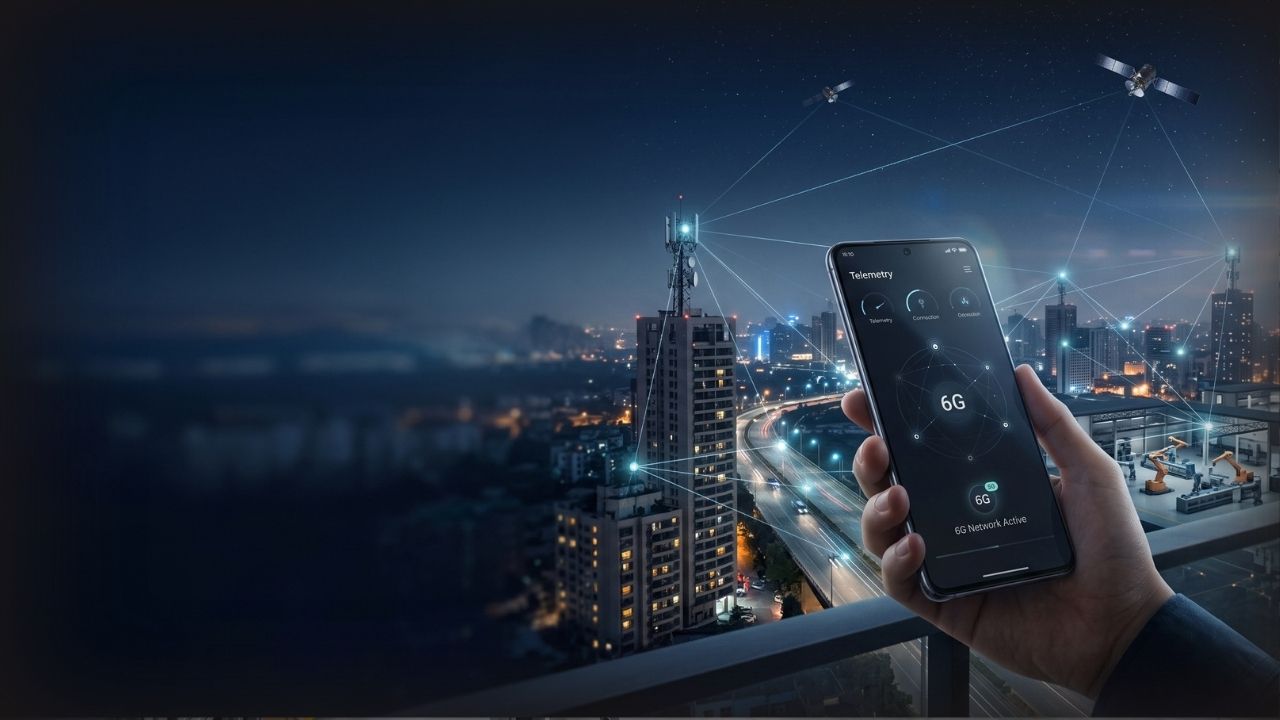
6G is the proposed next generation of mobile communications after 5G. It could eventually support more intelligent networks, tighter integration between terrestrial and satellite systems, new sensing capabilities and substantially higher capacity.
But there is an important fact for anyone buying a smartphone in Pakistan 6G is not a mainstream commercial mobile service in 2026.
The technology is still moving through research, spectrum studies, and international standardization. The International Telecommunication Union’s IMT-2030 framework defines the broad direction for sixth-generation mobile systems, while 3GPP is developing the specifications needed to turn that vision into interoperable networks. Commercial deployment is widely associated with around 2030, although actual availability will vary by country and operator.
Companies including Samsung, Nokia, Ericsson, Qualcomm, and other telecom and semiconductor organizations are researching technologies that may contribute to 6G. Apple, Google and Android manufacturers will eventually depend on standardized modem and network technology before sixth-generation connectivity becomes an ordinary smartphone feature.
This guide explains 15 important facts about 6G using information available through 2026, including its expected benefits, relationship with AI, possible spectrum, satellites, smartphones and what the transition could mean for Pakistan.
What Is 6G?
6G is the name used for the next generation of wireless mobile communication technology expected to follow 5G.
The International Telecommunication Union uses “IMT-2030” for the framework associated with the next generation of International Mobile Telecommunications. Its vision extends beyond faster downloads to capabilities including ubiquitous connectivity, integrated sensing and communication, AI-related capabilities, sustainability and more advanced communications.
Consumers should not expect mainstream 6G service in 2026 or 2027. The important work happening now involves standards, spectrum, research, prototypes and testing.
For Pakistani smartphone buyers, a good 4G or 5G phone available today remains much more relevant than waiting for a 6G handset.
Key Takeaways
- 6G will succeed 5G, but it is not yet a mainstream commercial network.
- The ITU’s framework for the next generation is known as IMT-2030.
- Commercialization is broadly associated with around 2030 rather than 2026 or 2027.
- is about much more than headline download speed.
- Future networks may combine communications, positioning, and sensing more closely.
- AI is expected to play a larger role in network optimization and operation.
- Non-terrestrial networks, including satellite systems, could become more tightly integrated with mobile connectivity.
- Higher-frequency spectrum may unlock exceptional capacity while creating coverage challenges.
- Lower frequencies will remain valuable because signals generally travel farther and penetrate obstacles better.
- Energy efficiency will be an important engineering consideration.
- could support future AI, robotics, industrial automation and immersive computing.
- Pakistan’s 5G and broader digital infrastructure matter much more in the near term.
- Consumers should not postpone buying a smartphone to wait for 6G.
Table of Contents
5G vs 6G Comparison
| Feature | 5G | 6G / IMT-2030 direction |
| Status in 2026 | Commercial globally | Research/standardization |
| Generation | Fifth generation | Sixth generation |
| Standards ecosystem | Mature 3GPP specifications | Under development |
| Commercial era | 2020s | Around 2030 expected |
| AI use | Increasing | Expected to be deeper |
| Satellite integration | Developing | Expected to become more integrated |
| Sensing | Not a central general-purpose capability | Integrated sensing is a major research direction |
| Spectrum | Sub-6 GHz and mmWave, depending on market | Existing and new bands, potentially including higher frequencies |
| Consumer phones | Widely available | Not mainstream |
| Relevance to Pakistan today | Immediate/near-term | Longer term |
Exact 6G performance targets and commercial implementations can change during standardization, so specifications advertised years before final networks should not be treated as guaranteed consumer performance.
1. 6G Is the Next Mobile Generation After 5G
The simplest 6G definition is also the most useful: it is the next generation of mobile technology after 5G.
Each generation has represented more than a speed upgrade.
2G expanded digital voice and messaging. 3G made mobile internet increasingly practical. 4G LTE enabled the modern app and streaming economy. 5G expanded capacity while targeting enhanced mobile broadband, lower-latency applications and large-scale machine connectivity.
6G aims to build on those capabilities with a network designed for the computing and connectivity requirements expected in the 2030s.
Wikipedia’s overview of 6G technology provides useful introductory history, although standards and deployment claims should be verified against organizations such as the ITU and 3GPP.
2. 6G Is Not a Commercial Consumer Network in 2026
This is the most important fact in the entire guide.
There are no mainstream standardized commercial smartphone networks for ordinary consumers in 2026.
Research demonstrations are not the same as deployed mobile networks.
A laboratory may demonstrate extremely high wireless data rates using experimental frequencies and specialized equipment. That does not mean a normal Samsung Galaxy, iPhone or Android phone can connect to a commercial 6G network.
The distinction is especially important because “6G” can be used loosely in marketing.
Consumers should ask three questions: Has the technology been standardized? Does a mobile operator actually offer it? Can a standardized consumer handset connect to it?
In 2026, 5G remains the current commercial cellular generation.
3. IMT-2030 Is the International Framework
The ITU plays an important role in creating the international framework for mobile telecommunications.
Its next-generation framework is called IMT-2030.
The framework identifies scenarios and capabilities rather than defining a single retail product or smartphone modem.
Industry standardization then has to convert broad objectives into technical specifications that equipment manufacturers, chipset companies and mobile operators can implement interoperably.
3GPP is particularly important in this process because its specifications form the technical foundation of modern cellular systems.
This means 6G is not something one smartphone manufacturer can simply invent independently. International interoperability requires a standards ecosystem.
4. About More Than Extreme Speed
Search for 6G online and you will encounter eye-catching speed predictions.
Those numbers require context.
Theoretical peak data rates are engineering objectives rather than guarantees of what somebody will receive on a smartphone in Karachi, Lahore or Islamabad.
Real network performance depends on spectrum, signal quality, congestion, device capability, backhaul and deployment density.
6G’s more interesting advances may therefore involve reliability, intelligence, positioning, sensing and ubiquitous connectivity rather than simply downloading a movie faster.
This is why comparing generations using only “maximum speed” misses much of the story.
5. Lower Latency Could Enable More Responsive Systems
Latency measures the delay between sending information and receiving the required response.
Lower network latency can be important for interactive applications such as industrial control and some forms of remote operation.
Future networks aim to improve latency and reliability, but advertised radio-interface targets should not be confused with end-to-end internet latency.
A data packet may still travel through routing infrastructure, applications, cloud data centres and processing systems.
The practical lesson is that the physical network is only one part of responsiveness.
Edge computing can help by processing information closer to the user. Our cloud computing guide for Pakistan explains how cloud and edge architectures relate.
6. AI Could Be Built More Deeply Into Networks
Future AI and future networks are increasingly connected.
Machine learning can help operators predict traffic, optimize radio resources, manage energy consumption and detect network problems.
A more AI-native network could potentially adapt dynamically to changing demand.
AI also creates demand for connectivity. Smart glasses, vehicles, robots and mobile AI applications may exchange large amounts of contextual data.
This relationship is explored further in our guide to future AI trends and innovations.
However, AI does not eliminate fundamental radio engineering constraints. Spectrum, interference, antenna design and physics remain decisive.
7. Could Combine Communication With Sensing
Integrated sensing and communication is one of the more distinctive ideas associated with IMT-2030.
A future wireless system could potentially do more than transmit information. Radio signals may also help detect properties of objects or environments.
Potential applications could include transportation, industrial systems and localization.
This does not mean every 6G base station will become an all-seeing radar.
Actual capabilities will depend on frequency, hardware, standards, local regulation and deployment.
Sensing also creates privacy questions. If wireless infrastructure can infer more about physical environments, governments and operators will need clear rules about appropriate collection and use.
8. Satellites Could Become a More Natural Part of Mobile Networks
Traditional cellular networks depend mainly on ground-based towers.
Non-terrestrial networks extend connectivity using satellites and potentially other airborne systems.
Satellite-to-device communications already exist in limited commercial forms, so this concept does not begin with 6G.
The longer-term goal is better integration between terrestrial and non-terrestrial connectivity.
That could be particularly interesting for Pakistan because geography includes mountainous, desert and sparsely populated areas where building dense conventional infrastructure is difficult.
Satellite networks could support emergency communications, logistics and remote connectivity.
For mobile-industry information, the GSMA is a valuable primary industry source. Local spectrum and telecommunications announcements should be verified through the Pakistan Telecommunication Authority.
9. Research Includes Higher-Frequency Spectrum
Wireless spectrum is one of the fundamental resources underlying mobile communications.
Higher frequencies can potentially provide large amounts of bandwidth, and 6G research includes spectrum above frequencies commonly associated with existing consumer mobile networks.
Sub-terahertz communications consequently receive considerable research attention.
There is a trade-off.
Very high-frequency signals tend to face greater propagation challenges and may be more easily blocked or attenuated. That can require short communication distances, advanced antenna systems and denser infrastructure.
Lower bands remain valuable because of their coverage characteristics.
Future 6G networks are therefore unlikely to use one magical frequency. They will probably depend on combinations of bands suited to different requirements.
10. Coverage May Be Harder Than Headline Speed
Producing an enormous wireless speed over a short controlled distance is one engineering challenge.
Providing dependable coverage across an entire country is another.
Pakistan illustrates that difference clearly.
Dense areas such as Karachi and Lahore have different infrastructure requirements from Balochistan’s sparsely populated territory or mountainous northern regions.
Higher-frequency networks can require significantly denser infrastructure, which costs money and needs fibre or microwave backhaul, sites and electricity.
This is one reason existing low- and mid-band spectrum remains important even as research explores much higher frequencies.
A useful mobile network must provide dependable service, not merely record-setting laboratory results.
11. AR/VR and Spatial Computing Could Benefit
AR/VR systems can demand significant processing and bandwidth, particularly if lightweight headsets offload demanding workloads to nearby edge infrastructure.
Future networks could make this architecture more practical.
Instead of placing every high-performance component in a pair of glasses, part of the computing workload might happen on an edge server while the device handles time-critical local processing.
Potential uses include training, engineering, collaborative design, entertainment and remote assistance.
But 6G is not required for today’s AR/VR. Existing Wi-Fi and 5G technologies can already support many applications.
6G should be seen as a possible future enabler rather than a prerequisite.
12. Humanoid Robots and Autonomous Machines Could Benefit
Robots require extremely fast local control. A humanoid cannot depend on a distant cloud server for every balance adjustment.
Connectivity can still provide useful functions including fleet coordination, telemetry, map updates, cloud AI access and remote supervision.
Future networks could make these systems more scalable.
This is where 6G overlaps with another major future technology area: humanoid robot development.
Safety-critical robotic functions should still be designed to cope appropriately with network outages. A robot should not become dangerous merely because connectivity disappears.
13. Industrial 6G May Matter More Than Faster Phones
Consumers naturally evaluate new networks by smartphone speed. Industry may provide some of the stronger use cases.
Future wireless systems could support:
- Factory automation
- Connected sensors
- Digital twins
- Autonomous logistics
- Smart ports
- Advanced agriculture
- Energy infrastructure
- Machine coordination
Private networks can give businesses greater control over performance and security.
Combining edge computing, AI and wireless connectivity may allow industrial equipment to share information more efficiently.
Pakistani organizations considering long-term digital infrastructure can start with today’s technology. Our guide to cloud computing for businesses explains practical infrastructure already available.
14. Security Will Need to Protect More Than Smartphones
A network connecting phones, vehicles, robots, industrial systems and sensors creates a huge security surface.
research therefore cannot treat cybersecurity as an optional extra.
Networks will need secure authentication, encryption, resilient software architecture and effective device identity management.
AI adds another dimension. Network-management systems using machine learning need protection against manipulation and compromised information.
Cryptographic standards will also evolve over the long life of next-generation networks, including broader industry transitions toward post-quantum cryptography.
For consumers, today’s fundamentals remain essential. Follow practical cybersecurity advice for Pakistan rather than waiting for a future network generation to solve security problems automatically.
15. Pakistan’s 6G Future Depends on What Happens With 5G and Fibre
Pakistan will eventually participate in the next generation of global mobile technology, but the path matters.
The foundations for future 6G are being built through today’s spectrum policy, fibre deployment, data centres, cloud infrastructure, energy availability and mobile-network investment.
Pakistan therefore benefits more from improving current digital infrastructure than from chasing an early 6G label.
Affordable smartphones are another crucial factor.
Samsung, Xiaomi, Realme, Oppo, Vivo, Infinix and Tecno compete heavily across Android price segments. Apple operates mainly at the premium end. Qualcomm Snapdragon and MediaTek chipsets supply modem technology across a large share of Android devices.
When standardized 6G smartphones eventually arrive, flagship devices are likely to adopt new modem technology before it becomes affordable across mass-market hardware. The exact sequence will depend on manufacturers and networks.
Consumers comparing what actually works now should use our Pakistan smartphone buying guide rather than making purchases around speculative future connectivity.
Smartphones: What Will Actually Change?
When sixth-generation phones eventually become commercial products, the modem will be only one part of the story.
Apple will need appropriate modem and radio hardware for future iPhones. Samsung and Android manufacturers will depend on compatible modem platforms, whether internally developed or supplied by semiconductor partners.
Qualcomm and MediaTek are therefore important entities to watch because mobile modem technology determines which network standards phones can access.
Operating systems including Android will also need software support for associated capabilities.
Other fundamentals will remain important. A phone with an AMOLED display, a capable Snapdragon or MediaTek processor, sufficient storage, strong battery and long software support can provide far more immediate value than an unsupported next-generation network label.
Google Play compatibility also remains important for Android buyers purchasing imported hardware.
For current product comparisons, see our guide to the best smartphones in Pakistan.
Will 6G Replace Wi-Fi?
Probably not.
Cellular networks and Wi-Fi serve overlapping but different roles.
Mobile networks excel at wide-area connectivity and mobility. Wi-Fi remains highly effective and economical for homes, offices and local networks.
Both technologies are developing.
Future phones will likely continue using both Wi-Fi and cellular networks, choosing whichever provides the appropriate performance and availability.
The same principle already applies with 4G and 5G.
A new cellular generation does not make local wireless networking obsolete.
Step-by-Step Guide: How to Check a Claim
Many misleading technology claims become easy to identify with five checks.
- Check whether the claim comes from the ITU, 3GPP, a recognized manufacturer, operator or research institution.
- Identify whether it describes research, a laboratory prototype, a standards proposal, a trial or a commercial network.
- Check which frequency, bandwidth and equipment produced an advertised speed.
- Determine whether standardized consumer hardware exists.
- Verify whether the service is actually available in Pakistan through PTA and local operators.
This process is especially important when an online seller advertises a device as “6G.”
A model name, Wi-Fi label or marketing phrase does not automatically mean sixth-generation cellular support.
Pros and Cons of 6G
| Potential benefits | Challenges |
| Higher capacity | Expensive infrastructure |
| More advanced connectivity | Higher-frequency coverage challenges |
| Integrated sensing | Privacy considerations |
| Greater AI integration | Complex network management |
| Better satellite integration | Regulatory and spectrum issues |
| Advanced industrial applications | Device upgrade costs |
| Improved positioning possibilities | Standards still evolving |
| More efficient networking targets | Growing total network demand |
These are future-network objectives and trade-offs, not guaranteed features of every eventual deployment.
Buying Advice: Should You Wait for a 6G Phone?
No, not if you need a phone now.
There is no practical reason for a Pakistani consumer in 2026 to delay buying a suitable smartphone because of 6G.
Mainstream deployment remains years away, and normal phone replacement cycles are much shorter than the transition from research to widespread sixth-generation coverage.
Choose a device based on technologies you can actually use: reliable 4G/5G compatibility, battery life, cameras, RAM, storage, security updates, AMOLED or another quality display, performance and warranty support.
Pakistan buyers can compare 5G smartphone options rather than paying for vague “future-ready” claims.
If an unknown device claims to support 6G cellular service today, verify its exact modem and standardized radio bands before purchasing.
Expert Tips for Following Development
For dependable updates, follow the standard rather than the hype.
The most useful sources are the ITU for the IMT-2030 framework, 3GPP for cellular specifications, PTA for Pakistan’s regulatory environment, GSMA for mobile-industry analysis, and official research from established network and semiconductor companies.
Samsung, Qualcomm and other companies publish valuable research, but company roadmaps remain commercial forecasts rather than guarantees of industry-wide deployment.
Also distinguish a technology demonstration from a product launch. Researchers can demonstrate radio technologies years before they become economical enough for ordinary networks.
For the bigger picture—including AI, robotics, quantum computing and battery developments—see our analysis of future technology trends for 2027.
Summary Box: 15 Essential 6G Facts
The proposed sixth generation of mobile communications and is associated internationally with the ITU’s IMT-2030 framework.
It is not a mainstream commercial consumer network in 2026.
The next generation is expected to explore substantially more than speed, including AI-native network capabilities, integrated sensing, advanced positioning, broader connectivity scenarios and stronger integration between terrestrial and non-terrestrial systems.
Higher-frequency spectrum could unlock major capacity but will create significant coverage and infrastructure challenges.
Commercial availability is broadly expected around the 2030 era, and deployment will vary substantially by country.
For Pakistan, building strong 5G, fibre, cloud and digital infrastructure is the sensible path toward any eventual 6G transition.
FAQs
What is 6G?
The proposed sixth generation of mobile communication technology after 5G. Its international development is associated with the ITU’s IMT-2030 framework and ongoing standards work.
Is 6G available in 2026?
No mainstream standardized commercial 6G mobile service is available to ordinary consumers in 2026. Research, testing and standardization are still underway.
When will 6G launch?
Commercial 6G is broadly associated with around 2030. Individual countries and operators may launch at different times, and widespread coverage could take additional years.
Is 6G available in Pakistan?
Pakistan does not have a mainstream commercial 6G mobile network in 2026. Check PTA and licensed operators for authoritative updates about Pakistani mobile networks.
How fast will 6G be?
6G research investigates much higher capacities and data rates than existing networks. Exact peak and typical user speeds cannot yet be treated as final consumer specifications because standards and deployment architectures are still evolving.
Is 6G faster than 5G?
6G is being designed to improve on 5G in several dimensions, including capacity and other network capabilities. Actual real-world performance will depend on deployment and spectrum.
Does a 6G smartphone exist?
Not as a normal standardized commercial 6G cellular phone for mainstream consumer networks in 2026. Be cautious when retailers use “6G” loosely in product descriptions.
Should I wait for 6G before buying a phone?
No. Buy a smartphone that works well on networks available during your ownership period. For Pakistani consumers today, dependable 4G/5G support is much more relevant.
Will 6G replace 5G?
Eventually, 6G is expected to become the next cellular generation, but older technologies normally coexist with newer ones for years. 5G will not simply switch off when 6G begins.
Will 6G replace Wi-Fi?
No. Wi-Fi and cellular networks serve different needs and will likely continue evolving alongside each other.
Does 6G use artificial intelligence?
AI and machine learning are expected to become more deeply integrated into future network optimization, resource management and services. Exact implementations will depend on final standards and operator deployments.
Does 6G need satellites?
No. Terrestrial networks will remain fundamental. However, non-terrestrial connectivity involving satellites is expected to become increasingly important in next-generation mobile systems.
Will 6G use terahertz frequencies?
Sub-terahertz and other higher-frequency ranges are important research areas, but future commercial 6G will likely use multiple spectrum bands. It should not be described as exclusively a terahertz network.
Will 6G improve AR and VR?
Potentially. Greater capacity, edge integration and improved latency could support advanced AR/VR and spatial-computing applications, although today’s technologies already support many immersive experiences.
Why does 6G matter for Pakistan?
Long term, 6G could support advanced industrial connectivity, AI systems, remote services and broader digital infrastructure. In the near term, improving existing mobile broadband, fibre, cloud services and 5G readiness is more important.
Conclusion
A serious engineering and standards effort, but it should not be confused with a technology Pakistani consumers can simply buy today.
The work taking place through 2026 is about creating the foundations: IMT-2030, international specifications, spectrum research, experimental radio systems, AI-assisted networking and deeper integration between terrestrial and non-terrestrial communications.
Its eventual impact could reach far beyond faster smartphone downloads. Future networks may help connect robots, industrial machines, smart glasses, vehicles, sensors and AI-powered services while adding new sensing and positioning capabilities.
The technical barriers are equally important. Higher frequencies create coverage problems, infrastructure is expensive, sophisticated networks increase security complexity, and laboratory performance does not guarantee affordable nationwide service.
For smartphone buyers in Pakistan, the practical advice is straightforward: do not wait for Buy for the networks, software and device capabilities available during the years you will actually own the phone.
The most important 6G developments for now are happening in standards meetings, research laboratories and network planning not in the smartphone aisle.