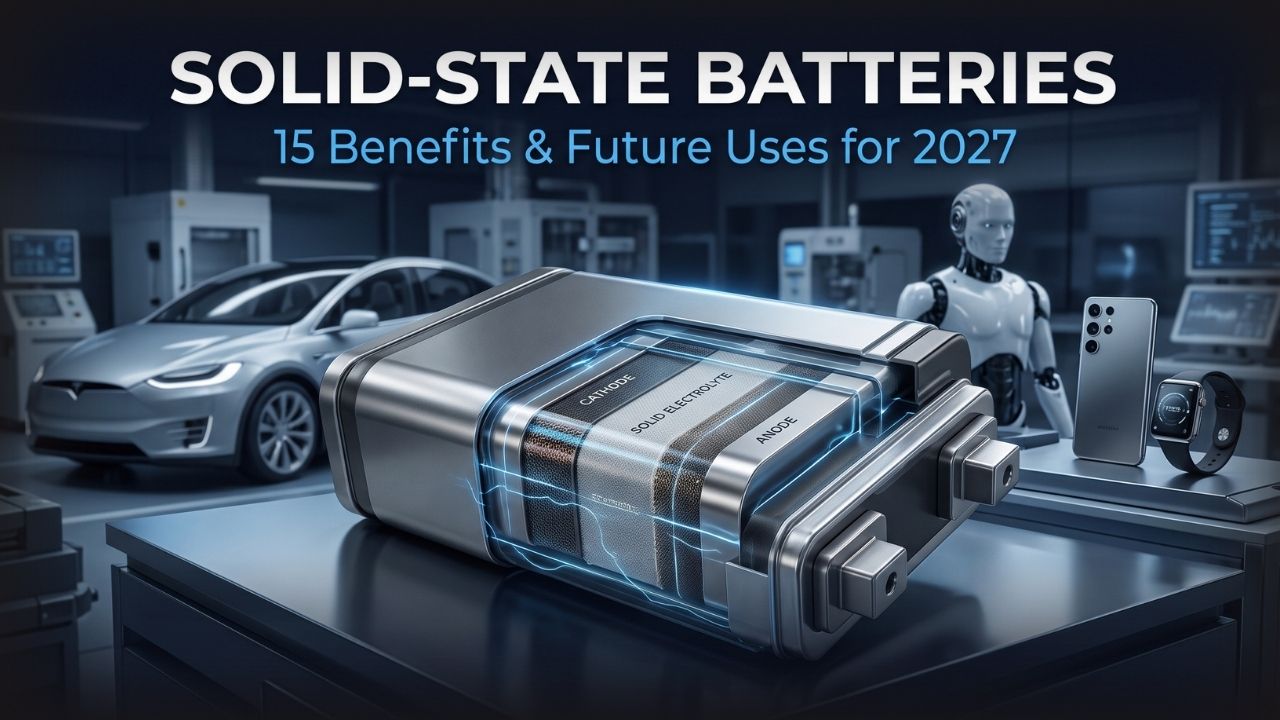
Solid-state batteries could become one of the most important advances in energy storage, potentially improving electric vehicles, smartphones, wearables, robots and other battery-powered products. But in 2026, there is still a substantial gap between promising laboratory results, early commercialization and affordable mass-market batteries.
The basic idea is straightforward. Conventional lithium-ion batteries normally transport lithium ions through a liquid or gel electrolyte. A solid-state battery instead uses a solid electrolyte. Depending on the chemistry and design, this can create opportunities for higher energy density, different electrode materials and improved safety characteristics.
The engineering is anything but straightforward.
Toyota, Samsung SDI, QuantumScape, Solid Power and other companies are working on solid-state or related next-generation battery technologies. Automotive manufacturers see particular potential because better energy density could translate into greater driving range, smaller battery packs or both.
Smartphone buyers should be more cautious about near-term predictions. Manufacturers including Samsung, Apple, Xiaomi, Oppo, Vivo, Realme, Infinix and Tecno continue improving conventional lithium-based batteries, while silicon-carbon and silicon-rich anode technologies are already influencing some consumer devices. A true solid-state battery is not required to produce a significant improvement in phone capacity.
This guide explains 15 potential benefits and future uses of solid-state batteries, the limitations still facing the technology, and what developments actually matter for consumers in Pakistan as we move toward 2027.
What Is a Solid-State Battery?
A solid-state battery is an electrochemical battery that uses a solid electrolyte rather than the conventional liquid or gel electrolyte associated with many lithium-ion batteries.
The electrolyte allows ions to move between electrodes during charging and discharging while separating other aspects of the battery’s internal operation.
Potential advantages of solid-state designs include greater energy density, improved safety characteristics, opportunities to use lithium-metal anodes and new battery-pack designs. The exact benefits depend on the materials and engineering; “solid-state” does not automatically mean safer, cheaper, faster-charging or longer-lasting.
In 2026, conventional lithium-ion batteries still dominate smartphones, laptops and electric vehicles. Solid-state development is advancing, but broad, low-cost mass production remains a major challenge.
For introductory scientific context, Wikipedia’s explanation of the solid-state battery provides useful terminology and references.
Key Takeaways
- Solid-state batteries replace a conventional liquid or gel electrolyte with a solid electrolyte.
- Higher energy density is one of their most important potential advantages.
- Some designs could use lithium-metal anodes.
- Removing a flammable liquid electrolyte can improve some safety characteristics, but solid-state batteries are not automatically risk-free.
- Faster charging is possible for suitable designs, but it is not guaranteed.
- Cycle life depends heavily on chemistry, interfaces, temperature and charging conditions.
- Electric vehicles are a major target market.
- Smartphones could benefit eventually, but mass-market solid-state phones should not be assumed for 2027.
- Silicon-carbon battery technology is not the same as solid-state technology.
- Humanoid robots and AR/VR hardware could benefit from higher energy density.
- Manufacturing yield and cost are major obstacles.
- Extreme temperatures and material interfaces create engineering challenges.
- Recycling and material sourcing remain relevant even if the electrolyte becomes solid.
- Early commercialization does not mean immediate replacement of lithium-ion technology.
- Pakistan consumers should buy products according to tested battery performance today rather than promises about future chemistry.
Table of Contents
Solid-State vs Conventional Lithium-Ion Batteries
| Feature | Conventional lithium-ion | Solid-state battery |
| Electrolyte | Typically liquid/gel-based | Solid |
| Commercial maturity | Very high | Emerging/developing |
| Mass-market smartphones | Standard | Not mainstream |
| Mass-market EVs | Standard | Limited/emerging |
| Energy density | Strong and improving | Potentially higher |
| Lithium-metal anode | Generally difficult | Possible in some designs |
| Flammable liquid electrolyte | Common in many designs | Removed in fully solid-state designs |
| Manufacturing ecosystem | Highly mature | Scaling remains challenging |
| Cost | Falling/mature supply chain | Generally challenging at early scale |
| Fast charging | Available in many products | Potentially strong but chemistry-dependent |
A solid electrolyte alone does not determine every battery characteristic. Cathode chemistry, anode materials, cell architecture and battery-management systems matter too.
1. Solid-State Batteries Replace the Liquid Electrolyte
The defining difference is the electrolyte.
In conventional rechargeable lithium-ion cells, ions move through a liquid electrolyte between the electrodes during charging and discharging. Solid-state designs use a solid ion-conducting material instead.
Possible solid electrolytes include ceramic, sulfide, oxide and polymer-based materials, among other approaches.
Each creates trade-offs.
A material might offer excellent ionic conductivity but be difficult to manufacture. Another may be easier to process but perform less effectively at certain temperatures.
This is why “solid-state battery” describes a broad technology family rather than one universal chemistry.
Two batteries can both be called solid-state while having significantly different safety, lifespan, energy density and manufacturing characteristics.
2. Higher Energy Density Could Be the Biggest Benefit
Energy density describes how much energy a battery stores relative to its mass or volume.
This is crucial for mobile technology.
Higher gravimetric energy density can reduce weight for a given amount of stored energy. Higher volumetric energy density can place more capacity into the same physical space.
An electric car could therefore potentially travel farther without carrying a proportionately larger battery.
A phone manufacturer could use the same improvement differently: increase runtime, reduce device thickness or allocate more internal space to cameras and other components.
The outcome is a product-design decision.
This is why consumers should be skeptical of claims that next-generation batteries will automatically produce week-long smartphones.
3. Solid-State Batteries Could Improve Some Safety Characteristics
Conventional lithium-ion batteries contain electrolyte systems that can present fire risks under certain failure conditions. Modern batteries use numerous engineering protections to manage those risks.
A fully solid-state design can remove the conventional flammable liquid electrolyte, potentially reducing some failure hazards.
But “solid” does not mean “impossible to burn.”
Battery safety involves the entire cell: electrodes, electrolyte, separator or interfaces, charging systems, manufacturing quality, thermal behaviour and physical protection.
Lithium metal itself is highly reactive. Internal short circuits and other failure mechanisms remain important considerations.
Consumers should therefore be cautious when a manufacturer describes a battery simply as “fireproof.”
Independent safety testing matters more than the chemistry label.
4. Solid Electrolytes Could Enable Lithium-Metal Anodes
One reason researchers are so interested in solid-state batteries is their potential compatibility with lithium-metal anodes.
Conventional lithium-ion cells generally use materials such as graphite, increasingly with silicon incorporated to improve capacity.
Metallic lithium can theoretically store significantly more charge per unit mass than conventional graphite-based anodes.
That creates opportunities for higher energy density.
The problem is controlling lithium deposition safely and repeatedly.
Irregular structures can develop during cycling, and interfaces between solid materials create their own mechanical and chemical problems.
The electrolyte must remain in effective contact with the electrodes while accommodating changes inside the cell over repeated charge cycles.
This is one of the reasons laboratory promise does not translate automatically into factory-scale production.
5. Faster Charging Is Possible but Not Guaranteed
Fast charging is frequently listed as a benefit of future solid-state batteries.
Some designs may indeed support high charge rates, but charging performance depends on much more than whether the electrolyte is solid.
Temperature, ion conductivity, electrode materials, battery-management software and the ability to prevent harmful lithium deposition all matter.
There is also a familiar trade-off between charging speed and battery health.
Even if a battery can accept extremely high power briefly, manufacturers need to determine how repeated fast charging affects lifespan and safety.
The same principle applies to phones today. A larger wattage number does not tell you everything about charging performance.
6. Smaller Battery Packs Could Store the Same Energy
Higher energy density does not have to produce greater runtime.
It can instead reduce size and weight.
This could be particularly valuable in devices where every gram matters.
Wearable computers, drones, medical equipment and smart glasses are constrained by battery mass. Reducing battery size without reducing usable energy can free engineers to improve comfort and design.
There is an important lesson here for future product announcements: ask where the energy-density gain went.
Did it create longer runtime? Lower weight? More computing power? Or a thinner product?
All are legitimate uses of improved battery technology.
7. Electric Vehicles Could Be the Biggest Solid-State Market
Electric vehicles provide one of the strongest arguments for solid-state technology because battery properties directly affect range, weight, charging and vehicle cost.
Toyota and several other automotive and battery companies have publicly discussed solid-state development and commercialization plans.
What matters now is moving from prototypes and pilot lines to reliable mass manufacturing.
Automotive cells face demanding requirements.
They must work across temperature ranges, survive thousands of real-world driving conditions, provide predictable performance and meet strict safety requirements.
Manufacturing yield is equally important. A technically excellent battery that is too expensive to produce at scale will struggle against rapidly improving conventional lithium-ion alternatives.
Industry plans are therefore useful evidence of direction, not guaranteed delivery dates.
8. Solid-State Smartphone Batteries Could Eventually Matter
Smartphones are another obvious potential application, but expectations need context.
Today’s phones are already benefiting from substantial battery improvements that are not necessarily solid-state.
Silicon-carbon or silicon-rich anode designs can increase energy capacity relative to traditional graphite-heavy approaches. Several smartphone manufacturers have used newer battery technologies to fit higher capacities into practical phone dimensions.
This matters for Pakistan because brands such as Xiaomi, Realme, Oppo, Vivo, Infinix and Tecno compete aggressively on battery capacity and charging. Samsung and Apple typically balance battery improvements with software, chipset efficiency and device design.
Qualcomm Snapdragon and MediaTek processors also affect battery endurance because a more efficient chipset consumes less energy for a given workload.
If runtime is your priority, evaluate what exists now. Our guide to long-battery-life phones in Pakistan is more useful for a current purchase than waiting for a theoretical solid-state smartphone.
9. Laptops, Wearables and Other Electronics Could Benefit
Laptops have the same battery dilemma as smartphones on a larger scale.
Users want long runtime, high performance and light devices at the same time.
Higher energy density could allow manufacturers to improve one or more of those properties.
Wearables have an even stronger need for compact energy storage. Smartwatches, earbuds and future smart glasses have very little internal space.
Apple, Samsung and other manufacturers consequently pursue improvements throughout the system—not only batteries but also displays, processors and operating systems.
Efficiency remains crucial because doubling battery capacity is not the only way to double useful runtime. Cutting average power consumption can be equally important.
For current laptop buyers, processor efficiency, display technology and real-world battery tests remain more useful than future chemistry promises. Our Pakistan laptop buying guide covers these practical factors.
10. Humanoid Robots Need Better Energy Storage
Humanoid robots are effectively powerful battery-operated computers with moving arms and legs.
Actuators consume energy. Cameras and other sensors run continuously. CPUs, GPUs and AI accelerators process information, while wireless radios communicate with other systems.
Battery weight then creates a feedback problem: a heavier battery stores more energy but requires the robot to move additional mass.
Higher energy density could make robots lighter or allow them to work longer between charges.
This is why solid-state battery development intersects with future humanoid robots.
However, robotics manufacturers cannot simply wait for solid-state technology. Today’s machines must work with commercially available batteries and improve energy efficiency through motors, software and mechanical design.
11. AR/VR and Smart Glasses Could Benefit Significantly
Battery limitations are particularly noticeable in AR/VR hardware.
A headset needs displays, processors, cameras, wireless connectivity and tracking sensors, all while remaining light enough to wear comfortably.
Adding a large battery extends runtime but makes the headset heavier.
Smart glasses are even more constrained because consumers expect something closer to ordinary eyewear.
Improved energy density could therefore be highly valuable for the next generation of spatial computing.
It is only one part of the equation. Efficient processors, improved displays and better operating systems must reduce consumption too.
Our analysis of AR/VR trends and future applications explains the broader hardware challenge.
12. Grid Storage Has Different Requirements
Renewable-energy systems need storage because solar and wind generation varies with environmental conditions.
That might sound like an obvious market for solid-state batteries, but grid storage has different priorities from phones and electric cars.
Weight and volume are generally less critical for a stationary battery.
Cost per stored unit of energy, cycle life, safety, supply chains and long-term reliability can matter more.
This gives alternative chemistries room to compete.
Lithium iron phosphate (LFP), sodium-ion systems, flow batteries and other storage technologies may be appropriate for different stationary applications.
Solid-state batteries therefore do not need to dominate every energy-storage market to become commercially important.
The right battery depends on the problem being solved.
13. Manufacturing Scale Is the Real Test
A battery technology can perform brilliantly in a laboratory and fail commercially.
Mass production introduces different problems.
Factories need repeatable material quality, high yields, fast production rates and strict quality control.
Solid materials also create interface challenges that liquids can handle differently. Maintaining intimate contact between electrodes and solid electrolytes through charging, discharging and temperature changes can be difficult.
Some solid electrolyte materials have demanding manufacturing or moisture-control requirements.
This is why pilot production deserves attention but should not be confused with mature gigafactory-scale economics.
When a company announces a breakthrough, ask how large the cell is, how many cycles it has completed, under what conditions it was tested, and whether the result can be produced economically.
14. Solid-State Does Not Automatically Mean Longer Lifespan
One of the most common misconceptions is that all solid-state batteries last substantially longer than conventional lithium-ion cells.
Battery longevity depends on the exact chemistry.
Interfaces can degrade. Electrodes expand and contract. Unwanted chemical reactions can occur. Mechanical stress can damage internal contact.
Temperature and charging behaviour matter as well.
A promising laboratory cell completing many controlled cycles is valuable evidence, but commercial products need to maintain performance under realistic conditions.
For electric vehicles, that includes fast charging, cold starts, heat, vibration and years of operation.
For smartphones, users expect hundreds of charging cycles while exposing devices to very different temperatures and charging routines.
“Solid-state” should therefore be treated as a technology category rather than a guarantee of cycle life.
15. Solid-State Will Compete With Rapidly Improving Lithium-Ion Technology
Solid-state batteries are not developing in a vacuum.
Existing lithium-ion technology keeps improving.
LFP chemistry offers attractive cost, safety and longevity characteristics for many applications. Nickel-rich chemistries target high energy density. Silicon-rich anodes can increase capacity. Sodium-ion technology could provide advantages where material cost and supply considerations matter more than maximum energy density.
Manufacturing improvements continue too.
This creates a moving target.
By the time a new solid-state product reaches mass production, it must compete against the lithium-ion technologies available at that future date—not against batteries from ten years earlier.
That competition is healthy. Consumers ultimately care about runtime, safety, price, charging and lifespan rather than the electrolyte’s marketing label.
Solid-state technology consequently belongs among the most significant future technology trends for 2027, but it is one branch of a much broader battery race.
Solid-State Batteries and Future AI
AI itself is software, but AI hardware consumes increasing amounts of energy.
Mobile AI places additional workloads on smartphones, laptops, robots and wearables. More capable on-device models require processors and memory to stay active for longer.
Battery improvements can help offset those demands.
This is especially relevant to the future of AI, where increasingly capable assistants may run partly on phones and other personal devices.
The semiconductor industry is attacking the problem from the other direction.
Qualcomm Snapdragon and MediaTek platforms use specialized AI accelerators so that compatible workloads do not have to run inefficiently on general-purpose processors.
Better batteries and more efficient chips therefore reinforce each other.
Solid-State Batteries and Quantum Computing
Quantum computing could eventually contribute to chemistry and materials research, including aspects of battery science, because quantum systems can be difficult for classical computers to simulate accurately.
That potential remains a research topic, not a shortcut that has already solved solid-state battery chemistry.
Modern battery research still relies extensively on laboratory experiments, materials science, conventional simulation and advanced manufacturing research.
Our quantum computing applications guide explains why future quantum machines may become useful for materials research without replacing today’s scientific methods.
This is a good example of why emerging technologies should be connected carefully rather than treated as magical solutions for one another.
What Solid-State Batteries Mean for Pakistan
Pakistan is more likely to experience solid-state technology initially through imported products than domestic mass battery manufacturing.
Electric vehicles would be an obvious route. If international automakers begin deploying solid-state cells at meaningful scale, vehicles using those batteries may eventually reach the Pakistani market.
Consumer electronics provide another route.
Samsung, Apple, Xiaomi, Oppo, Vivo, Realme, Infinix and Tecno sell devices relevant to Pakistani consumers, while Qualcomm and MediaTek provide many of the processors powering Android hardware.
But global availability does not automatically mean immediate availability in Pakistan.
Price, duties, exchange rates, official distribution and warranty support can affect adoption significantly.
Energy storage is also important nationally. Pakistan’s expanding use of solar energy increases interest in reliable battery storage, although solid-state technology will have to compete on cost with more mature stationary-storage options.
Official energy information should be verified through Pakistan’s Ministry of Energy and relevant national authorities rather than relying on social-media claims.
Could Solid-State Batteries Give Phones Week-Long Battery Life?
Not automatically.
Suppose a new cell stores substantially more energy in the same volume. A smartphone manufacturer does not have to use all that improvement for longer runtime.
Engineers could reduce battery thickness, install more powerful hardware or increase camera space.
Phones are also becoming more demanding.
5G modems, high-refresh AMOLED displays, cameras, gaming and on-device AI consume energy. Manufacturers continuously balance performance against endurance.
The useful purchasing metric remains measured battery life.
Pakistani buyers comparing devices today should use a comprehensive smartphone buying guide and understand how AMOLED, LCD and IPS displays affect the overall phone experience.
Waiting years solely for solid-state technology rarely makes sense.
Step-by-Step Guide: How to Judge a Battery Breakthrough
Battery headlines frequently turn preliminary research into claims that a revolution is “just months away.” Use this six-step check.
- Identify the cell type. Determine whether it is genuinely all-solid-state, semi-solid or another lithium-based technology.
- Check whether the results come from a laboratory cell, prototype, pilot line or mass-produced commercial product.
- Look for energy-density figures and confirm whether they refer to material, cell or complete battery-pack level.
- Check cycle life and test conditions. A high energy-density figure is less useful if capacity degrades rapidly.
- Examine charging speed, temperature and safety simultaneously rather than focusing on one record.
- Look for independently validated results and manufacturing evidence.
Never assume a small experimental cell will behave identically when scaled into an EV pack or smartphone.
Pros and Cons of Solid-State Batteries
| Potential advantages | Challenges and limitations |
| Potentially higher energy density | Expensive early manufacturing |
| No conventional liquid electrolyte | Complex solid-solid interfaces |
| Potential safety improvements | Not completely risk-free |
| Possibility of lithium-metal anodes | Dendrite and interface challenges remain |
| Smaller or lighter battery packs | Scaling laboratory cells is difficult |
| Potential fast charging | Fast charging is not guaranteed |
| Useful for EVs and mobile devices | Manufacturing yield matters |
| Could improve robot runtime | Commercial timelines remain uncertain |
| New design opportunities | Existing lithium-ion keeps improving |
The word “potential” matters. These advantages depend on successful chemistry and engineering, not merely replacing a liquid electrolyte with a solid one.
Buying Advice: Should You Wait for Solid-State Batteries?
For most consumers in Pakistan, no.
If you need a smartphone, laptop or vehicle now, buy according to measurable current performance.
For smartphones, prioritize real battery endurance, software support, charging behaviour, processor efficiency, storage, camera quality, display quality and local warranty.
Our comparison of the best smartphones available in Pakistan can help with current options.
Do not assume a phone with an unusually large battery uses solid-state technology. Newer silicon-carbon anodes and packaging techniques can substantially increase capacity while the cell still uses a conventional liquid electrolyte.
Similarly, do not pay an excessive premium simply because an unfamiliar product is described as “solid-state.” Look for a precise chemistry description and credible test data.
Expert Tips for Battery Buyers and Technology Enthusiasts
For current devices, thermal management and software optimization often matter more than fashionable chemistry names. A well-designed conventional battery can deliver an excellent user experience.
When evaluating new technology, rely on cell-level specifications rather than promotional phrases. Check who manufactured the cell and whether an independent organization has validated major performance claims.
Avoid directly comparing laboratory energy density with commercial battery-pack energy density. A finished pack includes structural components, cooling, electronics and safety hardware.
Also remember that charging speed and battery longevity can conflict. Extreme charging claims should be evaluated alongside heat and cycle-life information.
Students interested in the field should study electrochemistry, materials science, electrical engineering and battery-management systems. Solid-state batteries sit at the intersection of all four.
Summary Box: Solid-State Batteries in 2026
Solid-state batteries replace conventional liquid or gel electrolytes with solid ion-conducting materials. Their potential advantages include higher energy density, opportunities for lithium-metal anodes and improved safety characteristics.
Electric vehicles represent one of the largest potential markets, while future smartphones, laptops, wearables, AR/VR devices and humanoid robots could also benefit.
The central challenge is mass manufacturing.
Cost, interfaces between solid materials, cycle life, charging behaviour, temperature performance and manufacturing yield all need to reach commercial requirements simultaneously.
Conventional lithium-ion technology will therefore remain important even as solid-state commercialization advances.
For the broader context—including batteries, AI, 6G, robotics and quantum technology—see our roundup of technology trends for 2027.
FAQs
What are solid-state batteries?
Solid-state batteries are electrochemical batteries that use a solid electrolyte rather than the conventional liquid or gel electrolyte used by many rechargeable lithium-ion cells.
Are solid-state batteries better than lithium-ion batteries?
They have the potential to improve characteristics such as energy density and safety, depending on chemistry and design. Conventional lithium-ion technology currently has a major advantage in manufacturing maturity, cost and established supply chains.
Are solid-state batteries available in 2026?
Solid-state technology exists in specialized and emerging commercial applications, while automotive and other high-capacity implementations continue developing. Fully solid-state batteries are not yet the standard battery across mainstream smartphones and mass-market electric vehicles.
Do smartphones use solid-state batteries?
Mainstream smartphones generally continue using lithium-based batteries with liquid or gel electrolyte systems. Some newer phones use silicon-carbon or silicon-rich anode technology, which should not be confused with a solid-state battery.
Is a silicon-carbon battery a solid-state battery?
No. Silicon-carbon usually describes technology associated with the anode. A battery can use a silicon-carbon anode while retaining a conventional liquid electrolyte.
Will Samsung use solid-state batteries?
Samsung SDI has invested in solid-state battery development. However, battery-company research and automotive programmes should not automatically be interpreted as confirmation that a particular upcoming Samsung Galaxy smartphone will use that chemistry.
Will Apple use solid-state batteries?
Apple investigates and develops numerous battery and device technologies, but claims about a specific future iPhone using solid-state cells should be treated as unconfirmed unless Apple officially announces the product specification.
Are solid-state batteries safer?
Removing a conventional flammable liquid electrolyte can improve some safety characteristics. However, overall battery safety depends on materials, manufacturing, cell architecture and control systems. Solid-state batteries are not inherently immune to failure.
Can solid-state batteries charge faster?
Some designs may enable fast charging, but there is no universal charging rate for all solid-state cells. Chemistry, temperature, electrode design and battery-management systems all affect charging.
Do solid-state batteries last longer?
Potentially, but not necessarily. Cycle life depends on the specific materials, interfaces, operating conditions and cell design.
When will solid-state batteries become mainstream?
There is no reliable date for widespread adoption across all industries. Automotive pilot and commercialization efforts are progressing, but scaling, cost and reliability will determine how quickly adoption grows.
Will solid-state batteries make electric cars better?
They could potentially increase energy density, reduce pack weight or improve other battery characteristics. Whether these benefits appear in affordable production vehicles depends on successful mass manufacturing.
Could humanoid robots use solid-state batteries?
Yes, in principle. Higher energy density could improve robot runtime or reduce weight. Robots can also continue using improving conventional lithium-ion technology.
Are solid-state batteries good for Pakistan?
Potentially. They could eventually benefit EVs, consumer devices and some energy applications. For stationary solar storage, however, cost and cycle life may be more important than maximum energy density, so other battery technologies may remain more economical.
Should I wait for a solid-state battery phone?
Usually not. Buy a phone according to real-world battery life, price, software support and other features available today. Future battery commercialization timelines can change.
Conclusion
Solid-state batteries have the potential to reshape energy storage, but their importance comes from serious materials science and engineering—not from the idea that every battery problem disappears once the electrolyte becomes solid.
Their most attractive possibilities are clear. Higher energy density could extend an electric vehicle’s range, reduce the weight of wearable devices, increase a robot’s operating time or let smartphone manufacturers fit more energy into limited internal space. Certain designs could also improve safety characteristics and make lithium-metal anodes more practical.
The difficult part is delivering those advantages together at industrial scale.
A commercially successful battery needs high energy density, acceptable cycle life, good temperature performance, reliable safety, high manufacturing yield and a price customers can afford. Achieving one record specification is much easier than meeting all of those requirements at once.
That is why 2026 should be viewed as part of a transition rather than the year conventional lithium-ion suddenly becomes obsolete. Silicon-rich anodes, LFP, sodium-ion systems and improved traditional lithium-ion cells will continue advancing while solid-state developers work toward larger-scale commercialization.
For Pakistan’s smartphone and technology buyers, the practical advice is simple: do not delay a useful purchase solely to wait for solid-state batteries. Buy on measured endurance, reliability, efficiency and local support today.
If solid-state batteries eventually achieve their full commercial potential, consumers may not need to think much about the chemistry at all. They will simply notice that their cars travel farther, their robots work longer, and their mobile devices do more without requiring a larger battery.