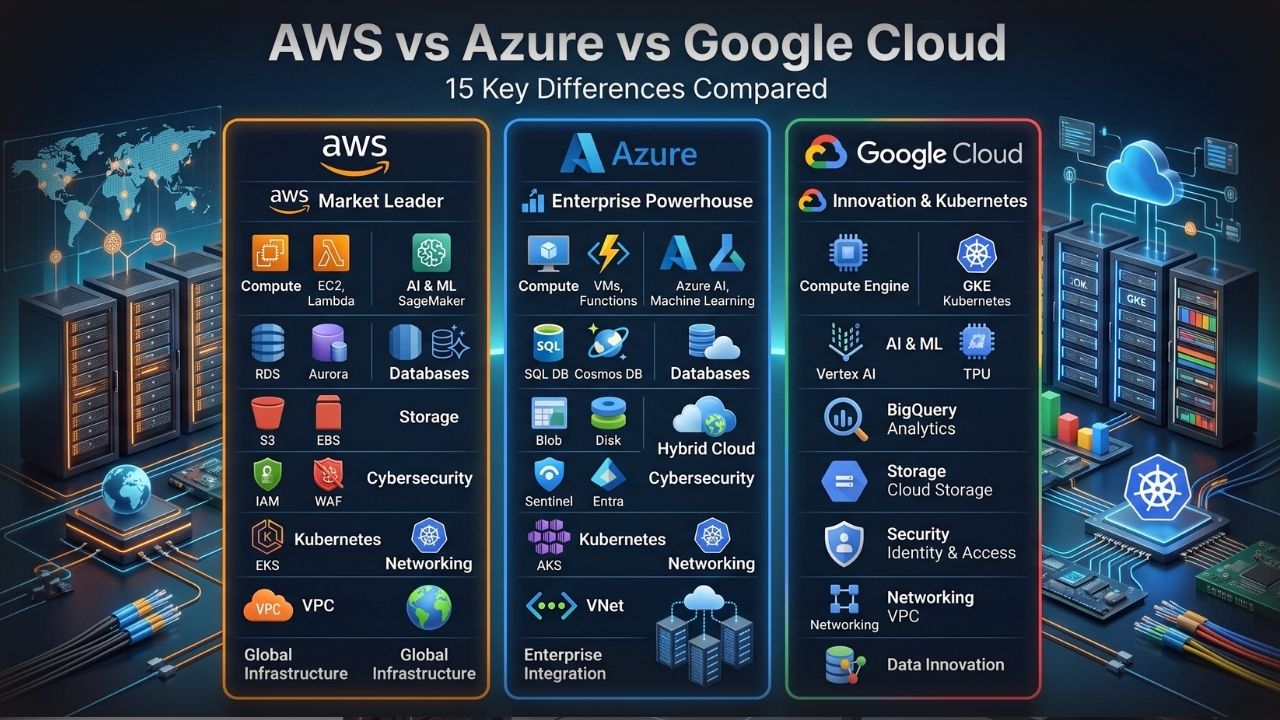
Choosing between Amazon Web Services (AWS), Microsoft Azure, and Google Cloud in 2026 is less about finding a single “best cloud” and more about matching a platform to your workloads, existing technology stack, staff skills, geographic requirements, security needs, and long-term budget.
AWS stands out for the breadth and maturity of its cloud portfolio. Azure is especially compelling for organizations already invested in Microsoft technologies such as Windows Server, Microsoft Entra, Microsoft 365, .NET, and SQL Server. Google Cloud is particularly attractive for data analytics, Kubernetes, cloud-native development, and Google’s AI ecosystem.
For businesses in Pakistan, the comparison needs another layer. Latency from Pakistani networks, available cloud regions, foreign-currency exposure, support, data-location requirements, payment arrangements, and staff expertise can matter as much as a provider’s feature list.
This AWS vs Azure vs Google Cloud comparison examines 15 practical differences rather than declaring a winner based on market reputation. Service portfolios and pricing change frequently, so procurement decisions should always be checked against current AWS documentation, Microsoft Azure documentation, and Google Cloud documentation.
For readers who need the fundamentals first, IT Magazine Pakistan’s cloud computing guide for Pakistan explains IaaS, PaaS, SaaS, public cloud, private cloud, hybrid cloud, storage, backup, and cloud security.
AWS vs Azure vs Google Cloud Which Is Best?
There is no universal winner in 2026.
AWS is usually a strong default when a business wants a very broad cloud ecosystem, mature infrastructure services, extensive third-party integration, and a large cloud talent pool.
Azure often makes the most sense for Microsoft-centric enterprises using technologies such as Microsoft Entra ID, Windows Server, SQL Server, .NET, Power Platform, Microsoft 365, or hybrid Microsoft infrastructure.
Google Cloud is particularly competitive for data-intensive systems, BigQuery workloads, Kubernetes, AI/ML, and cloud-native application development.
A practical shortlist looks like this:
| Requirement | Strong candidate |
| Broad general-purpose cloud portfolio | AWS |
| Microsoft-heavy enterprise environment | Azure |
| Data analytics and BigQuery | Google Cloud |
| Kubernetes/cloud-native development | Google Cloud, AWS, Azure |
| Enterprise hybrid Microsoft environment | Azure |
| Broad cloud-native ecosystem | AWS |
| Generative AI | All three; compare exact models/services |
| Pakistani startup | Workload and team dependent |
| Lowest price | No universal winner |
| Best security | No universal winner; configuration matters |
Do not choose solely from this table. A specific workload can reverse the general recommendation.
Key Takeaways
The three platforms overlap heavily. Each offers virtual machines, object storage, managed databases, Kubernetes, serverless computing, networking, identity, observability, security tools, data analytics, AI services, backup, and disaster-recovery options.
Their differences are often found in ecosystem depth and operating experience rather than basic capability.
For Pakistani organizations, four factors deserve special attention: real network latency, foreign-currency costs, data location/compliance, and availability of engineers who understand the chosen platform.
Security is a shared responsibility on all three platforms. No hyperscale cloud can protect a workload from every insecure customer configuration.
Finally, multi-cloud is not automatically safer or cheaper. Running all three clouds can multiply operational complexity.
Table of Contents
AWS vs Azure vs Google Cloud: Core Services Compared
Service names are different even where the underlying capabilities are conceptually similar.
| Category | AWS | Microsoft Azure | Google Cloud |
| Virtual machines | Amazon EC2 | Azure Virtual Machines | Compute Engine |
| Object storage | Amazon S3 | Azure Blob Storage | Cloud Storage |
| Managed Kubernetes | Amazon EKS | Azure Kubernetes Service | Google Kubernetes Engine |
| Functions | AWS Lambda | Azure Functions | Cloud Run functions |
| Relational databases | Amazon RDS/Aurora | Azure SQL and managed database services | Cloud SQL/AlloyDB |
| Data warehouse | Amazon Redshift | Microsoft Fabric/Synapse ecosystem | BigQuery |
| Identity | AWS IAM | Microsoft Entra + Azure RBAC | Cloud IAM |
| AI platform | Amazon Bedrock/SageMaker ecosystem | Azure AI ecosystem | Vertex AI |
| Monitoring | Amazon CloudWatch | Azure Monitor | Google Cloud Observability |
| Infrastructure as code | CloudFormation/CDK | ARM/Bicep | Infrastructure Manager plus ecosystem tools |
These are conceptual comparisons, not exact one-for-one products. Architecture, features, quotas, pricing, and integration can differ substantially.
1. AWS Has the Longest Hyperscale Public-Cloud History
Amazon launched Amazon Web Services’ foundational infrastructure products before today’s Azure and Google Cloud platforms matured into their current forms.
That history matters because AWS has accumulated an unusually broad service catalogue, extensive documentation, certification programs, third-party integrations, consultancies, and community expertise.
AWS can support everything from a tiny serverless API to large enterprise systems, data lakes, machine learning, high-performance computing, and global web infrastructure.
Its breadth creates a drawback: newcomers can face choice overload.
There may be several AWS products capable of addressing similar requirements, each with different operational and pricing models.
AWS is therefore powerful, but good architecture still requires understanding what not to use.
2. Azure Fits Microsoft-Centric Organizations Naturally
Azure’s clearest strategic advantage is Microsoft’s enormous enterprise footprint.
Organizations already using Microsoft Entra ID, Microsoft 365, Windows, Active Directory environments, .NET, SQL Server, PowerShell, and Microsoft security tools can find Azure integration particularly appealing.
For a Pakistani bank, software company, university, enterprise, or public-sector environment with substantial Microsoft infrastructure, this can reduce organizational friction.
That does not mean Azure is limited to Windows. Linux workloads, containers, open-source databases, Kubernetes, and cross-platform software are all major parts of Azure.
The advantage is ecosystem alignment, not an inability to run alternatives.
3. Google Cloud Has Deep Cloud-Native and Data Credentials
Google operates some of the world’s largest distributed systems, and that experience has influenced Google Cloud.
BigQuery is particularly important in the data-analytics discussion because it offers a highly managed approach to large-scale analytical querying.
Google also created Kubernetes before donating the project to the Cloud Native Computing Foundation. Kubernetes now underpins container orchestration across all three providers.
Google Kubernetes Engine (GKE) remains an important option for organizations building around Kubernetes.
For developers already working extensively with Google technologies—including Android, Google APIs, Firebase and data/AI systems—the broader ecosystem can also feel familiar.
IT Magazine Pakistan readers following Google’s consumer ecosystem can see how its software strategy extends from Android smartphones and phone comparisons to large-scale cloud platforms. These are different products, but they demonstrate Google’s unusually broad role across consumer and infrastructure computing.
4. Compute Services Use Different Ecosystems
All three providers offer general-purpose virtual machines.
AWS uses Amazon EC2, Azure offers Azure Virtual Machines, and Google Cloud uses Compute Engine.
Each provides numerous machine families designed for different balances of CPU, memory, storage, accelerators, and networking.
The underlying processor landscape is increasingly diverse.
Cloud infrastructure can include x86 processors and provider-specific or Arm-based designs. AI workloads add GPUs and specialized accelerators.
That is quite different from smartphone processors such as Qualcomm Snapdragon and MediaTek chips found in Samsung, Xiaomi, Oppo, Vivo, Realme, Infinix, and Tecno Android phones, but the trend is similar: specialized silicon is increasingly important to computing efficiency.
The important buying rule is to benchmark your real workload rather than comparing only virtual CPU counts.
5. AWS vs Azure vs Google Cloud Storage Differs in Detail
Object storage is foundational to all three platforms.
AWS provides Amazon S3.
Microsoft provides Azure Blob Storage.
Google provides Cloud Storage.
All can store enormous quantities of unstructured data, including application assets, documents, logs, backups, media, analytics datasets, and archives.
The major differences emerge in pricing structure, storage classes, API ecosystems, replication choices, lifecycle management, integrations, security controls, and data-transfer policies.
Cloud storage comparison
| Need | AWS | Azure | Google Cloud |
| Object storage | S3 | Blob Storage | Cloud Storage |
| VM block storage | EBS | Managed Disks | Persistent Disk/Hyperdisk options |
| Managed file storage | EFS/FSx families | Azure Files and related services | Filestore and related services |
| Archive options | S3 archive classes | Blob archive tiers | Archive storage class |
Storage price per GB is only part of the bill. Requests, retrieval, replication, operations, and network transfer can materially affect total cost.
6. Their Managed Database Portfolios Differ
Database selection is a significant architecture decision.
AWS offers Amazon RDS for several relational engines and Amazon Aurora, alongside DynamoDB and multiple specialist databases.
Azure provides Azure SQL services and managed options for PostgreSQL, MySQL, Cosmos DB and other database requirements.
Google Cloud offers Cloud SQL, AlloyDB, Spanner, Firestore and other database technologies.
Do not choose a database simply because the provider promotes it heavily.
Start with consistency requirements, query patterns, transaction model, scalability, availability, recovery objectives, operational expertise, and portability.
Migrating away from a deeply integrated proprietary database can be substantially harder than migrating a virtual machine.
7. Google Cloud Is Particularly Strong in Analytics
All three clouds can run advanced analytical workloads.
AWS has services such as Amazon Redshift and a broad data ecosystem.
Microsoft’s data strategy includes Microsoft Fabric, Azure data services and integrations with the wider Microsoft business stack.
Google Cloud’s BigQuery is one of its most recognizable differentiators.
BigQuery’s highly managed architecture is attractive for organizations that want to analyze large datasets without operating a traditional data warehouse infrastructure themselves.
Which one is “best” depends heavily on where the data lives and which tools employees already use.
A Microsoft-centric enterprise using Power BI may reach a different decision from a data engineering team standardized on Google Cloud.
8. AI Is a Major Battlefield in 2026
AWS, Microsoft, and Google all treat artificial intelligence as a strategic cloud workload.
AWS offers services including Amazon Bedrock and SageMaker.
Microsoft has built an extensive Azure AI ecosystem and has deep commercial relationships across the generative-AI market.
Google provides Vertex AI and has the Gemini model family within its broader AI strategy.
There is no responsible universal statement that one provider has “the best AI.”
Different models perform differently by task, while prices, context windows, regional availability, data-governance controls, APIs, and enterprise features change.
A Pakistani business building AI should test the actual workload.
If your application processes Urdu and English customer support, for example, benchmark those languages and your domain-specific prompts instead of relying solely on generic model leaderboards.
IT Magazine Pakistan’s 2026 AI tools guide provides broader context, while the guide to AI agents and the changing workplace explores an increasingly important cloud workload.
9. Kubernetes Is Mature Across All Three
AWS offers Amazon EKS, Azure offers AKS, and Google Cloud provides GKE.
All can run serious production Kubernetes environments.
Google’s historical connection to Kubernetes remains relevant, but it should not automatically determine a platform choice.
Kubernetes introduces meaningful complexity: clusters, networking, ingress, storage, autoscaling, security policies, upgrades, observability, and workload deployment all require expertise.
Many applications do not need Kubernetes.
A managed application service, serverless platform, or straightforward VM architecture can sometimes be cheaper and easier to operate.
Good cloud architecture avoids adding complexity purely for résumé value.
10. Serverless Approaches Differ
AWS Lambda is one of the most recognizable function-as-a-service products.
Azure Functions provides Microsoft’s event-driven serverless environment.
Google Cloud offers serverless technologies including Cloud Run and function-oriented services.
Serverless can be excellent for APIs, event processing, automation, scheduled workflows, lightweight backends, and workloads with irregular demand.
It is not literally server-free.
The cloud company operates the servers while customers work at a higher abstraction layer.
Compare execution limitations, cold-start behavior where relevant, supported runtimes, networking, observability, event integrations, and pricing before choosing.
11. Security Is Strong on All Three—But Customers Can Still Misconfigure Them
Asking which provider is “most secure” oversimplifies cloud security.
AWS, Azure, and Google Cloud all invest heavily in physical data-center security, encryption, identity, network protection, security monitoring, hardware security, and compliance.
The customer remains responsible for substantial portions of security.
This is the shared-responsibility model.
Customer mistakes can include publicly exposing storage, granting excessive administrator permissions, failing to patch an IaaS virtual machine, leaking API keys, or allowing credentials to be phished.
Good practices include MFA, least privilege, short-lived credentials where possible, centralized logging, network segmentation, encryption, tested backup and regular access reviews.
The NIST zero-trust architecture guidance provides a useful security framework.
For individuals and small teams, IT Magazine Pakistan’s cybersecurity best practices and password security guide cover important account-level protection.
12. Identity Management Feels Different
AWS uses its IAM system and associated account/organization controls.
Azure combines Azure role-based access mechanisms with Microsoft’s Entra identity ecosystem.
Google Cloud uses Cloud IAM alongside Google identity technologies.
For organizations already standardized on Microsoft Entra, Azure’s identity integration can be a significant operational advantage.
Whatever platform you choose, avoid giving every engineer permanent administrator permissions.
Cloud identities can control databases, servers, customer records, encryption resources, AI services and backups. A compromised high-privilege account can therefore have enormous impact.
Phishing-resistant MFA options should be considered for high-value administrative accounts. IT Magazine Pakistan’s phishing prevention guide explains why credential protection remains critical.
13. Pricing Cannot Be Ranked With One Number
AWS vs Azure vs Google Cloud pricing comparisons often fail because they compare one virtual machine and ignore the rest of the architecture.
Real cloud spending can include:
- Compute
- Memory
- Storage
- Storage operations
- Database capacity
- Data transfer
- Load balancers
- Public networking resources
- Logging
- Monitoring
- Backups
- Security tooling
- AI API calls
- GPUs
- Support plans
- Software licences
Pricing also varies by location and usage model.
Each provider offers mechanisms for discounted committed usage, but the details differ.
A commitment can lower predictable compute costs while reducing flexibility.
For Pakistan, add another variable: exchange rates. If invoices are denominated in foreign currency while revenue is primarily in Pakistani rupees, PKR depreciation can increase local effective costs even without a provider changing its list price.
Use the official AWS pricing calculator, Azure pricing calculator, and Google Cloud pricing calculator for workload-specific estimates.
14. Geographic Infrastructure Matters for Pakistan
The best cloud architecture on paper can disappoint users if latency is poor.
Pakistani businesses should inspect each provider’s current region and service-availability documentation rather than relying on old comparison articles.
Then test actual network performance from the Pakistani ISPs and cities relevant to the application.
Geographic distance is only one factor. Peering, routing, CDN placement, provider network architecture, application design and ISP conditions also affect performance.
Data residency matters too.
Organizations handling regulated data should determine where information is stored and processed and seek qualified compliance advice where necessary.
Relevant Pakistani organizations include the Pakistan Telecommunication Authority and, for applicable financial-sector matters, the State Bank of Pakistan.
Do not infer legal compliance merely because a cloud provider advertises a certification.
15. Ecosystem and Staff Skills May Decide the Winner
This difference is often underestimated.
A technically excellent platform can be the wrong choice when nobody on the team can operate it safely.
Cloud platforms require understanding of networking, Linux or Windows administration, identity, databases, logging, security, infrastructure as code, containers and cost management.
Recruitment matters too.
Before migrating, ask which platform your current engineers understand and which skills are realistic to hire in Pakistan.
For students, there is little value in trying to memorize hundreds of AWS, Azure, and Google Cloud service names simultaneously.
Learn cloud fundamentals first. Then go deep on one provider.
The skills transfer surprisingly well because compute, storage, networking, databases, IAM, observability and automation exist conceptually across all three.
AWS vs Azure vs Google Cloud Pros and Cons
AWS Pros
AWS offers exceptional breadth, a mature ecosystem, large global community, extensive documentation, and sophisticated cloud-native services.
Its third-party ecosystem is substantial, and many cloud professionals begin their careers with AWS.
AWS Cons
The enormous product portfolio can be confusing.
Billing can also become complicated, and organizations need disciplined governance to keep accounts, permissions and resources manageable.
Azure Pros
Azure integrates particularly well with Microsoft’s enterprise software and identity ecosystem.
It is compelling for organizations using Windows, .NET, SQL Server, Entra, Microsoft 365 and related technologies.
Hybrid enterprise scenarios are another major strength.
Azure Cons
The Microsoft ecosystem can be complex, with overlapping products, licensing considerations and changing naming conventions.
Teams still need deep cloud skills rather than assuming Microsoft familiarity automatically translates into good Azure architecture.
Google Cloud Pros
Google Cloud is especially attractive for data engineering, BigQuery, Kubernetes, AI, cloud-native applications and Google’s broader technology ecosystem.
Its managed approaches can make complex infrastructure relatively approachable.
Google Cloud Cons
Its enterprise footprint and third-party ecosystem can differ from AWS or Microsoft depending on market, workload and organization.
Again, this is not a technical inability—the practical question is whether its ecosystem matches your requirements.
Cloud Backup and Disaster Recovery
Regardless of provider, backup should be designed independently from ordinary file synchronization and application availability.
A highly available database can still suffer logical corruption or unwanted deletion.
A replicated storage system can replicate the mistake.
Good cloud backup considers independent recovery points, encryption, retention, restricted deletion permissions, geographic requirements and restoration tests.
Ransomware makes this particularly important. IT Magazine Pakistan’s ransomware guide for 2026 explains why recovery planning must accompany preventive security.
Multi-cloud is not inherently a backup strategy either.
Copying selected backups to another provider may be useful in a properly designed recovery architecture, but simply running workloads in multiple clouds does not guarantee recoverability.
SaaS vs AWS, Azure and Google Cloud
Businesses should also ask whether they need to operate infrastructure at all.
If a mature SaaS product already solves the problem, deploying virtual machines can create unnecessary work.
SaaS shifts more infrastructure responsibility to the vendor.
Examples include productivity, CRM, project management, accounting and collaboration applications.
Infrastructure cloud becomes more valuable when organizations need to build custom applications, host specialized systems, process data, train or serve AI models, or control infrastructure configuration.
Cloud architecture should start with business requirements rather than an assumption that every application needs Kubernetes and virtual machines.
Step-by-Step: How to Choose AWS, Azure or Google Cloud
Step 1: Define the workload
Document compute, memory, database, storage, networking, AI, availability and compliance requirements.
Step 2: Identify your existing ecosystem
A Microsoft-heavy organization should evaluate Azure deeply. A cloud-native data team may prioritize Google Cloud. A general-purpose startup may shortlist AWS alongside the others.
Step 3: Check current regions
Verify region and service availability from official provider websites.
Do not depend on outdated region maps.
Step 4: Benchmark from Pakistan
Measure latency and application performance using relevant Pakistani networks.
Step 5: Build a total-cost model
Include compute, storage, operations, data transfer, logging, backup, licences, support, tax considerations and staff time.
Step 6: Run a proof of concept
Deploy a realistic small workload on your finalists.
Do not benchmark only an empty VM.
Step 7: Test security
Evaluate identity, MFA, logging, network controls, secret management, encryption and incident response.
Step 8: Test recovery
Restore a backup and simulate component failure.
Step 9: Assess skills
Determine whether your team can operate the platform safely.
Step 10: Make an evidence-based choice
Choose the provider that performs best against your weighted requirements rather than picking the brand with the most marketing visibility.
Expert Tips for Pakistani Businesses
Do not start with multi-cloud unless you have a concrete business reason. Operational simplicity has real value.
Set spending budgets and alerts before deploying production workloads. Apply consistent resource tags or labels so teams understand ownership.
Keep production separate from experimental environments.
Use infrastructure as code where practical and review infrastructure changes as carefully as application source code.
Secure the administrator accounts before uploading sensitive information.
Test backup restoration regularly.
Finally, monitor foreign-currency exposure. A workload that appears comfortably affordable today can change in PKR terms as exchange rates move.
Buying Advice: Which Cloud Should You Choose in 2026?
For a small Pakistani startup without a legacy technology stack, shortlist all three and run a practical proof of concept. AWS may be an attractive general-purpose default, but that should be validated against workload and staff experience.
For an enterprise heavily invested in Microsoft, Azure deserves serious priority because identity, Windows, .NET, SQL and broader Microsoft integration can reduce operational friction.
For a company centered on data analytics, BigQuery, Kubernetes or Google’s AI ecosystem, Google Cloud deserves strong consideration.
For AI development, benchmark AWS Bedrock, Azure’s AI ecosystem and Google Vertex AI against your actual models and data requirements. Don’t choose from benchmark headlines alone.
For students, choose one provider and learn it deeply. Cloud fundamentals matter more than collecting introductory certifications across every platform.
For organizations worried mainly about cloud security, provider choice is only part of the answer. Misconfiguration and stolen credentials remain major risks regardless of platform.
Frequently Asked Questions
Which is best: AWS vs Azure vs Google Cloud?
There is no universal winner. AWS is particularly strong as a broad general-purpose platform, Azure fits Microsoft-heavy enterprises especially well, and Google Cloud is highly competitive in data, Kubernetes and AI. Choose according to your actual workload.
Which cloud is cheapest in 2026?
None is consistently cheapest. Costs vary according to region, machine type, commitments, storage, databases, requests and data transfer. Build the same architecture in each provider’s official calculator and compare total cost.
Which cloud is best for Pakistan?
The answer depends on workload, provider-region availability, latency from Pakistani networks, staff skills, data requirements and cost. Pakistani businesses should benchmark real connections rather than choosing only by geographic distance.
Is AWS better than Azure?
Not universally. AWS has exceptional service breadth and cloud-native maturity. Azure can be a stronger organizational fit when a company relies heavily on Microsoft’s identity, Windows, .NET, SQL Server and enterprise ecosystem.
Is Google Cloud better for AI?
Google Cloud has significant AI capabilities through Vertex AI and Google’s broader AI ecosystem, but AWS and Azure also offer extensive AI platforms. Test the required models, regions, governance controls, latency and pricing for your application.
Which cloud is best for students?
Any of the three can teach transferable cloud skills. AWS has an enormous learning ecosystem, Azure is valuable for Microsoft-oriented careers, and Google Cloud is strong for data, Kubernetes and AI. Learning one deeply is generally better than learning all three superficially.
Which cloud is best for Kubernetes?
AWS EKS, Azure AKS and Google GKE are all capable production platforms. Google created Kubernetes originally, but operational requirements, integrations, price and team expertise should decide the provider.
Are AWS, Azure and Google Cloud secure?
All three provide extensive security capabilities. Customers remain responsible for many identities, permissions, data, applications and configurations under shared-responsibility models. Secure architecture matters more than choosing a provider based on a simplistic security ranking.
Should a Pakistani company use multi-cloud?
Only with a clear requirement. Multi-cloud may help access specialized technologies or satisfy particular organizational strategies, but it increases skills, security, networking, billing and governance complexity.
Can I move from AWS to Azure or Google Cloud later?
Yes, but the difficulty depends on architecture. Workloads based on portable technologies may be easier to move than applications deeply integrated with proprietary databases, serverless events or provider-specific APIs. Design portability according to realistic business needs.
Conclusion
The AWS vs Azure vs Google Cloud comparison in 2026 has no single winner because the platforms increasingly overlap in basic capabilities while differentiating through ecosystems, integrations, operational models and specialized services.
AWS is a strong general-purpose choice with extraordinary service breadth and ecosystem maturity. Azure deserves particular attention from organizations invested in Microsoft’s enterprise stack. Google Cloud is especially compelling for organizations centered on analytics, Kubernetes, cloud-native systems and Google’s AI ecosystem.
For Pakistani businesses, global feature comparisons are not enough. Test latency from Pakistan, verify the current location of required services, calculate costs in the context of PKR exposure, understand where data will reside, and determine whether your team can operate the platform securely.
Then test the finalists with a realistic workload.
A small proof of concept will usually tell you more than a hundred generic AWS vs Azure vs Google Cloud rankings. Measure performance, security, operational effort, recovery and full cost. The best cloud is the one that meets your technical and business requirements with the least unnecessary complexity.