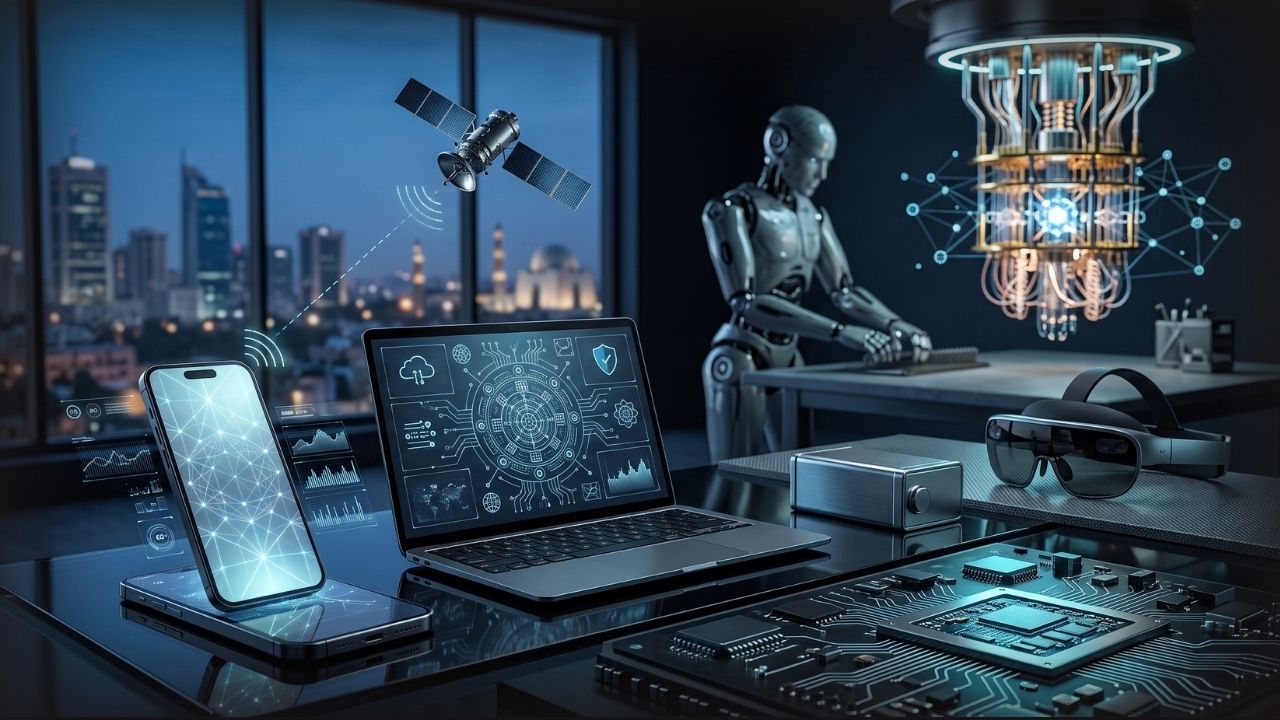
Technology trends 2027 will be shaped less by one revolutionary gadget and more by technologies becoming connected: AI that can take actions, processors capable of running AI locally, robots that understand natural language, satellite links for ordinary phones, and increasingly powerful cloud and edge computing.
But there is an important reality check. Some technologies discussed for 2027 already work today, while others remain experimental. AI agents and on-device AI are commercially available and developing quickly. Humanoid robots are moving through factory trials and early deployments. 6G remains a research and standardization project rather than a mainstream commercial mobile network. Fault-tolerant quantum computing is still a major engineering challenge.
For Pakistan, affordability, network infrastructure, regulation, electricity, local availability and exchange rates will influence which innovations become useful first. Pakistani buyers should therefore judge technology by what actually works locally—not simply by international launch headlines.
This guide examines 15 technology trends 2027 is likely to bring into sharper focus, using developments visible through 2026 as the evidence base.
Quick Answer
The biggest technology trends 2027 include autonomous AI agents, multimodal AI, on-device AI, humanoid robots, AI smartphones and PCs, spatial computing, smart glasses, satellite-to-phone communication, continued 6G development, quantum computing, post-quantum cybersecurity, solid-state and higher-density batteries, autonomous machines, edge AI and advanced semiconductor technology.
AI should produce the most immediate consumer impact because Google, Apple, Samsung and software companies are already integrating it into operating systems, smartphones, PCs and cloud services.
6G and large-scale fault-tolerant quantum computing are important longer-term technologies, but consumers should not treat them as mainstream 2027 products.
Key Takeaways
- AI is shifting from answering questions toward completing multi-step tasks.
- On-device AI can improve speed, offline capability and privacy for supported workloads.
- Humanoid robots are most likely to grow first in factories, warehouses and controlled environments.
- Smartphones from Samsung, Apple, Google and Android manufacturers will increasingly be designed around AI.
- Qualcomm Snapdragon and MediaTek platforms are making local AI processing more practical.
- 6G is not a reason to delay buying a good 4G or 5G smartphone.
- Quantum computing will complement rather than replace conventional computers.
- Post-quantum cybersecurity is important before powerful quantum computers arrive.
- AR/VR and smart glasses are moving toward lighter, more context-aware interfaces.
- Solid-state batteries are promising, but mass manufacturing and cost remain major hurdles.
- Satellite-to-device systems could eventually improve communications in remote parts of Pakistan.
- Buyers should pay for capabilities available today, not speculative marketing promises.
Table of Contents
Technology Trends 2027 Comparison
| Technology | Position in 2026 | 2027 outlook | Consumer impact |
| AI agents | Commercial, developing rapidly | Strong growth | Very high |
| Multimodal AI | Commercial | Wider integration | Very high |
| On-device AI | Shipping in devices | More mainstream | High |
| Humanoid robots | Pilots/early deployments | More industrial testing | Medium |
| AI phones and PCs | Commercial | Broader adoption | Very high |
| AR/VR | Commercial | Gradual improvement | Medium |
| Smart glasses | Early commercial market | More AI integration | Medium |
| Satellite-to-phone | Emerging | Wider availability possible | Medium |
| 6G | Research/standardization | Continued development | Low near term |
| Quantum computing | Specialized/research | Continued progress | Low direct impact |
| Post-quantum security | Deployment underway | Increasing importance | High |
| Solid-state batteries | Development/early applications | Gradual progress | Medium |
| Autonomous machines | Commercial in limited domains | Expansion | High |
| Edge AI | Commercial | Rapid growth | High |
| Advanced chips | Commercial/developing | Major enabler | Very high |
1. AI Agents Will Move From Answers to Actions
One of the defining technology trends 2027 is agentic AI.
An AI agent is software that can interpret an objective, decide which steps are required, interact with tools or applications, and attempt to complete a task.
This is different from a basic chatbot. Instead of only explaining how to organize a project, an agent might search files, create a schedule, prepare documents and update project-management software—with appropriate permissions.
Google and other AI companies are developing increasingly tool-capable systems, while business software providers are adding agents to customer service, coding and productivity platforms.
For a closer look at current capabilities, see how AI agents are changing work.
The limitation is reliability. An AI model can misunderstand instructions or generate incorrect information. Financial transactions, important communications and destructive actions should therefore retain meaningful human confirmation.
2. Multimodal AI Will Understand More Than Text
Future AI is becoming multimodal.
Multimodal AI is an artificial intelligence system capable of processing multiple types of information, such as text, images, audio and video.
This allows much richer interaction than a conventional text chatbot.
A user could point a camera at a machine, ask what a warning light means, and receive instructions based on visual and spoken information. Students could combine documents, diagrams and voice questions in a single interaction.
Google and other developers have made multimodality an important part of their AI platforms. Readers wanting to explore today’s options can compare the best AI tools available in Pakistan.
The main concerns are privacy, accuracy and cost. Giving AI access to cameras, microphones and personal files makes clear permissions and data controls essential.
3. On-Device AI Will Make Phones Smarter
Not every AI request needs to travel to a data centre.
On-device AI processes compatible workloads directly on a smartphone, laptop or other device. Neural processing units and other accelerators are making this increasingly practical.
Apple silicon, Qualcomm Snapdragon platforms and MediaTek Dimensity processors all demonstrate the growing importance of dedicated machine-learning capability.
Local AI can provide lower latency, potential offline operation and better privacy where data genuinely stays on the device.
Uses can include transcription, image processing, translation, summarization and accessibility features.
However, “AI phone” does not mean everything happens locally. Large models and advanced requests may still rely on cloud servers.
4. Humanoid Robots Will Move Deeper Into Industry
Humanoid robots are no longer purely science-fiction concepts.
Companies including Tesla, Figure AI, Boston Dynamics and multiple Chinese robotics manufacturers are developing robots capable of interacting with environments designed for people.
Factories and warehouses are the most realistic near-term targets. They offer repetitive tasks, predictable layouts and professional supervision.
Households are substantially harder. A home robot must safely handle stairs, pets, children, breakable objects and constantly changing environments.
AI is helping robots understand vision and natural-language instructions, but impressive demonstrations do not establish general reliability.
Among technology trends 2027, humanoid robotics deserves attention—but expectations should remain tied to real deployment data.
For neutral technical background, Wikipedia’s overview of humanoid robots provides definitions and historical context.
5. AI Smartphones and PCs Will Become Normal
AI is becoming part of operating systems rather than just a separate application.
Google is integrating Gemini across parts of its ecosystem. Samsung continues building AI functionality into Galaxy products, while Apple is integrating AI capabilities across supported devices and software.
Android manufacturers such as Xiaomi, Oppo, Vivo and Realme are also competing around AI-assisted photography, translation, search and productivity. Infinix and Tecno are important to watch as AI capabilities move into more affordable market segments.
These changes make chipset choice increasingly relevant. Snapdragon and MediaTek processors influence AI processing alongside gaming, cameras, connectivity and efficiency.
Still, Pakistani buyers should not purchase a phone simply because “AI” is printed on its marketing page. Battery life, software support, display quality, camera performance, Google Play compatibility, storage and warranty remain fundamental.
Our smartphone buying guide for Pakistan explains these factors in detail.
6. Spatial Computing and AR/VR Will Mature Gradually
Virtual reality places users inside predominantly digital environments. Augmented reality adds digital information to the physical world. Mixed reality combines virtual elements with an understanding of the user’s surroundings.
Spatial computing is a broader concept involving software and interfaces positioned within three-dimensional space.
Apple Vision Pro and Meta Quest have helped move these ideas beyond research laboratories.
Potential applications include education, engineering, architecture, healthcare training, design and entertainment.
AR/VR still faces practical barriers, however: hardware can be expensive, headsets can be uncomfortable, batteries have limited runtime and compelling applications are uneven.
For 2027, expect steady improvements rather than smartphones suddenly disappearing.
7. Smart Glasses Could Become AI’s Natural Interface
Smart glasses may ultimately prove more important than bulky mixed-reality headsets for everyday consumers.
Current products can combine cameras, microphones, speakers and AI. Future models could provide translation, navigation, contextual assistance and accessibility tools.
The long-term objective is convincing augmented reality in glasses that people are comfortable wearing throughout the day.
Engineering that product is difficult. Manufacturers must fit displays, optics, processors, radios and batteries into lightweight frames without producing excessive heat.
Privacy matters just as much. Camera-equipped glasses need transparent recording indicators and understandable data controls.
8. Satellite-to-Phone Communication Will Expand
Satellite-to-device technology allows compatible smartphones to communicate beyond conventional terrestrial cell towers under supported conditions.
This could be particularly valuable for remote and disaster-prone areas.
For Pakistan, possible applications include emergency communications, mountain travel, agriculture, logistics and rural connectivity.
But satellite emergency messaging and satellite broadband are not the same thing. Capacity, spectrum, device hardware, operator support and regulatory approval determine which services work.
Pakistanis should verify telecommunications developments through the Pakistan Telecommunication Authority and global mobile developments through the GSMA.
Never assume a satellite feature advertised internationally automatically works in Pakistan.
9. 6G Will Remain a Development Story
6G is among the most discussed technology trends 2027, but it needs careful context.
It is the proposed generation of cellular technology following 5G. Research includes new spectrum options, AI-assisted networks, communications combined with sensing and deeper integration with non-terrestrial networks.
It is not, however, a mainstream commercial smartphone network in 2026.
Standards work and research are progressing toward the next decade. The International Telecommunication Union and 3GPP are better references for this subject than speculative “6G phone” advertising.
Pakistani consumers should not delay a smartphone purchase waiting for 6G. Current network compatibility matters more.
Use our 5G phones in Pakistan guide for practical buying information.
10. Quantum Computing Will Keep Advancing
Quantum computing uses quantum-mechanical effects to process information with quantum bits, or qubits.
It is not simply a faster laptop.
Potential applications include chemistry, materials science, optimization and selected computational problems. Google, IBM, Microsoft and other organizations continue researching different approaches.
The central difficulty is error.
Quantum states are fragile, so useful large-scale systems require extremely sophisticated error management and, ultimately, fault-tolerant logical qubits.
The field may make important progress through 2027, but consumers should not expect quantum PCs or phones.
For a technical overview, see the background on quantum computing.
11. Post-Quantum Cybersecurity Will Become More Important
Quantum computing creates a security problem before large quantum computers necessarily arrive.
Sufficiently capable future quantum computers could threaten widely used public-key cryptography. Post-quantum cryptography uses algorithms intended to resist known attacks from both classical and quantum computers.
The U.S. National Institute of Standards and Technology finalized its first main post-quantum cryptography standards in 2024, enabling organizations to begin serious migration.
Consumers do not need to implement these algorithms themselves. Keeping operating systems, browsers and devices updated is more useful.
Businesses should inventory cryptographic systems and develop migration strategies.
For immediate risks such as phishing, weak passwords and malware, follow these practical cybersecurity tips.
12. Solid-State and Higher-Density Batteries Will Progress
Solid-state batteries replace the liquid or gel electrolyte found in conventional lithium-ion cells with solid electrolyte materials.
Potential advantages can include higher energy density and improved safety characteristics, depending on chemistry and design.
Automotive and battery manufacturers are investing heavily, but mass production remains difficult. Cost, manufacturing yield, material interfaces and durability have to work at factory scale—not simply in laboratory prototypes.
Other battery improvements matter too. Silicon-rich or silicon-carbon anode technologies are already helping manufacturers increase capacity in some consumer devices.
For smartphone shoppers, measured endurance remains more useful than chemistry promises. Compare current long-battery-life phones in Pakistan instead of waiting indefinitely for solid-state phones.
13. Autonomous Machines Will Expand Beyond Cars
Autonomous technology is broader than self-driving cars.
Warehouses, farms, mines, ports and factories provide controlled environments where automation can be easier to deploy than on unpredictable public roads.
Expect continued progress in autonomous:
- Warehouse machines
- Agricultural equipment
- Drones
- Industrial robots
- Inspection systems
- Logistics equipment
Consumer vehicles will continue improving driver-assistance features too. Buyers should distinguish assisted driving from actual autonomous capability and follow the manufacturer’s supervision requirements.
14. Edge AI Will Bring Computing Closer
Cloud AI processes information in remote data centres. Edge AI performs some computation closer to where data is generated, such as on phones, cameras, vehicles or factory equipment.
The advantages can include lower latency, reduced bandwidth usage and better data privacy when raw information genuinely remains local.
A factory camera, for example, may identify a safety hazard without continuously streaming every frame to a distant server.
Cloud and edge computing are complementary rather than competing ideas. Large-scale training can happen in data centres while local hardware handles real-time inference.
Our cloud computing guide for Pakistan explains the infrastructure supporting this transition.
15. Advanced Chips Will Power Almost Everything Else
AI, smartphones, robots and edge computing ultimately depend on semiconductor hardware.
Technology trends 2027 will therefore be strongly influenced by processors even when consumers never see the chips themselves.
Apple, Qualcomm, MediaTek, NVIDIA, AMD, Intel and other companies are developing increasingly specialized computing architectures. TSMC and Samsung remain major players in semiconductor manufacturing.
Progress now involves more than shrinking transistors. Chiplets, advanced packaging, faster memory and specialized AI accelerators are increasingly important.
For phones, this means future Snapdragon and MediaTek platforms may improve AI performance alongside photography, gaming and efficiency.
Large AI-performance numbers should still be approached carefully. TOPS measurements are not necessarily comparable across different hardware and workloads.
Technology Trends 2027 in Pakistan
Pakistan will adopt these innovations at different speeds.
AI will probably have one of the fastest impacts because much of the infrastructure already exists through smartphones, browsers and cloud computing. Students can use AI for learning and coding, professionals can automate routine work, and businesses can improve customer service and data processing.
Affordable Android devices will also play an important role. Samsung, Xiaomi, Realme, Oppo, Vivo, Infinix and Tecno compete across different price ranges, making the migration of flagship AI features into mid-range hardware particularly significant.
Connectivity remains fundamental. 5G development, fibre networks, reliable mobile broadband and cloud infrastructure are more immediately relevant to Pakistan than consumer 6G.
Buyers comparing today’s market can consult our best smartphones in Pakistan and AMOLED vs LCD vs IPS guide before spending money on headline features.
Step-by-Step Guide to Evaluating Technology Predictions
When a company claims a breakthrough, use this simple process:
- Find the original announcement from the manufacturer, research institution, standards organization or government agency.
- Determine whether it is research, a prototype, a pilot programme or an actual commercial product.
- Check the release date, supported countries, price and hardware requirements.
- Look for independent testing rather than relying only on demonstrations.
- Ask what the technology reliably does today instead of focusing entirely on future promises.
This process is especially valuable in Pakistan because global announcements do not always translate into immediate local availability.
Pros and Cons of 2027 Technology Trends
| Advantages | Challenges |
| More productive AI software | AI errors and misinformation |
| Better accessibility | Privacy concerns |
| Smarter devices | Higher hardware costs |
| More automation | Changes to employment |
| Improved connectivity | Infrastructure requirements |
| More efficient computing | Expensive semiconductor manufacturing |
| Better batteries | Scaling new chemistry is difficult |
| Advances in robotics | Safety and accountability |
| Stronger future security | Complex cryptographic migration |
The useful question is not whether a technology is impressive, but whether its benefits outweigh its costs and risks for a particular user.
Buying Advice for 2027
Do not attempt to “future-proof” every purchase. Technology evolves too quickly for that promise to be reliable.
For smartphones, prioritize software and security support, battery endurance, sufficient RAM and storage, cameras, display quality, network compatibility and warranty service. AI functionality should come after those fundamentals.
For Android, confirm Google Play services and local network compatibility, particularly with imported devices.
For laptops, focus on CPU performance, RAM, SSD capacity, battery life, display quality and support. An NPU can add value if you expect to use compatible local AI applications. Our Pakistan laptop buying guide covers these decisions.
Avoid paying a large premium solely for labels such as “AI-powered,” “quantum,” “6G-ready” or “future-proof.”
Expert Tips for Preparing for 2027
The safest preparation is developing skills rather than trying to predict a winning gadget. Learn AI tools while also learning to verify their output. Students should strengthen programming, mathematics, cybersecurity, communication and data skills.
Keep operating systems and applications updated, use strong authentication and pay attention to privacy permissions. Future AI makes basic security more important, not less.
For broader analysis as individual technologies change, follow our future technology coverage alongside primary sources from manufacturers, standards bodies and regulators.
FAQs
What are the biggest technology trends 2027?
The biggest technology trends 2027 include AI agents, multimodal and on-device AI, humanoid robots, AI smartphones, spatial computing, smart glasses, satellite connectivity, quantum computing, post-quantum security, advanced batteries, edge AI and new semiconductor technologies.
What will be the biggest AI trend in 2027?
Agentic and multimodal AI are likely to be among the most important developments. AI systems will increasingly interact with software and tools instead of only generating text responses.
Will 6G launch in 2027?
Mainstream commercial 6G should not be expected in 2027. Research and standards work will continue, while broader commercialization is generally associated with around 2030.
Should I wait for 6G before buying a 5G phone?
No. Buy according to networks you can realistically use during the phone’s ownership period. Waiting for 6G is unnecessary for most consumers.
Will humanoid robots be common in 2027?
More industrial trials and deployments are plausible, but general-purpose household robots are unlikely to become ordinary appliances everywhere by 2027.
Will quantum computers replace normal computers?
No. Quantum computers target specialized problem classes. Classical CPUs, GPUs and AI accelerators will remain the foundation of everyday computing.
Are solid-state batteries coming in 2027?
Development and limited commercialization may continue, but consumers should not assume solid-state batteries will suddenly replace conventional lithium-ion batteries across smartphones and electric vehicles in 2027.
What is on-device AI?
On-device AI runs compatible machine-learning workloads directly on local hardware rather than sending every request to cloud servers. It can offer lower latency, offline functions and privacy advantages.
Will smart glasses replace smartphones?
Not in the immediate future. Smart glasses may become useful companions for AI, cameras, navigation and translation, but phones offer larger screens, stronger batteries and mature application ecosystems.
Which technology trends matter most for Pakistan?
AI, affordable smartphones, cybersecurity, cloud computing, digital services, reliable broadband and 5G are likely to matter most in the near term. Satellite connectivity could also become important for remote areas if supported locally.
Should I buy an AI phone in 2027?
Buy one if its AI functions are genuinely useful, but evaluate the entire phone first. Battery life, camera quality, chipset efficiency, software support, storage and local warranty usually matter more than an AI label.
Which companies should consumers watch in 2027?
Google, Apple, Samsung, Qualcomm, MediaTek, major AI developers, semiconductor manufacturers and robotics companies are worth watching. In Pakistan’s smartphone market, Xiaomi, Oppo, Vivo, Realme, Infinix and Tecno are also important because they can bring new features to lower price categories.
Conclusion
Technology trends 2027 point toward a world in which AI becomes less of a separate application and more of a layer running throughout everyday computing. AI agents will perform more actions, phones and PCs will process more intelligence locally, and robots will become increasingly capable in controlled environments.
At the same time, expectations need to remain grounded. 6G is still a longer-term network evolution. Quantum computing is advancing without replacing conventional computers. Humanoid robots face difficult safety and reliability challenges, while solid-state batteries must prove they can be manufactured affordably at scale.
For Pakistan, the most meaningful developments are likely to be the technologies people can actually access: affordable AI smartphones, improved Android software, stronger cybersecurity, cloud services, better connectivity and digital skills.
The best way to prepare for 2027 is not to chase every futuristic product. Follow reliable primary sources, distinguish prototypes from commercial products, verify Pakistani availability and invest in devices and skills that provide measurable value today.